








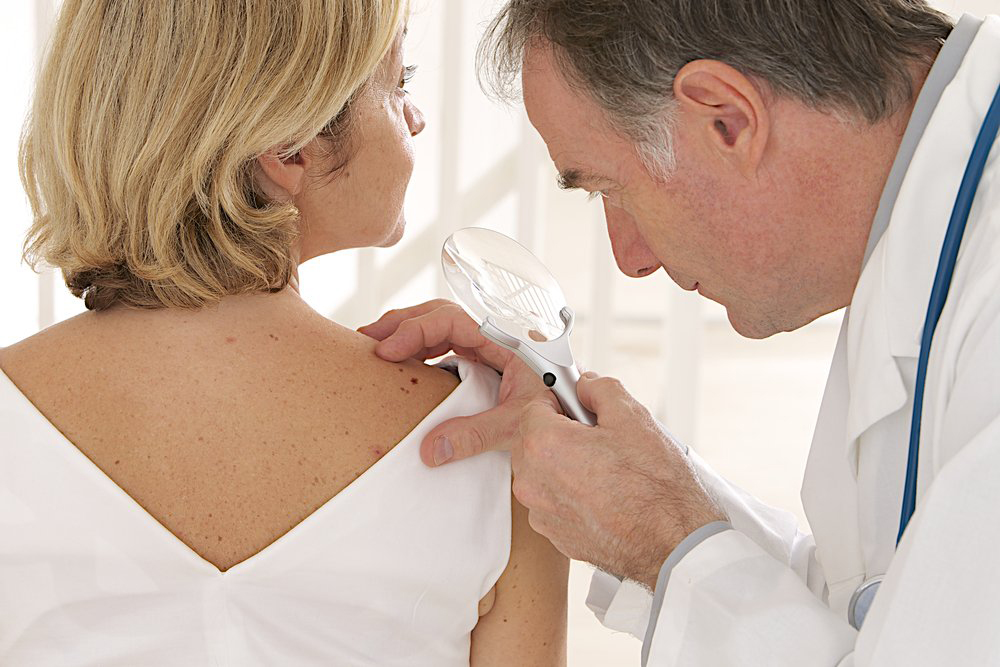
Whether you have a scattering of moles all over your body – or just a few – there’s a lot of confusion about what’s considered “normal” and what might pose a risk. While most moles rarely turn into skin cancer, it’s easy for our untrained eye to confuse a mole and a melanoma (the deadliest form of skin cancer).
A normal mole is a small, typically round and regularly shaped brown spot or growth. Most moles do not cause any health problems over a lifetime. But studies show that a person with many moles has a higher risk for melanoma. And any mole that seems to be growing in size should be examined by a dermatologist right away.
A melanoma is a cancerous skin growth that needs the care of a dermatologist immediately. The good news is that when detected early, melanomas are almost always cured by surgical removal. Knowing when to seek help for an abnormal mole is as easy as learning your “ABCDE’s.”
A- Asymmetry: This means it doesn’t look round.
B- Border is irregular: That means the border appears jagged and not smooth.
C- Colors are different: This means within the same mole, multiple colors appear.
D- Diameter is growing: This means anything larger than a pencil eraser.
E- Evolution of the mole: This means it’s somehow changing in color, size, or itchiness.
If this “alphabet soup” approach is too much for you, just remember the “ugly duckling.” Look for a mole or growth that looks and behaves differently from any others on your body. You can do a body check yourself, or make a habit of seeing a dermatologist once a year for a full body examination. That’s especially important if you are at an increased risk for developing a melanoma (due to family history, multiple severe sunburns, or having fair skin and light eyes). And if you notice one or more of these symptoms, it’s important for a dermatologist to check it out. Don’t wait – and don’t be afraid! Early detection is key to a positive recovery. Madelyn Fernstrom, PhD is the NBC News Health Editor. Follow her on Twitter @drfernstrom.
Madelyn Fernstrom, PhD
Madelyn Fernstrom, Ph.D., is the Diet and Nutrition editor for TODAY.
Fernstrom is a professor of psychiatry, epidemiology and surgery at the University of Pittsburgh Medical Center and a board certified nutrition specialist from the American College of Nutrition. She is the founding director of the UPMC Weight Management Center. Recommended


