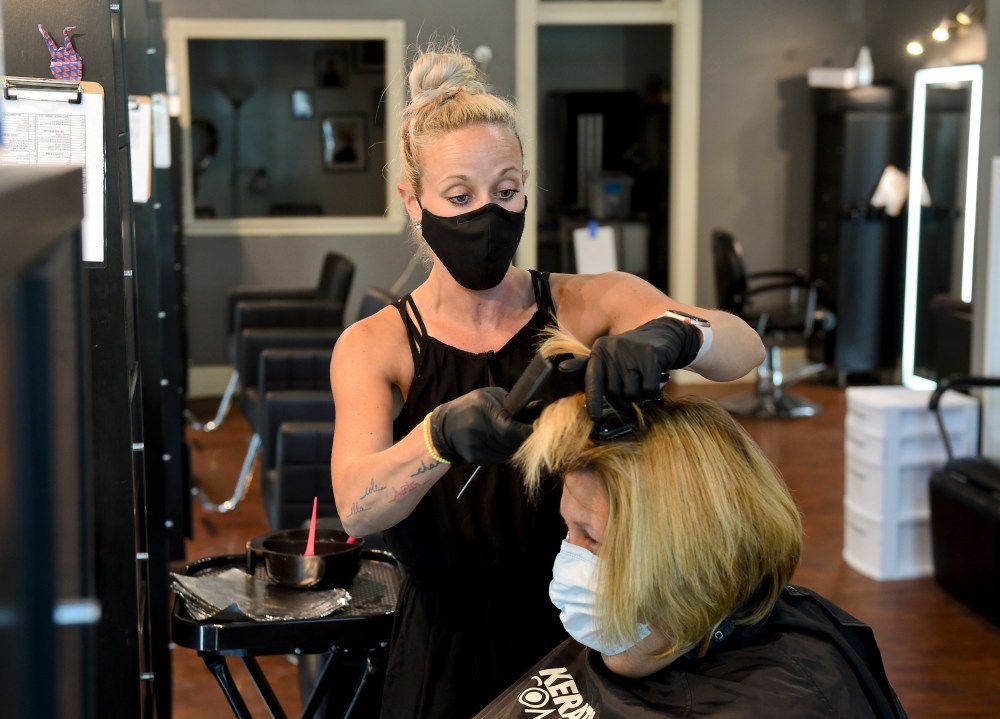
WASHINGTON — Despite the pandemic’s major blow to business, there’s a lot of gratitude at D.C.’s Koiled and Coiffed Salon.
“We try and keep each other on a positive note, because it’s hard. It’s hard,” salon co-owner Choi Rose told NBC News. Rose, and co-owner Koko Gilbert, were forced to close their doors in March when stay-at-home orders hit D.C. They turned to federal lifelines like the Paycheck Protection Program Loans and small business grants to stay afloat, while filing for unemployment.
“We’re not a big salon,” said Gilbert, likening the preparation to close their doors to preparing for “doomsday.” She added, “We don’t have all of those things in place.”

Meanwhile, Kora Polydore , owner of Kora Lee’s Cafe in Catonsville, MD, is struggling to keep her dream alive. “I opened up a business to be able to provide jobs for my community, hire those who look like me and do something wonderful,” she told NBC News.
Before the pandemic hit, Polydore was growing her business, moving to a new location, hiring new employees and expanding into catering. “And literally like two to three weeks later, COVID. And it just completely wiped us out.”
These businesses are microcosms of a larger, national trend: female-majority sectors of the economy bearing the brunt of this pandemic-spurred recession. Asked in May who was getting hurt the worst by the economic downturn, Federal Reserve Chairman Jerome Powell stated bluntly: “the people who’re getting hurt the worst are the most recently hired, the lowest paid people. It’s women to an extraordinary extent.”
April was the worst of it. Women made up less than half of the U.S. workforce, but accounted for 55 percent of the 20.5 million jobs lost. The female unemployment rate skyrocketed to 15.5 percent— the first time it reached double-digits since 1948, when the Bureau of Labor Statistics began reporting the data by gender. Black, Hispanic and Asian women were hit especially hard.
“Women work a lot of jobs that are very people intensive,” economist Diane Lim told NBC News. “They work in sectors of the economy that were most adversely affected by the stay at home orders and the business closures.” Those female- majority sectors of the economy include retail, leisure and hospitality, personal services, and food services, all of which saw massive job losses at the height of the economic downturn.
It’s a shift from the last recession, which predominantly impacted men in sectors like manufacturing and housing. Then, these jobs were considered “recession proof” because while Americans stayed away from bigger ticket purchases, such as homes or cars, they continued to seek out local, personal services. That was a “normal” recession; this one, Lim says, “is not like any economic recession we’ve ever had because it’s driven completely by the control, or lack of control, of the virus.” Dr.. C. Nicole Mason, president and CEO of the Institute for Women’s Policy Research, sees a compounding issue: “What makes this more perilous for women is that women are the primary caregivers in their family and many women are breadwinner mothers…So it was really a double whammy. Women have increased care responsibilities and they’re struggling with job loss.” Koko Gilbert of Koiled and Coiffed has felt that “double whammy” first hand. She has cut back her hours drastically after reopening, noting that there is no childcare she feels comfortable sending her son to. “I’m working a super limited schedule, which is really hard for some clients and some people need you during the week, but I’m just unavailable,” she said. “I don’t have any flexibility like I used to.” That said, the phone is ringing off the hook; clients in need of their services. The newest report from the Bureau of Labor Statistics shows that jobs are starting to come back, with 1.8 million jobs gained in July. Women gained 64.4 percent of those jobs, but still lag far behind their pre-pandemic employment levels. Long-term unemployment, people unemployed for three months or more, also spiked to its highest reading ever recorded. An analysis by the Economic Policy Institute shows that 8 percent of women have no reasonable chance of being called back to the workforce. That number is even higher for Black, Hispanic, and Asian women. Even for jobs that have come back, the virus’s uncertainty is leaving some wondering if they are back for good. “I’m not nervous,” Gilbert said when asked by NBC News if she thought things could shut down again, “but I’m sure there’s going to be another one.”
Molly Roecker
Molly Roecker is a journalist for NBC News in New York.
Ali Vitali is MS NOW's senior congressional correspondent and the host of "Way Too Early." She is the author of "Electable: Why America Hasn’t Put a Woman in the White House … Yet." Recommended