









Everyone wants to negotiate better. Whether we are lobbying for a promotion, pitching new clients or trying to convince our toddler that ice cream is not breakfast, we all want to negotiate confidently and achieve the best results. Any when a crisis hits —our company is struggling, or we’re working from home with no childcare, for example — rising emotions can make negotiation even more challenging.
As a negotiation professor, I help lots of people, ranging from United Nations diplomats to Fortune 500 executives and solo entrepreneurs, learn to negotiate successfully. And if you thought that negotiation meant just haggling over money, think again.
Negotiation is any conversation in which you are steering a relationship – including the relationship you have with yourself. So yes, asking for a promotion is negotiation – but so is a regular conversation with your colleague about a work project. Figuring out how to allocate housework responsibilities with your partner? Negotiation. Showdown with your tween over screen time? Negotiation.
And that conversation you have in your head about asking for what you’re worth? Also negotiation.
Many people go through life settling for less instead of asking for more – all because they don’t know the secret to negotiation success. What is that secret? The answer might surprise you.
Ask the right questions.
Research shows that the best negotiators ask themselves, and other people, great questions. But only 7 percent of people know the right questions to ask to get the best results from their negotiations. This means that most of us – nearly all of us – are settling for less.
So what are the questions that hold us back, and which ones help us pave the way forward?
One of the most ineffective words people ask when trying to negotiate is “why.” For example, in a meeting with a coworker, we might say, “Why didn’t you get this report in on time?” Or, in a frustrated argument with our spouse: “Why do you always get the home office while I’m stuck in the dining room with the kids?”
We also do the same thing to ourselves. “Why haven’t I asked for that promotion?” or “Why couldn’t I speak up in the meeting?”
“Why” is a word we tend to use when assigning blame. It keeps us looking backward. And it puts people on the defensive, leading to distorted, self-serving answers. Your colleague, for example, might say, “Well, I couldn’t finish the report because the team didn’t get me the information I needed!” Your spouse might fire back, “Why am I the bad guy here? You never told me you wanted the home office!”
And when we ask ourselves “why?” we heap shame on ourselves that only makes it harder to move forward: “I guess I’m just not good at advocating for myself. I don’t really deserve the promotion after all.”
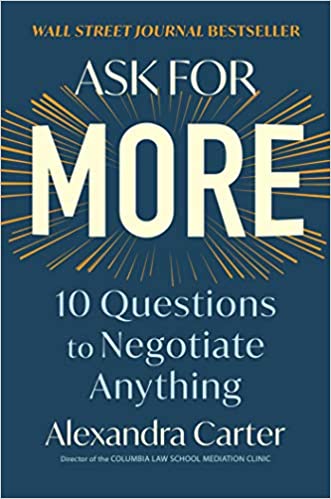
In other words, asking “why?” usually leads to an unhelpful response without getting us the information we need to solve our problem. So how do we fix this? Instead of asking “why,” try using “what.” For example, in the conversation with your coworker over the report, you might ask, “What made things challenging this time?” or “What might we try for our next report?” With your spouse in the home office, you could try, “What works for you as a way to share our space?” or “What are your space needs for this upcoming week?” And when we are talking to ourselves about that promotion we didn’t request, instead of saying, “Why can’t I do this?” we might try asking: “What makes this feel hard for me?” or “What support do I need?” When we move from “why” to “what,” we move from blame to diagnosis. We shift our focus from the past to the future. Instead of shutting people down, we encourage them to open up, share information and participate with us in the search for a solution. And when we stop asking ourselves “why,” we get out of the shame game. Asking ourselves “what” keeps us curious, instead of judgmental, about what we need. And in doing so, it helps us move forward toward our goals. In your next negotiation, try asking “what” instead of “why.” Not only will you have better, more productive conversations, but you’ll also get better results. Alexandra Carter is a professor at Columbia Law School, a world-renowned negotiation trainer for the United Nations, and the Wall Street Journal best-selling author of “Ask for More: 10 Questions to Negotiate Anything.”
Alexandra Carter
Alexandra Carter is a professor at Columbia Law School, a world-renowned negotiation trainer for the United Nations, and the Wall Street Journal best-selling author of "Ask for More: 10 Questions to Negotiate Anything." Recommended


