








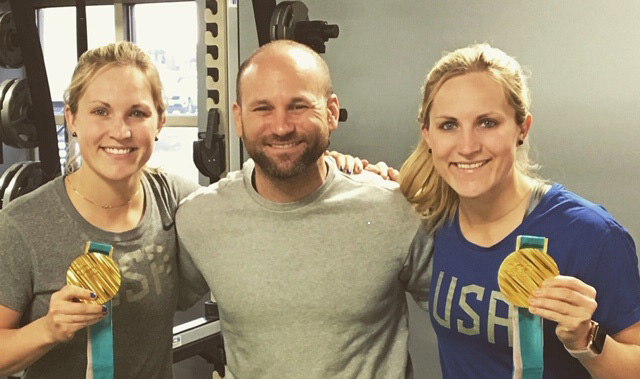
Since birth, identical twin sisters Jocelyne Lamoureux-Davidson and Monique Lamoureux-Morando have done pretty much everything together, including becoming hockey standouts at a young age. Their athletic prowess culminated in 2018 when they brought Olympic gold home to the U.S. from PyeongChang.
The 29-year-old twins, who are Know Your Value contributors, also went through pregnancy at the same time. And they continued training together right up until giving birth in December and January, respectively.
Their trainer is Monique’s husband, Anthony Morando, who said his training style during their pregnancies “boiled down to empathy, understanding and flexibility.”

Morando stressed pregnant women — whether they’re elite athletes like the twins, or regular Janes — can and should continue working out during their pregnancies.
“When people look at pregnancy, they make it into this daunting process, which it absolutely is – but instead of getting prepared for that journey, society sends this message of, ‘Oh, sit down, don’t lift a finger,’” Morando told Know your Value. “That’s not going to get you ready for the greatest physical challenge of your life.”
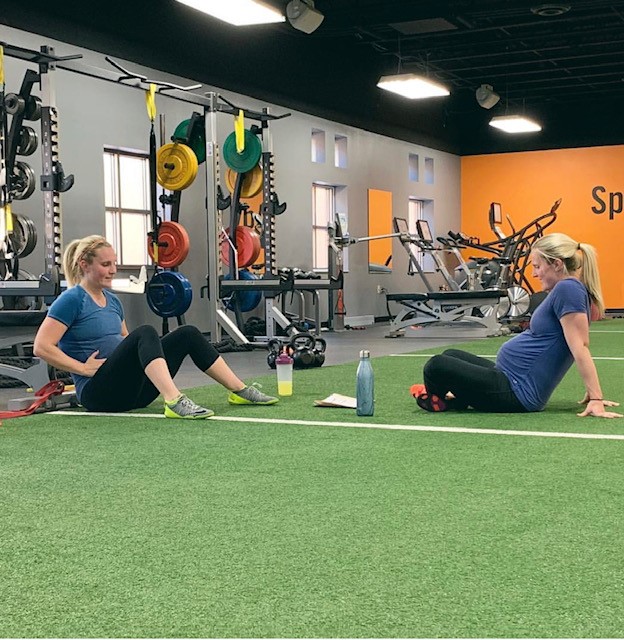
The key, Morando said, is making safe and smart adjustments throughout the pregnancy. But the changes might not be as major as one might think.
“It’s not ‘You can’t lift anymore.’ You can,” he said. “But maybe we reduce the weight over time and limit the range of motion – like have you lift the weight elevated on a box instead of straight up off the floor.”
Here’s how Morando and the twins worked together in their hometown of Grand Forks, North Dakota, to keep them fit throughout their pregnancies.
First trimester: How to deal with ‘all the time morning sickness’
Morando said he conducts a “readiness survey” with every client before training sessions, asking about “the three consistent variables of appetite, sleep and stress level.”
That daily assessment is important for all athletes, especially pregnant women, Morando noted.
The results “give you a roadmap about how to plan your training,” he added. For example, “If Monique was up all night getting sick, and she feels like a four on a scale of one to eight, the weight she lifts today is going to be moderate rather than intense.”

In the early weeks of the twins’ pregnancies, Morando didn’t yet have to adjust for physical changes like a large belly throwing off balance. But Monique had “morning sickness, afternoon sickness, all-the-time sickness,” Morando recounted. “When someone is sick, whether they’re pregnant or not, you don’t want to throw their intensity to the highest level possible.”
But beyond the daily factors like stress and sickness, Morando didn’t deviate from the twins’ standard weekly plan:
· Monday and Tuesday: Dynamic stretching, core activation, squatting, deadlifting. One day is upper-body pushing and lower-body pulling; the other is lower-body push, paired with upper-body pull.
· Wednesdays: Regeneration day, with a moderately paced walk on an elliptical to help muscles recover while still working up a light “feel-good sweat,” as Morando put it.
· Thursday: Mirror Monday’s workout, except focus on one arm and one leg rather than both with the push and pull drills.
· Friday: Mirror Tuesday’s workout; focus on one arm and one leg.
Second trimester: ‘Focus on what you can do, not what you have to avoid’
As each twin entered the second trimester, Morando focused on preparing them psychologically for training changes.
“If you look at the short list of what to avoid, it shows that there’s a lot you can do,” Morando said. “It’s a subtle shift in thinking that makes a big difference.”
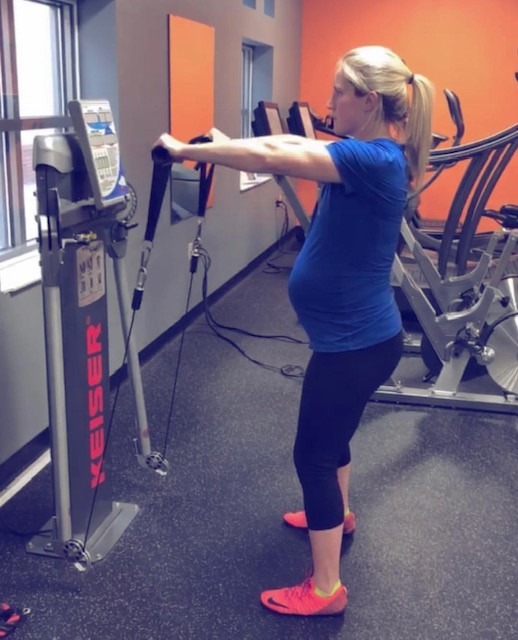
In the second trimester, Morando recommended pregnant women avoid exercises that require laying on their backs. That means skipping the crunches and going for moves like standard and side planks. Instead of lifting free weights, resistance bands may feel more comfortable.
“We want to stabilize the musculature, not jostle it around excessively,” Morando said.
As the pelvis and belly begin to expand, it’s easier for a pregnant woman to lose her balance. Movements like squats, for example, are better done over a bench for safety. And while Morando said not every trainer agrees with him on this point, he avoided plyometric drills — or jump training — with the twins. “If there’s pelvic instability I don’t want to make them jump and land excessively on the ground. It’s not going to feel good.” The second trimester can also bring increased energy compared to the fatigue of the first, but Morando noted that “you want gas in the tank for future workouts, so don’t go too wild.” “There’s a ton of hormone secretion happening in the third trimester, prepping the uterus for labor,” Morando explained, “Your ligaments loosen up, and you can push too far without realizing it.” Instead, foam rollers are a great way to keep blood flowing and help muscles recover. In this final trimester, pregnant women are even more easily thrown off balance, Morando pointed out. It’s still OK to do a lot of the same exercises as the last trimester, but with assisted movement. The twins did deadlifts from a high surface like a tall box. They held PVC pipes to help balance while performing lunges. Balance-challenging moves like single-leg holds were limited to 30 seconds or less. As the third trimester progresses, “it’s as much about the psychological as it is the physiological,” Morando said. “I knew there would be ebbs and flows both mentally and physically. So, it’s about knowing when to back them off at certain times, even if they want to keep pushing.” That might mean significantly reducing the weight lifted, eliminating some exercises that no longer feel comfortable or even skipping the workout for the day. “Emotions can get high in the last few weeks, and your body can get uncomfortable,” Morando said. “It’s OK to go take a walk for an hour instead – or just go home and take a nap.” Overall it comes down to being safe and listening to the body, but Morando stressed pregnant women shouldn’t be afraid of continuing to work out. “You’re preparing for your game day, your labor,” Morando said. “It’s not only OK to get out there and sweat; it’s beneficial.” Both twins continued training until the very end of their pregnancies. Monique gave birth to Mickey Salvatore Morando on Dec. 11, and Jocelyne and her husband Brent welcomed Nelson Maurice Davidson on Jan. 22. While elite athletes like the Lamoureux twins constantly look ahead to big competitions — in their case, annual world tournaments and eventually the 2022 Olympic Games in Beijing — Morando said his wife and sister-in-law are focused on their new babies and transitioning in a healthy way to their former training intensity. “Their No. 1 goal is to generally get back to a sustainable and health fitness level where they can begin exerting effort with no pain and no discomfort,” Morando said. “Their overall fitness level is what they are training for in the early stages. That is big in itself.”
Julianne Pepitone
Julianne is the senior technology writer for NBC News Digital, covering large consumer tech companies' (Apple, Google, Facebook, etc.) news and trends, as well as cybersecurity. She also writes and appears in original videos for NBCNews.com, and speaks as an expert guest on live shows across the NBC and MSNBC networks.
She previously worked at CNNMoney.com where she covered large techs from a business angle, as well as the intersection of the tech and media industries.
In addition to NBC and CNN online properties, Julianne has written for several national magazines and online publications including Esquire, Self, Popular Mechanics and Cosmopolitan. Recommended



Third trimester: Don’t over-stretch in the home stretch!
