









It’s no surprise that children today are growing up in a very digital world, but a new report sheds light on the fact that parents are treating their sons and daughters differently when it comes to their tech use. Consequently, this disparity is contributing to a confidence gap that could impact girls’ views about technology for years to come.
There’s an obvious lack of trust among parents when their daughters use technology, compared to their sons, according to a new report called “Decoding the Digital Girl,” which was published this week by the Girl Scout Research Institute and based on a national analysis of nearly 2,900 girls and boys ages 5 to 17, as well as their parents.

“Parents put many more constraints around girls than they do boys around technology,” Sylvia Acevedo, CEO of the Girl Scouts of the USA told Know Your Value. “Boys tend to have a computer in their bedroom, but girls won’t. Parents tend to be really focused on what girls are seeing and doing online more so than they are with what their boys are doing.”
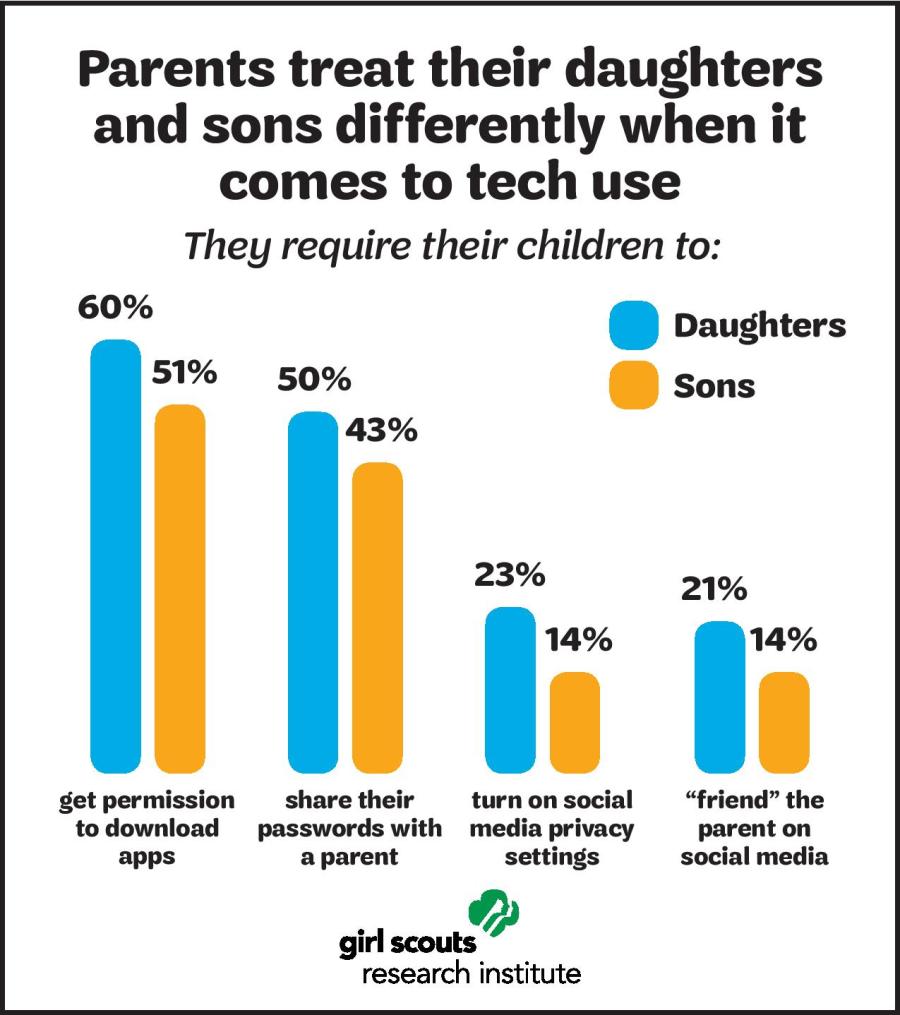
Roughly 60 percent of daughters are required to ask their parents for permission to download apps, versus 51 percent of sons, the report said. Some 50 percent of daughters must share their passwords with a parent, versus only 43 percent of sons. And 21 percent of daughters must “friend” their parents on social media, versus only 14 percent of sons.
“Parents and caregivers play a critical role in how we set up expectations for boys and girls about technology and how confident they feel navigating technology,” said Andrea Bastiani Archibald, chief girl and family engagement officer for the Girl Scouts of the USA. “What we found is that girls exceed boys in every area of technology use, from helping others with technology to discovering a new talent or interest through technology and using technology to advance a social cause,” Archibald added. “But interestingly, boys are still more confident in their tech skills.”
If parents boost the level of trust they have when their daughters use technology, girls, in turn, could feel more confident in leading their own digital lives. Archibald believes that children who consider themselves to be confident digital leaders could also be more inclined to purse STEM careers in the future. As it stands today, women make up 47 percent of the workforce, but only 28 percent of the science and engineering workforce, according to a report called The State of Girls and Women in STEM.
“It might be unintended by parents and caregivers, but we send certain messages when we set stricter rules for girls around social media and technology while emboldening and trusting boys,” Archibald said.
Acevedo added that along with gender differences, there are also differences among families of different socioeconomic backgrounds. “You can really see the difference between children who have first, second and third screens. For some girls in low-income areas, they may have access to a mobile device, but that might be their only screen,” she said. “That’s fantastic, but it may be really hard to write an essay when you only have that as your digital tool.” Girls of higher socioeconomic levels might have that second or third device, such as a home computer, which broadens their window to technology.
Parents and caregivers play a critical role in how we set up expectations for boys and girls about technology and how confident they feel navigating technology. What we found is that girls exceed boys in every area of technology use, from helping others with technology to discovering a new talent or interest through technology and using technology to advance a social cause. But interestingly, boys are still more confident in their tech skills.
Andrea%20Bastiani%20Archibald,%20chief%20girl%20and%20family%20engagement%20officer%20for%20the%20Girl%20Scouts%20of%20the%20USA.
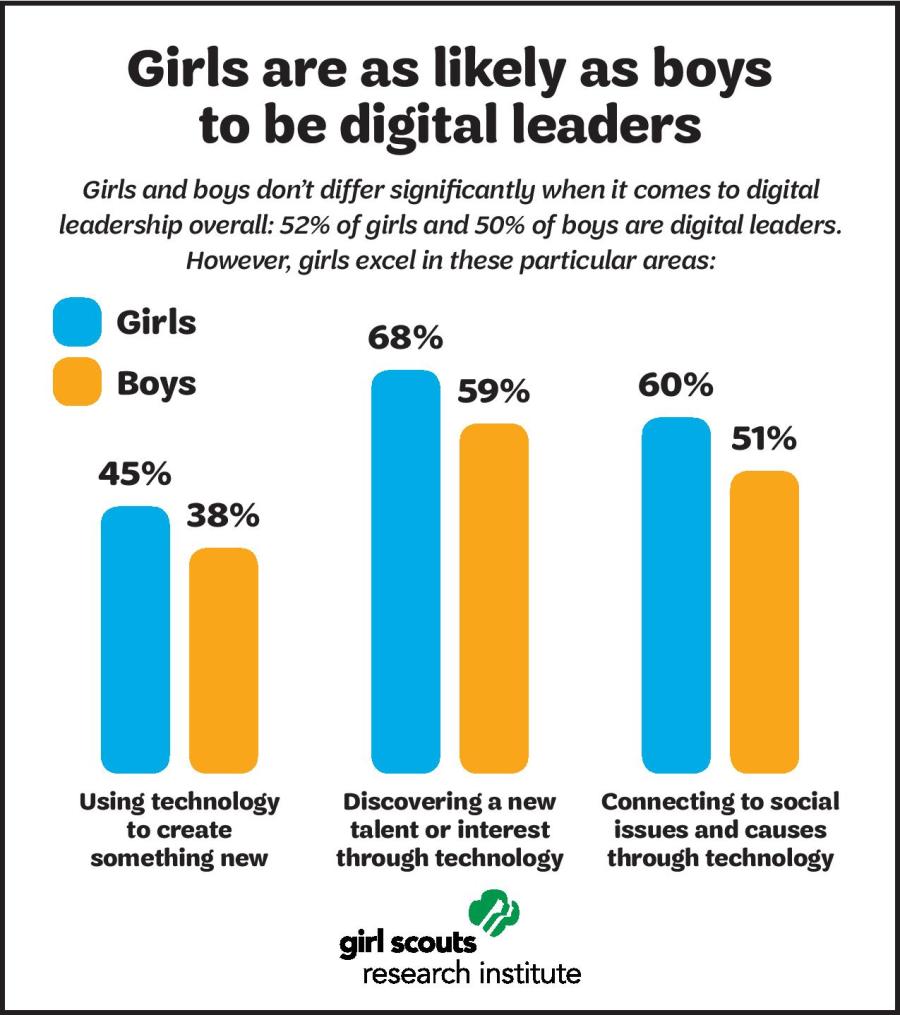
The good news is that despite parents’ mixed signals and varying household income levels, many young girls fall under the category of being a “digital leader,” which means that they demonstrate the potential to become digital innovators in the future, according to the Girls Scouts report. Some 45 percent of girls use technology to create something new, compared to 38 percent of boys, for example. In addition, 68 percent of girls discover new talents and interests through technology, versus 59 percent of boys.
“Girls see technology as a tool for connecting and augmenting their life and care a lot about learning new things,” Acevedo said. “When they have technology, they really want to apply it to make the world a better place.”
Below, some best practices for parents raising children in today’s digital world.
“Create a really supportive tech climate to the extent that your children have means and access,” Archibald said. This includes providing both daughters and sons with the opportunity to experiment and play with technology at a young age. Girls with limited tech access at home are two times more likely to be missing out on educational activities online compared to girls with greater exposure, the report noted. It’s also important that parents and caregivers share a positive outlook on technology. The study showed that parents who view tech favorably tend to have daughters who are digital leaders. Parents should seek to understand what their children are doing online, talk to them about it and help their children learn how to engage safely in the digital space. Often, girls are raised to strive for perfection, Archibald explained. They won’t raise their hand in class unless they’re confident that they have the perfect answer, for example. But technology can help this issue by fostering a climate where it’s perfectly okay to take risks and fail—and the hope is that this will transfer over to their interactions in the real world as well. Encourage new apps and experiences online, whether it’s a new art app, using technology to aid in the teaching of a new language or exploring a new culture through technology. It’s important to set restrictions on screen time and online use, but these standards are easier to impose when parents also model them. Archibald suggests a charging basket to place all smartphones and electronics in before dinnertime, and to prohibit the use of smartphones and tablets in the bedrooms. Furthermore, teach your children how to manage their time online. Girls who can regulate their own screen time are more likely to be digital leaders, according to the study. Parents can also help children realize when they should communicate over text or social media versus when it’s beneficial to pick up the phone and call or have a conversation in person. “We need to help youth understand when a conversation is better had in person versus online,” Archibald said. “Children are developing relationships younger, and it’s more likely that there could be unintended meanings when communicating in short texts or over social media.” According to the Girl Scouts study, 52 percent of girls are digital leaders, exhibiting key leadership skills and qualities. Girls who are digital leaders are more interested in STEM overall and in tech, specifically. The report also uncovered that all girls display the most interest in STEM careers during middle school, which suggests that high school is an important intervention point in maintaining girls’ interest in STEM. In fact, the Girl Scouts announced last year that its troops would be able to earn badges in robotics, computer science, space exploration, and more to address “some of society’s most pressing needs.” By helping to nurture their children’s relationship with tech, parents could help shrink the confidence gap and provide their daughters and sons with the tools for a successful future.
Renee Morad Recommended


Create a supportive tech climate
Make novelty the norm
Model appropriate behavior
Bridge the gap between digital and real life experiences
Encourage an interest in STEM
