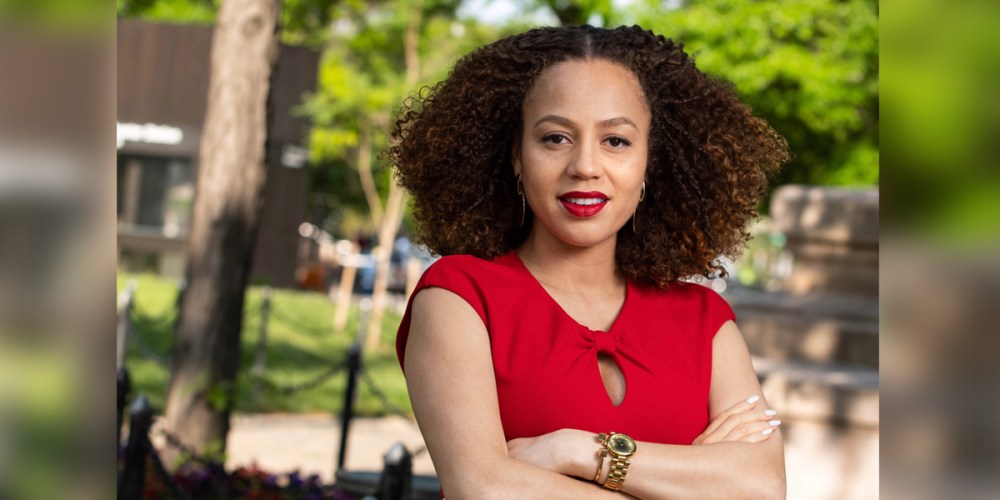
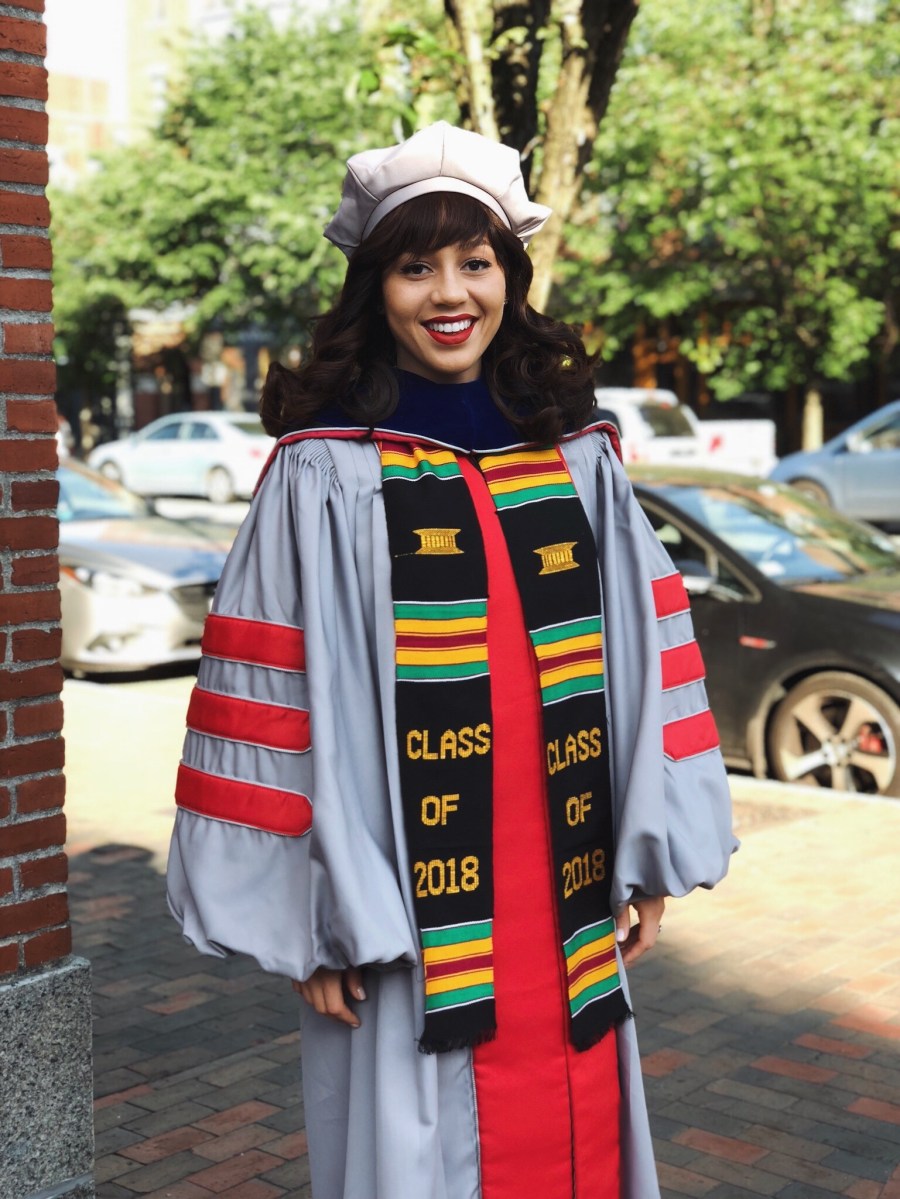
Mareena Robinson Snowden made headlines in 2017 when she became the first black woman to earn a Ph.D. in nuclear engineering from the Massachusetts Institute of Technology. Since then, she’s worked to pave a pathway for more women and minorities to follow in her footsteps.
“I think it’s tremendously important to have this diversity of voices, not just from a cultural perspective or from a gender perspective, but just lived experience,” Snowden told Know Your Value. “…There is blood and treasure on the line with respect with the decisions that [nuclear engineers] make, and we’re actually sending people out to fight wars if things go wrong.”
Snowden, 32, lives in Washington, D.C. and works as a senior engineer at the Johns Hopkins University Applied Physics Laboratory in neighboring Maryland. Just eight months into the job, and now with a 7-month-old daughter, she’s settling into the first workplace she can call home after two year-long fellowships at the Carnegie Endowment for International Peace and National Nuclear Security Administration. Prior to that, she spent 11 years in school: five as a physics major at Florida A&M University, then six years in grad school at MIT, where she wrote her dissertation on the development of radiation detectors for future nuclear arms control treaties.
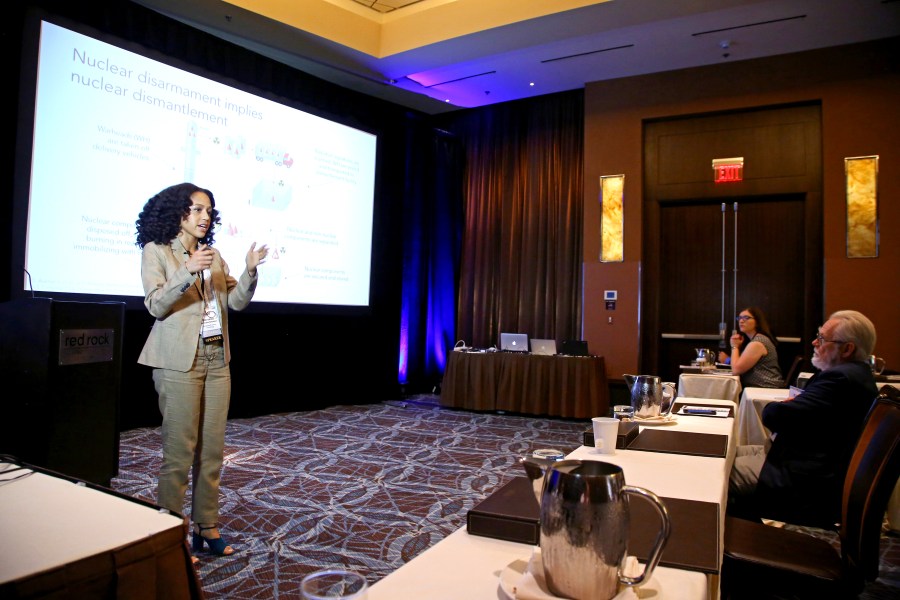
“I spend a lot of time thinking about nuclear weapons policy issues and technology,” Snowden said. “[And now] I’m broadening my umbrella [to] security in general [and] military force posture issues, [like], how should the military respond to certain types of challenges.”
Women and girls are chronically underrepresented in STEM (science, technology, engineering and math) fields of work and study. Looking back on her own journey, Snowden is clear-eyed about how they get left behind.
“In the gym, we’re all very comfortable with the idea of struggle and progress in a physical sense: lifting weights, that kind of thing, like what LeBron James or Serena Williams have to do every day on the court,” Snowden said. “But then when we start talking about the mind, building the muscle of the mind, we forget the critical role that struggle plays. We frame it in the wrong way, and we say that struggle is a character flaw as opposed to the natural process of learning.”
Snowden, who grew up in Miami, actually began to struggle academically around third grade when math lessons started getting more complex. Time tables had been easy for her to memorize, but long division made her nervous. “I didn’t really understand how learning worked,” Snowden said. “I often say, ‘We don’t teach kids how to learn before we teach them the actual material.’ And if you miss that part of the lesson, you can go through life as I did, really having an adversarial relationship with learning.”
At the same time, Snowden said young women come up against a lot of pressures young men don’t face during their crucial pre-teen years, when they’re beginning to see their potential for careers in math and science.
“You’re starting to come into your young womanhood and all of these narratives around femininity and what it means to be a woman are all starting to land on you and… they don’t always coincide with being technically excellent, being a nerd, or being interested in the stars and things like that,” Snowden said.
“So you feel the pressures of trying to be liked and trying to be part of a community [versus] what your natural inclinations are, which might be toward science or math. And that tension can be really difficult for some women … The desire to be part of a community wins out over what may be their natural aptitude for these types of careers.”
RELATED: 10 awesome books for young girls that encourage and celebrate STEM
Snowden said major gains have been made toward getting a more diverse group of students into places like MIT, including a focus on educational investments and mentorship on the front end of the pipeline. But she thinks a crucial aspect needs more attention.
“Once they’re there, what culture are they encountering? Is it one that’s there to help them succeed and to foster excellence, or is it one where they feel undervalued and constantly having to prove themselves and [are] stereotyped?” Snowden asked. “It’s that second piece of the conversation where organizations have to be introspective and they have to say, ‘OK, what are we doing to negatively contribute to this outcome? And that’s a hard conversation because the first part of the conversation, where you’re focused externally, it’s not about you.”
Snowden credited the foundation she received at Florida A&M University as what eventually led her to MIT. On a college visit to Florida A&M, her dad suggested they stop by the physics department and he introduced her to the department head. That person took an interest in her and together, they toured labs, met the graduate students, went out to eat and swung by the scholarship office.
“Dad said the department head told him, ‘We want you, we believe in you, we feel like you can do this.’ And I’m thinking, you don’t really know anything about me,” Snowden remembered. “Really it was the belief that Florida A&M professors have that we will do our part to invest in you, all you have to do [is] just come with the enthusiasm and the willingness to work hard and we will help you bridge whatever gaps you have.”
Studying at FAMU, and at historically black colleges and universities more broadly, Snowden said, is invaluable because black students’ heritage and identity is not only affirmed, but woven into the fabric of the university.

“[There’s] something powerful as a young black woman to come into an institution and to have so many tangible peer role models,” Snowden remembered. “You’re a high school student and you see these senior women and they’re so stylish and so poised… just like Michelle Obamas every day in the cafeteria that you’re looking at.”
RELATED: 5 ways to close the gender gap for women in STEM “The way that we feel about her is the way that I felt about the women in my school, the women that were only four years older than me,” Snowden said. “They were such a model for what it meant to be a powerful self-possessed black woman.” Transitioning to MIT, despite having had two internships there before she formally started her graduate work, was “a culture shock.” One interaction that particularly stung came when she was a newly admitted graduate student during “visit weekend” at MIT, when students meet with potential advisers. “I came and I was very excited, and trying to do my best meeting with professors and setting up appointments and everything, and one of the professors I met with straight-up told me during the meeting that my undergraduate institution didn’t prepare me to be there and I should expect to struggle,” Snowden remembered.” And he didn’t know anything about my undergraduate institution other than it was an HBCU [historically black colleges and universities].” Snowden took that as a direct challenge and let his words fuel her drive. On her graduation day six years later, that same professor — almost certainly having forgotten about their conversation and oblivious to its effect — was by chance the one selected to put the hood over graduates’ necks as they received their degrees. “I remember walking up to him on the stage and was just like, “Good morning, Dr. So-and-So!” Snowden recalled, laughing. “I was just very confident and I bent down and he put the hood around my neck and he shook my hand and he looked me in the eye and it was a very gratifying moment for me.” Snowden noted that there were far more people at MIT supporting her success as a student than were trying to block her. But figuring out how to navigate around roadblocks and persist in spite of them became a life lesson. “There’s a tax, always thinking about how you’re different,” Snowden said. “It’s something I’m currently working on, like not always focusing on the fact that I’m the only woman or the only black person in the room, because that’s not the root of my value. My value is from so many different places.” She knows firsthand how this “tax” affects women and minorities every day. “Let’s say for example you’re giving a presentation,” Snowden said. “As a black woman, and a lot of women face this, you’re not only thinking about the substance of your presentation, but you’re thinking about the inflection of your voice, you’re thinking about, do you wear lipstick or not, you’re thinking about what you wear, do you wear pants or a skirt. All these things have been put on you as signals of your credibility and signals that you’re serious. And your counterparts are not doing those calculations. And that’s taking away from the actual content of your work, for you to be thinking about that.” “It’s a criticism of the environment, not of the woman, that we have to think like this,” she said. “I think there’s just another layer to it for black women… that intersectionality, that not-being-able-to-put-your-finger-on-it: Is this misogyny I’m dealing with, is this racism, is this a combination of the two? What’s actually happening? It’s hard to make sense of it. So my reaction has been to stop trying to make sense of it,” Snowden said. “I’m here to do my work. I’m not here to understand your bias. That’s been my approach.”
Erin Delmore Recommended