








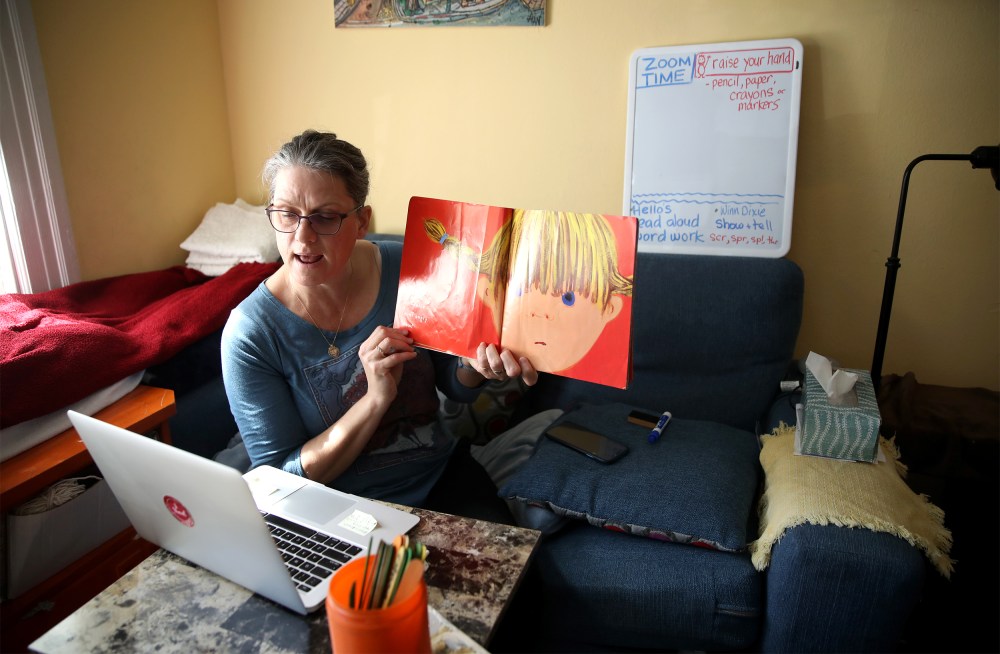
Now that August has arrived, it seems clear that, despite the desire to reopen U.S. schools for in-person learning, the reality is that for the most part it’s not going to happen this fall. In fact, I predict that, for most districts, it won’t happen in significant measure for the entire 2020-2021 academic year, and possibly even longer.
Few educators, or parents like me, don’t dispute the superiority of in-person learning over its online counterpart. Of course “live” is preferable. The lack of socialization and the isolation that have been regrettable byproducts of stuck-at-home learning have been painful to watch. Believe me, with four public-school kids at home since March, I’ve seen it firsthand, while, like many Americans, working a full-time job.
For my younger kids particularly, the “high-tech” nature of online doesn’t hold a candle to the “high-touch” of traditional classroom learning. They are falling behind in ways I fear I cannot catch them up. As for my older ones, well, they have managed to adapt, not without bumps. But the system of moving from class-to-class and now Zoom-to-Zoom is at least familiar to them.
No one knows exactly what the upcoming school year will look like, but we must be realistic.

As I write this, numerous states are reporting record deaths from COVID-19. Despite best intentions, and until the manufacture and wide distribution of a COVID-19 vaccine, distance learning (even if it’s a hybrid of at home and in school) is here to stay.
But be that as it may, here are a few immediate, actionable things parents, educators, and caregivers can do now to make the distance learning experience as successful as possible. We can learn from our missteps this past spring and use them to carve out a better path forward come September:
Do your homework.
Start by talking to your friends about “sharing responsibility.” Even if your kids return to the school building via a staggered schedule, the likelihood is that a portion of learning will be done at home. I know it’s daunting, and it feels like learning a new language, but you can get up to speed. Whether it be via pods, Zoom, Seesaw or Screencastify, the methods by which classrooms are being replaced include platforms on which families are “sharing” educational responsibility by teaming up to educate their kids in smaller groups. At least this way, we can commiserate, and our kids can lean on one another, and alleviate some of the isolation, while practicing social distancing in this new normal of learning together.

Establish a dedicated learning space at home and create structure.
Everyone tried to tell me that a routine was critical when COVID-19 first hit. But truth be told, nothing was easy in the beginning. I was literally doing homework in bed with my 8-year-old daughter at night, sometimes because it was due by midnight. In hindsight, I look at those organized parents with their calendars, org charts and Excel spreadsheets with envy. But find a place where your kids know they need to be focused. The fewer distractions, the better. And make sure the schedule includes brain breaks and “recess,” even if that’s just a walk around the block, or a short visit to the backyard.

Teachers: have realistic expectations.
One upstate New York middle-school teacher put it best: “Cut your expectations of what you’re going to cover in half, then cut it again. The sooner you accept that, the sooner your head won’t explode.” A Massachusetts middle-school English teacher agreed: “Teachers are recognizing they can’t get to the finish line they had in mind for their classes . . . they are learning to forgive themselves and adjust.” Teachers, we all need to forgive ourselves and adjust, but know this: we parents are so grateful to you for what you do every day to help our kids learn.
Online should be a safe space.
The anxiety that kids are wrestling with at this point in the pandemic is real. I learned this firsthand after carefully analyzing the results of a survey, Life Disrupted: The Impact of COVID-19 on Teens, commissioned by GENYOUth, the organization that I lead and which advances the student voice. Especially for high schoolers looking toward college or employment, anxiety can be severe. Teachers, if you’re genuinely listening to kids feelings, encouraging discussion, and keeping their mental health top of mind during this challenging time – perhaps even higher in priority than academics — you’re doing it right in my opinion.
Distance learning at home is a pain for everyone. However, if your kids are keeping up, they have it better than many others, especially those in urban and very rural districts. The “digital divide” is a reality that is hurting millions of kids. According to Education Week, one in three Black, Latinx, and Native American children fall into it. And nearly 17 million American children lack high-speed internet, while over 7 million of them don’t have a desktop, laptop, or tablet computer, reported Future Ready Schools. So keep things in perspective. In many ways, this is wartime, and we must “make do” for the greater good. Above all, know this: Distance learning is not new – it’s been around for nearly a century, starting with old-time correspondence courses by mail. Maybe, just maybe, if you keep an open mind, we’ll all learn things in this that make us better learners, better listeners, and more compassionate in the process. Attitude is everything. Think positive, while acknowledging that, as I wrote in an earlier “Know Your Value” post, there are no solutions that are going to satisfy everyone. Try, also, to keep in mind a piece of advice I used in a Zoom commencement speech earlier this summer, and that I believe to my core: change is the price of survival. That is perhaps truer these days than ever before. Alexis Glick is Chief Executive Officer of GENYOUth, a nonprofit organization dedicated to creating healthier school communities through programs presented in partnership with the National Football League and the National Dairy Council. Glick also serves as a frequent contributor to many national and international news programs, providing her perspective on global business topics of importance, the financial markets and CEO leadership trends. Prior to GENYOUth’s inception, Glick previously served as a senior media executive, and also appeared in the anchor role on NBC’s Today Show and CNBC’s Squawk Box. In addition to her current executive responsibilities at GENYOUth, and enjoying her active role as mom to four kids, Glick is active in several national and local non-profit institutions. She is a frequent, strategic advisor to CEOs for some of the largest international, blue-chip and Fortune 500 companies on issues relating to media strategy, business development, investor relations and communications and advises professional athletes on social media, branding and public speaking.
Alexis Glick Recommended


Remember: Of course this whole thing is inconvenient. But many have it far worse.
