








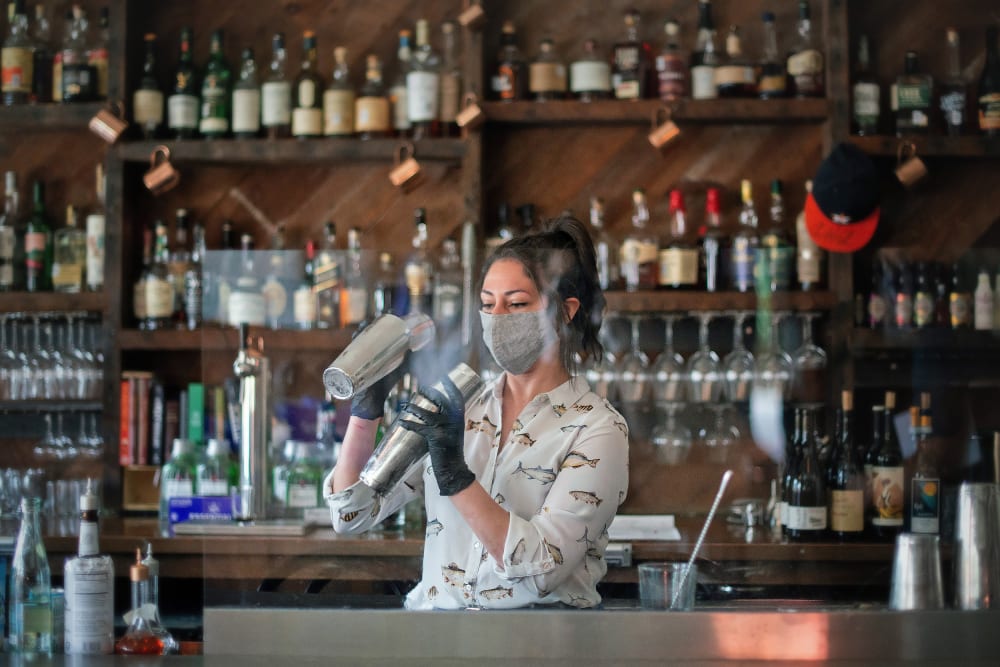
As a gender economist, my question with tipping is not how much—it’s how come? When we look at the data, we find that tipping stymies the economic potential of women and even more disproportionately, women of color. It also hinders the economic prosperity of our entire country.
To add fuel to the fire, the roots of American-style tipping trace back to the legacy of slavery. In the aftermath of the Civil War, tipping allowed employers to pay newly-freed slaves a $0 wage under the premise that customers’ tips would compensate. We call this $0 wage-plus-gratuity a tipped minimum wage. Today, instead of $0 per hour, the federal tipped minimum wage is $2.13 for every hour on the clock.
The tipped minimum wage has been harming women and the US economy—not to mention perpetuating slavery’s legacy—long before COVID-19 hit. Now, with the pandemic amplifying many of society’s inequities, we cannot afford complacency in this arena.
Tipping: an American tradition with disastrous externalities
Recently, one of my colleagues was reminiscing about her previous job at a steakhouse in Wisconsin. As a server, she was responsible for preparing the dining hall (pre-shift), waiting on tables, and then cleaning the dining hall at the end of the night (post-shift).
Like most restaurants, her former employer relied on a variety of tipped-workers, including servers, bussers, hosts and bartenders.
In her home state of Wisconsin, state labor laws require employers to pay tipped employees a minimum wage of $2.33 an hour—20 cents above the federal minimum wage but $6.65 lower than my home state’s (Colorado) minimum wage
Since 1991, the federal tipped minimum wage has been frozen at $2.13 an hour. Meanwhile, the non-tipped federal minimum wage has risen 70.6 percent and consumer prices have gone up 90.24 percent.
Federal law assumes tip-earning employees earn enough weekly gratuities to compensate for the $5.12 gap between the tipped minimum wage ($2.13) and the non-tipped minimum wage ($7.25). When this doesn’t happen, and employee wages plus tips don’t add up to $7.25 an hour, the onus ostensibly falls on employers to make up the difference. However, a DOL investigation of over 9,000 restaurants found 84 percent had at least one minimum wage violation in which employees earned less than $7.25 an hour after factoring in their weekly tips. This form of wage theft impacts 17 percent of low-wage workers in our economy and comes at an estimated $15 billion cost for tipped workers annually.
Minimum wage violations help explain why tipped employees are twice as likely (and servers nearly three times as likely) than non-tipped workers to live in poverty. In fact, restaurant workers occupy seven out of the ten lowest-paid jobs in the US economy.
And considering how the full-service restaurant sector has increased 86 percent between 1990 and 2013 while aggregate growth of the private sector rose by only 24 percent during the same period, calls for reforming the two-tier minimum wage system only grow louder.
As I mentioned earlier, I’m a gender economist. That means I disaggregate economic data by gender (as well as race, ethnicity, and age when the data is available). Watch what happens when we apply the intersectional gender lens to tipped wages.

Women of color, the majority of tipped workers, feel the effects of wage inequity first
Women are the first to feel the economic consequences of the tipped minimum wage. They make up 51 percent of the U.S. population, hold 49.7 percent of non-farm jobs, yet represent 70 percent of all workers in tip-dependent occupations. (Think servers, bartenders, hairstylists, etc.) Of the entire labor force, 2.6 percent of women versus 1.5 percent of men receive tips in at least one of their jobs.
Given this gender breakdown and what we discussed above, it makes sense that the poverty rate for tipped female workers is more than double the poverty rate of all workers. And, as a reappearing theme of today’s triple health/economic/racial crisis, women of color are hit hardest by the negative effects of the tipped minimum wage. More than 40 percent of the tipped workforce is Black, Latino, or Asian, and Latinas are almost twice as likely to work for tips as white, non-Hispanic men.
Compared to tipped white men, tipped Black women take home $5.00 less per hour and are less likely to work in fine-dining restaurants where tips skew higher. People of color hold 47 percent of tipped positions at casual dining restaurants versus 32 percent in finer establishments.

Yet another dimension of intersectional gender inequity comes from the U.S. Equal Employment Opportunity Commission, which found food service and accommodation workers represented one out of seven sexual harassment charges from 2005 to 2015. In many cases, tipped workers are told to alter their appearance or dress “sexier” to appease the customer base.
It’s 2020. Why are we asking people to accept the unacceptable because their economic well-being depends on it? Why are we forcing people to choose between their economic security and their physical safety?
Here’s the bright spot. We have an equitable way forward for tipped workers—and it doesn’t jeopardize the financial health of tip-reliant industries at the expense of payroll. On the contrary, this solution improves employee productivity and retention in the same way Henry Ford’s decision to pay factory workers a daily rate of $5.00 did in 1914. (Five dollars back then would be worth approximately $120 today.) To equitably reform the tipped minimum wage, we must follow in the footsteps of the seven One Fair Wage states that have adopted a unified minimum wage for all workers. Employees in One Fair Wage states must earn at least the regular minimum wage as determined by state or local law—regardless of the tips they may receive on the job. That’s compared to the other 43 states plus the District of Columbia where the two-tiered minimum wage system prevails. Of those 43 states, 18 maintain the federal tipped minimum wage of $2.13 an hour. Using the One Fair Wage states as an example, Congress should replace the tipped minimum wage of $2.13 an hour with an updated $12.00 an hour standard minimum wage. Then, they should peg the federal minimum wage to the median wage (Congress froze the minimum wage in 1996) to ensure it increases proportionately as the economy evolves. To incentivize such a reform, let’s return to the data. Eliminating the tipped minimum wage benefits everyone—and particularly women of color. In states that abide by the $2.13 tipped minimum wage, 21.7 percent of women of color (27.5 percent Black women and 22.6 percent Latinas) live in poverty. In One Fair Wage states, however, the aggregate rate of poverty for women of color drops to 14.9 percent. Overall, the poverty rate for women working tipped jobs in One Fair Wage states is 28 percent lower than in non-One Fair Wage states. The advantages of lifting people out of poverty extend far beyond the household. In lowering our nation’s poverty rate, we can increase the tax base, boost consumer spending (which drives GDP growth and revenue growth from state sales taxes), and decrease dependency on social welfare programs. Moreover, the lives of nearly 7.6 million working mothers along with the children who depend on them would improve by raising the minimum wage. This is especially important at a time when breadwinning-mom households disproportionately occupy the bottom two quintiles of income earners and Black mothers are more likely than any other cohort of mothers to be the primary breadwinners of their families. Replacing the tipped minimum wage with One Fair Wage is not only the right thing to do, it’s the smart thing to do. Now is the time to close the chapter on biased wage practices that hold back our entire economy. Katica Roy is a gender economist and the CEO and founder of Denver-based Pipeline, an award-winning SaaS company that leverages artificial intelligence to identify and drive economic gains through gender equity. Pipeline launched the first gender equity app on Salesforce’s AppExchange. The Pipeline platform was named one of TIME Magazine’s Best Inventions of 2019 and Fast Company’s 2020 World’s Most Innovative Companies.
Katica Roy Recommended


Is there an equitable solution to tipping?
Gender inequity is not a women’s issue. It’s an economic one.
