








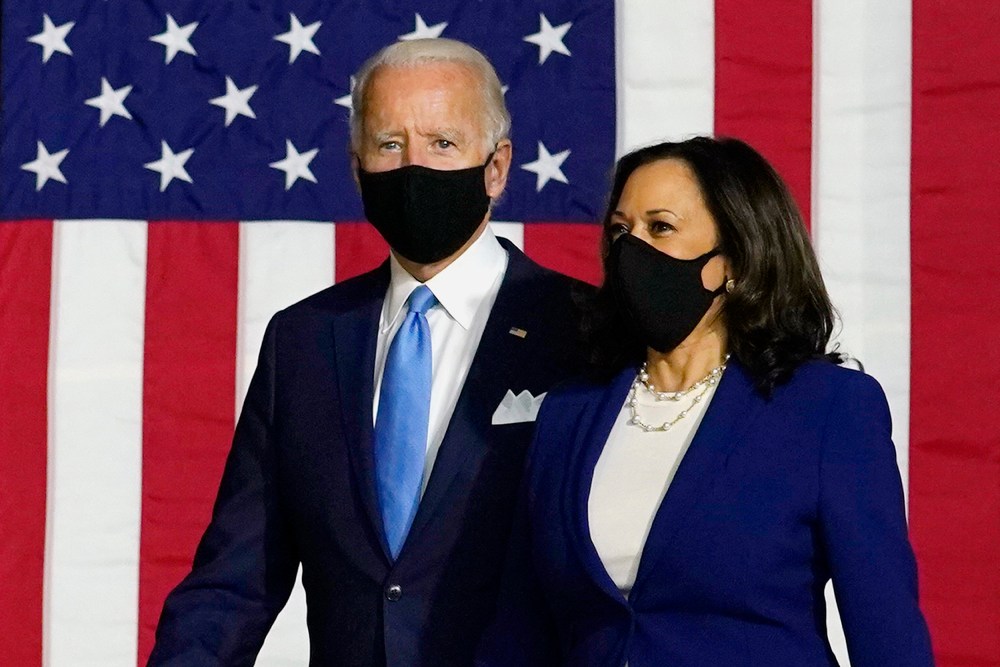
Not long after news broke that Kamala Harris had been named as Joe Biden’s running mate, donations started pouring into the campaign in unusual numbers: $19.08, $190.80, $1,908.00, $19,800.
“Those who knew, knew,” said Roslyn Brock, chair of the International Connection Committee for Alpha Kappa Alpha, the sorority to which Harris belongs. The donations represented the year 1908, when the sorority — one of the Divine Nine of the Historically Black Colleges and Universities — was founded at Howard University, Harris’ alma mater.
“All of those were a signal of Black women from Alpha Kappa Alpha making our voices heard through our financial contributions,” said Brock, who was responsible for the sorority’s get-out-the-vote efforts. While the sorority is a service organization and has members from both political parties, the support for Harris was overwhelming. “It was very organic about the pride we have in our sisterhood,” Brock said.

Alpha Kappa Alpha is one of many Black women’s groups that leveraged its power by mobilizing its members, coordinating its leadership and working in collaboration with others this election cycle. The result was an undeniable show of power from Black women voters and activists, and widespread recognition that their work was a cornerstone of the Democrats’ win.
“It was an awakening. A phoenix rising,” Brock said of the power of the whole. “Many of us have worked in our own individual capacities, mobilizing [during] electoral cycles. But we banded together in this historic moment because we understood the implications and the import of this seminal election in our nation’s history.”
Bishop Leah Daughtry has been doing this work for more than 30 years. She serves on the board of the Black women’s political groups Higher Heights and of Power Rising, and she co-founded Black Church PAC, an organization of Black church influencers aiming to leverage the power of the church and its followers, after the 2016 election. This cycle, her organization worked with 3,000 faith leaders across the country to mobilize voters in their communities through everything from virtual concerts to a ten-day get-out-the-vote bus tour through the South.
“It was really important that we supported the sisters on the ground who had been doing the work and who understood the terrain and had been building these coalitions for years,” Daughtry said, “and to not supplant that, but to support it.”

Daughtry described a network where each group played to its strengths, with The National Coalition on Black Civic Participation and Black Voters Matter focusing on South, and Higher Heights and The Collective PAC lending financial support to candidates. Alongside Win with Black Women, Sisters Lead Sisters Vote, Emerge, Coalition for the People’s Agenda, Fair Fight and others, the groups worked together to maximize their impact. Then when it came time for the Jan. 5 Senate run-offs in Georgia, they did it again.
“We made a decision because Power Rising is based in Washington not to try to direct the traffic, but to let [them] tell us, what do you need?,” Daughtry said. “And if you need us to not come, all of us non-Georgians, you need us to stay home, we’ll stay home. If you need money, we’ll get the money. If you want food trucks, we will get the food trucks.”
Daughtry described a core organizing principle embraced by the multitude of activist groups this election season. “We decided, which I think is the way of women, to collaborate,” she said, “not to duplicate each other’s efforts. That was a dialogue that was happening all across the country.”
Alpha Kappa Alpha is still in the process of counting, but the sorority’s leadership believes it was able to deliver more than 250,000 new voters to this election working with their partners in the Divine Nine, along with Michelle Obama’s When We All Vote organization, Oprah Winfrey’s Own Your Vote, Reverend William Barber’s Poor People’s Campaign, and with the NAACP on their grassroots advocacy and outreach programs to mobilize voters. More than 1,000 members of the National Bar Association partnered with AKA to volunteer as poll watchers and election protection officials. The sorority hosted candidate forums and webinars, while in their individual capacities, members phone banked and canvassed. Glynda Carr, the president, CEO, and co-founder of Higher Heights, is a member of Alpha Kappa Alpha and wore her sorority’s pink and green colors and signature pearls with pride on Election Day. The infrastructure around supporting black women candidates and mobilizing Black women voters has come a long way since Carr and her friend Kimberly Peeler-Allen sat around a table in a Brooklyn cafe in February 2011 talking about how they didn’t see many women who looked like them working in progressive politics in New York. In the decade since, they’ve worked to build a network that is uniquely designed to address the barriers that exist for Black women seeking political office, and the fundraising support to bolster their campaigns. “What we’ve seen increasingly [is] this discussion around ‘invest in Black women,’ ‘thank Black women,” Carr said. “And what you saw a little different in this cycle was that we were demanding our return on our voting investments.” The phrase “Thank Black women” has been making its way through political media and onto T-shirts, acknowledging Black women as the most reliable Democratic voting block in the country and a decisive force in electoral politics. During a 2017 special election for a Senate seat in Alabama, an overwhelming 98 percent of Black women cast ballots for Democrat Doug Jones. This cycle, 90 percent of Black women voters went for Joe Biden nationally, according to exit polls. Black women voters did it again in Georgia this month, when more than 90 percent of them voted two Democrats into the Senate. That election shifted the balance of power in Congress’s upper chamber to the Democrats, giving Biden and Harris their best chance of enacting their agenda.v “Black women in this cycle have seen what our power can do,” Daughtry said. “And we understand as women the power of collaboration. That’s just a principle of our lives and it’s how we have survived in this country is through cooperation and collaboration: ‘I work while you watch the children. Then I watch your children while you go to work.’ That’s the way we have survived and we’ve found a way to take the principle into every area of our lives, including the political.”
Erin Delmore Recommended


