








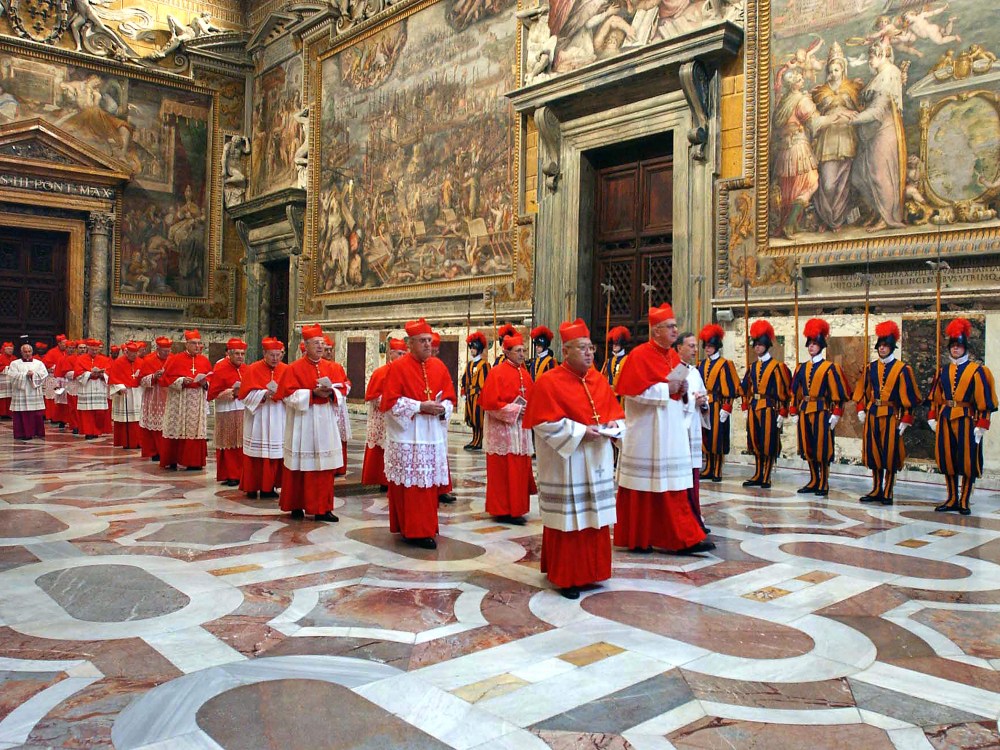
The cardinal electors have gathered in Rome, and the conclave to choose the next pope is beginning. The secretive process to choose Pope Benedict XVI’s successor is shrouded in tradition and mystery–right down to the black and white smoke signals that emanate from a temporary furnace installed in the Sistine Chapel.
From the Latin, meaning “with a key,” conclave is the word used for the assembly of cardinals–and there were in fact two times in the 13th century when the people held the cardinals under lock and key until they chose a successor, while the church went leaderless for months on end.
It’s unlikely to take quite that long for the 115 cardinal electors to reach a consensus this time around. For the first time since 1829, the church is pope-less in Lent–leaving Roman Catholics worldwide without a new pontiff ahead of Easter, which falls on March 31 this year. Although the former Cardinal Ratzinger was chosen in a mere 24 hours after just four rounds of voting, consensus is, Romans should look to the sky around Friday for the white smoke announcing a new leader.
Until then, all the eligible cardinals under 80 will gather in prayer under Michelangelo’s formidable “Last Judgment” fresco, until one among them emerges as the leader of the world’s 1.2 billion Catholics. The Catholic Church has been marred by allegations of corruption and sex abuse scandals in recent years–issues the next pope will likely address.
“It’s not an election. It’s not a lobbying process, ” Bishop Gregory Mansour told msnbc.com. “It’s a discernment.”
A bishop in the Maronite Catholic Church, Mansour said his group chose its patriarch in a similar process.
“The process is very beautiful. We talk around the table, walk around the gardens of the monastery and some of us pray the rosary, some of us talk, and talk about ‘what about this candidate, what about his person’ and [come] to a consensus that he is the best among us in our time to serve in this capacity,” he said. “We have to choose the best person to lead, and that’s really a spiritual choice.”
Two-thirds of the cardinal electors, or in this year’s case, two-thirds plus one (since the total number of electors is not divisible by three) are required to elect a new pope.
On the first day of a conclave, the cardinal electors attend mass at St. Peter’s Basilica in the Vatican, then proceed from the Pauline Chapel to the Sistine Chapel–that of the famous Michelangelo fresco–before taking an oath to adhere by conclave standards.
They’re not the only ones sworn to secrecy: about 90 people will be sworn in as well, including the Secretary of the College of Cardinals, priests responsible for hearing confession, doctors and nurses (the average age of the cardinal electors is 72) along with staff for serving meals, housekeeping, drivers, and security guards. Beyond that, the Vatican undergoes a ‘communications blackout,’ as the Sistine Chapel is swept of electronic devices. During the 2005 conclave following the death of Pope John Paul II, the Associated Press reported that the floor of the Sistine Chapel was raised to allow for electronic jamming devices–something the Vatican has not acknowledged. After last year’s ‘Vatileaks’ scandal involving stolen and leaked documents by the Pope’s butler, security is expected to be especially tight.
Elizabeth Lev, a professor of Christian art and symbolism at Duquesne University’s Italian campus, spoke with msnbc’s Chris Jansing about the intimate space where the cardinals will pray and vote.
“They start out in St. Peter’s Basilica, the largest covered space of any church in the world. It’s enormous. And then from there they move into the Sistine Chapel, [at the point] where you have the large sense of the chapel…and it gets smaller and smaller and more intimate and intimate, and then they find themselves before the Last Judgment,” Lev said. “So I think there’s a great deal of reckoning with God and prayer.” At set points in the day–once on Tuesday and twice every day thereafter–the cardinals are given a tiny ballot with the words ““Eligo in Summum Pontificem” (“I elect as Supreme Pontiff”) printed on them. They fill in a name below the text and place it in an urn. After the ballot is read and recorded, it is threaded through the word “Eligo” to form a chain with the other ballots. If over two-thirds majority is not reached, the ballot chain is burned in the in-room furnace, along with chemicals to color the smoke black. And if a new pope is chosen, chemicals are used to yield white smoke instead. “The critical moment is when each cardinal has his ballot in his hand,” Cardinal Theodore McCarrick told msnbc’s Andrea Mitchell last month. “And before he puts it in the urn, he has to repeat an oath…You say something like…‘I call upon the Lord Jesus, my Savior, as my witness. He who will judge me’ – and you’re looking at the Last Judgment–‘he who will judge me, that the man I am voting for is the one who, under God, I believe God wants to be Pope.’ And in a certain sense, it makes it not anymore an election, it makes it a discernment. You’re trying to figure out what you think God would want, what man you think God would want for all the needs of the church today.” Once a successor is chosen, that man is given time to pray in private in the ‘Room of Tears’ before greeting the public outside St. Peter’s Basilica. Then the Senior Cardinal Deacon announces in Latin, “Habemas Papem:” “We have a Pope.” Lev noted the difference in this year’s conclave, the first in nearly 600 years that has not followed the death of a Pope. “I think conclaves have always had a different feel to them, but this one is so…We don’t have the mourning for a lost pope, we have this excitement for a new pope. That curtain open, that expectation. Now that we have that curtain there, you’re just waiting for that face to come out. It’s thrilling,” Lev told Chris Jansing in Rome.
Erin Delmore Recommended


