








Updated June 10, 3:30 pm
When voters ushered a record number of female lawmakers into the halls of Congress last November, the power of the women’s caucus quickly took hold: in the months that followed, the 20 senators and 78 representatives fought to renew the Violence Against Women Act, worked across the aisle on gun control, and brought the decades-old “scourge” of military sexual assault to light.
But while a national conversation on “leaning in” dominated media headlines this spring, House Republicans quietly blocked a vote on legislation seeking to close loopholes in the half-century old Equal Pay Act. As the landmark legislation making gender-based wage discrimination illegal turns 50, women are still far from reaching pay parity with men.
As Senate Democratic Leader Nancy Pelosi said Thursday, marking the 50th anniversary of the bill’s passage through Congress, “Never could we expect at that time that 50 years later, we would still be fighting the fight.”
Congresswoman Rosa DeLauro, a Connecticut Democrat, has introduced the Paycheck Fairness Act 16 times in eight consecutive congresses. The legislation seeks to close loopholes in the Equal Pay Act by allowing employees to share salary information with coworkers, prohibiting employer retaliation, and requiring employers to demonstrate that disparities in pay between male and female colleagues result from seniority, productivity, or merit—not gender.
“Women in congress change the agenda in so many ways; that’s what the numbers really reflect,” DeLauro told msnbc.com, citing women’s healthcare, paid sick days, and the fight for pay equity. “But electing a woman to congress who doesn’t believe in these things doesn’t help you at all.”
When the Paycheck Fairness Act came up for a vote in the Senate in June 2012, it fell short of the votes needed to advance the bill. All Republicans opposed the bill, including female Senators Kelly Ayotte of New Hampshire, Susan Collins and Olympia Snowe of Maine, Kay Bailey Hutchinson of Texas, and Lisa Murkowski of Alaska.
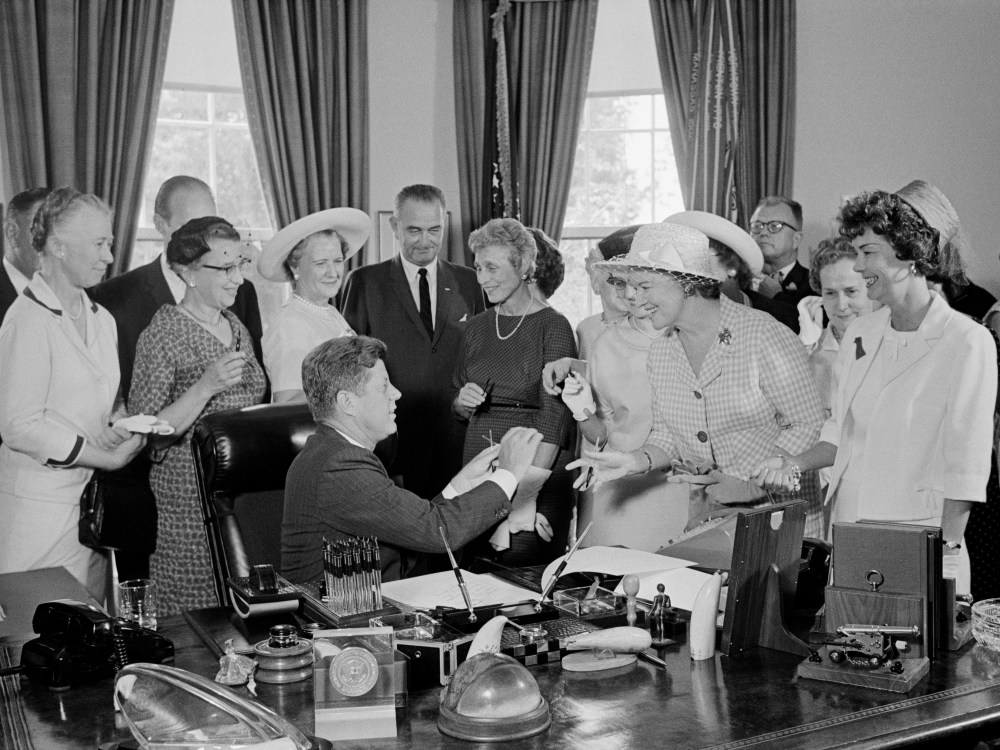
When President John F. Kennedy signed the Equal Pay Act into law on June 10, 1963, women made up only one-third of the national workforce and earned 59 cents for every dollar a man earned. Earnings in 2013 average 77 cents to every man’s dollar, according to Census Bureau Data.
As the nation’s population changes, so does its workforce, and the wage gap widens to 64 cents to the dollar for African-American women versus men, and 55 cents to the dollar for Hispanic women. Parity is even more elusive in male-dominated fields like manufacturing and financial services. President Obama marked the progress made in the last half-century during a speech in the East Room of the White House Monday, but told the crowd gathered, “This is the 21st century. It’s time to close that gap.” “When more women are bringing home the bacon, they shouldn’t be getting just a little bit of bacon,” the president said, citing a new study by Pew Research showing a record 40% of households are supported primarily, or completely, by working mothers, up from 11% in 1960.“If they’re bringing home more of the income and that income is less than the fair share, that means families have less to get by on,” President Obama said, tying the issue into his broader economic agenda. He talked about his administration’s efforts toward pay equality, including signing the Lilly Ledbetter Fair Pay Act into law at the start of his first term, and creating the White House Council on Women and Girls to work toward closing the wage gap. “Over the course of her career, a working woman with a college degree will earn on average hundreds of thousands of dollars less than a man who does the same work,” the president said Monday. “Now, that’s wrong. I don’t want that for Malia and Sasha. I don’t want that for your daughters. I don’t want that to be an example that any child growing up ends up accepting as somehow the norm. I want every child to grow up knowing that a woman’s hard work is valued and rewarded just as much as any man’s.” Watch President Obama’s speech commemorating the 50th Anniversary of the Equal Pay Act:
Erin Delmore Recommended


