









High-school sophomore Hilde Lysiak has already had the kind of journalism career many reporters only dream about. By the time she was 4, she was going on stake-out assignments in New York City with her father, then a reporter for the New York Daily News.

At 7, when the family moved to the small town of Selinsgrove, Penn., she started her own newspaper, the Orange Street News. And before she was 10, Lysiak scored her first exclusive reporting on a homicide that occurred only a few blocks from her house.
When that happened, the journalism protégé became a media sensation: she made national headlines after defending her story, landed a book series deal with Scholastic, inspired the Apple TV+ series “Home Before Dark,” and in 2019, she gave the commencement speech at West Virginia University’s Reed College of Media.
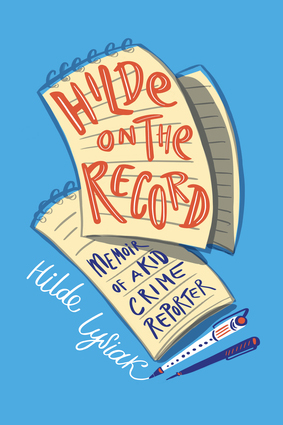
Now, Lysiak has taken a step back from reporting and wrote her first book reflecting on those formative years, including the more personal struggles that emerged with her fast rise to fame, “Hilde on the Record: Memoir of a Kid Crime Reporter.”
The 15-year-old – now living with her family in southern Arizona – shared what she’s learned about shattering age and gender norms, following her passion, navigating the national spotlight and hitting reset.
‘Should be playing with dolls’
In 2016, when Lysiak was the first reporter to break the story of a potential homicide in her community, she couldn’t believe the backlash she received on social media. Many questioned whether it was appropriate for a young girl to cover a crime scene. The Orange Street News Facebook page was filled with negative and sexist comments, including, “9-year-old girls should be playing with dolls not trying to be reporters.”
“I’ve put a lot of thought into whether it was my gender or my age that caused the criticism I got,” she recently told Know Your Value. “I think both played a big part in it. If I was a little boy doing this … it would have been more like, ‘Oh he’s so ambitious.’”
At the time, young Lysiak posted a video responding to her critics. “I know some of you just want me to sit down and be quiet because I’m 9,” she said in the video. “If you want me to stop covering news, then you get off your computers and do something about the news. There, is that cute enough for you?”
Her clap back went viral and soon national outlets came calling for interviews.
Navigating the media frenzy
In the months that followed, luminaries from Hillary Clinton to Malala Yousafzai congratulated her. Then a string of network news appearances. Scholastic developed a book series for young readers based on Lysiak’s stories and the Tribeca Film Festival honored her and her sister, Izzy, at the Disruptive Innovation Awards, where she caught the eye of television producer Joy Gorman Wettels.

That meeting led to the development of the 2020 Apple TV+ series “Home Before Dark,” directly inspired by Lysiak’s life as a cub reporter.
But as she was thrust into the national spotlight, Lysiak’s memoir details the private struggles she had adjusting to it. “I started to develop different sides of my personality,” she said. “I would have one side give interview answers and I’d go back to my house and be a completely different person.”
Looking back, she said she couldn’t really connect the dots to the fame, media and attention she received as a child. “I looked at it as if it was an alter ego that wasn’t really me,” Lysiak recalled.
Moreover, she grew increasingly frustrated with the way she was publicly portrayed, according to the book. “People painted me as this really confrontational girl and I wasn’t like that – I was a shy little kid,” Lysiak said. “I actually started my newspaper in part so that I could talk to people and grow out of my shell. When people started telling me things about myself that weren’t true, I felt I had to play a part.”
Leading up to this time, the young journalist struggled to cope with the sudden death of her grandparents. In the memoir, she revealed a stretch of bed-wetting and years of disordered eating. “It felt like there was a big hole inside me that I was trying to fill with food, but I never really could,” she wrote. “It wasn’t that my stomach would hurt (although sometimes it would) — it was that I would feel this horrible combination of anger and sadness.”
For Lysiak, her outlet to happiness became publishing the paper.
By 2018, Lysiak’s notoriety began affecting the way their community treated her family, she wrote. After vacationing in Patagonia, Arizona, they decided to start a new life in the even smaller town of 900 people. She welcomed the anonymity, but that didn’t last for long. Lysiak had an encounter with the town marshal while she was on her bike chasing a story lead that resulted in him threatening to arrest her for filming their interaction on her phone, according to the memoir. Lysiak posted the footage and it instantly went viral, once again generating national headlines, and ultimately a public apology from the town. “I wasn’t looking to ruffle feathers in this new place,” Lysiak said. “But if [the marshal] would do that to me, he’d do it to someone else.” In 2020, Lysiak made the difficult decision to stop publishing the Orange Street News. “I had a tricky time letting go of the newspaper and even getting older because I’ve had people from the time I was nine tell me that I’m so special for this particular thing,” she said. “It’s scary when your entire identity is attached to being a young journalist – that’s why you’re special, that’s why you’re smart, that’s why people like you because you are a child and you are a journalist.” At the time she stopped the paper, Lysiak’s memoir detailed her struggles with depression, including telling her parents during an argument that she no longer wished to live. “It wasn’t the first time I had thought that — not by a long shot — but it was the first [time] I had said it out loud,” she wrote. Soon after, the teenager began working with a counselor who helped her reclaim her sense of identity and self-esteem, apart from her life as a young reporter. “Even when I was younger, I always struggled with [depression] – the attention I got only amplified it,” she said. “I’ve been doing a lot of things to get help but it’s not some magic on/off switch where you wake up and think, ‘Oh, I’m not depressed anymore.’” Lysiak noted that working toward new goals, relishing small joys and finding new passions – in her case acting, filmmaking and the possibility of a career in science – have helped tremendously. “I keep little things in my life that make me happy: going on walks, listening to music, my old stuffed animals from when I was little – they make me happy,” she said. “But for anyone struggling with their mental health, don’t feel so much pressure to be instantly better one day because it’s going to be a process – if you pretend that you’re OK it will end up being worse and come out in a different way.”
Bianca Brosh Recommended


A move to Arizona and a made-up crime
When all the news that’s fit to print, didn’t fit her anymore
