








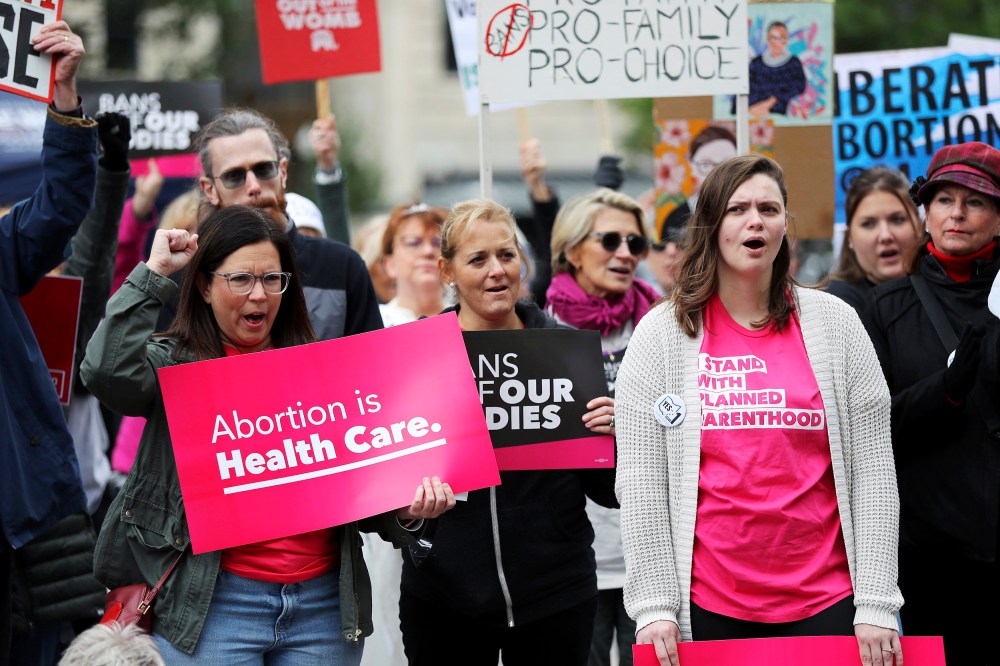
Monday marks the 51st anniversary of the landmark Supreme Court Roe v. Wade decision, which for half a century offered women and families the privacy and protection to choose when, where and how to have children. Since its overturn in June 2022, the Roe anniversary is a stark reminder, both of all that has been lost, but also of some small gains for women’s agency, freedom and power as Americans.
Since Roe was overturned, nearly two dozen states have seriously curtailed or completely banned abortion.
As a result, women in those states with restricted access have faced an array of life threatening, catastrophic health consequences. Even worse, in almost every state with abortion bans, already unacceptably high maternal mortality rates have increased.
How the idea of ‘freedom’ plays into messaging around abortion rights
In Ohio a woman was hauled before a grand jury and accused of murder after her miscarriage. Thankfully, the grand jury declined to indict. In several instances, women have come close to death from complications after being denied abortions. Even the supposed legal exceptions for the life of the mother have failed. Take Kate Cox, for example, who sued in Texas to access an abortion when she faced life threatening complications. Texas courts denied her request and she was forced to leave the state to get care.
And many doctors are giving up even trying to practice in states with abortion bans, driven away by government control of their practices and their oath to “do no harm,” exacerbating an already acute healthcare crisis. And now, as the Supreme Court prepares to rule on access to the abortion pill, there’s reason to worry that the worst of the consequences are still yet to come.
Sen. Baldwin on abortion rights: ‘Can’t stop fighting’ until Roe is ‘law of the land’
Indeed, the landscape since the end of Roe has been a grim one for women. And it has laid bare the agenda of far-right legislators across the country who are still not content with even the most extreme abortion restrictions.
Given all this, it seems almost impossible to fathom that anything positive was gained by women in the overturning of Roe. But there may be some small outcomes to celebrate.
For a generation, many Americans believed abortion was sacrosanct and would never be overturned, which led to a fair amount of political apathy. While women have out-voted men in every election since 1980, abortion was more of an animating issue for those who opposed it than those who supported it. In fact, the highly effective and powerful Christian conservative political movement was built almost entirely on the vision of repealing Roe. Opposition to abortion helped propel Reagan, Bush 41 and 43 and Trump to the presidency, all of whom pledged to — and did — appoint anti-abortion Supreme Court justices.
Today, though, voters are acutely and newly aware that if Roe can be overturned, other rights we take for granted, including gay marriage, birth control and more, might also be at risk. As a result, numerous polls, including those from All In Together, the women’s civic education organization I co-founded and lead, have found that support for abortion rights has not only become a top voting issue for women on the left and middle, it has overwhelming support among a significant majority of Americans. Even Republican women have been driven to vote in favor of abortion rights when given the chance. Ballot initiatives protecting abortion access like those passed in Kansas, Ohio, Michigan have been huge engines for galvanizing voter turnout across the political spectrum. To be clear there is no “silver lining” to the rollback of Roe, which opened an essential door to women’s full place in American society with vast impact on American life. But it has served as a wake-up call to Americans that no progress is guaranteed and that we as citizens and voters must always be vigilant stewards of our individual freedoms and rights. And given the galvanizing political force the end of Roe created it seems possible that it was also a political wakeup call to elected officials that women’s rights must urgently be defended. It took 50 years for activists to repeal Roe, and it will most certainly take many years to restore it. Let’s hope that it remains the kind of deeply personal issue of freedom, justice and equality that continues to mobilize Americans well into the future. Women’s lives depend on it.
Lauren Leader
Lauren Leader is the co-founder and CEO of All In Together. She is a frequent contributor to Know Your Value. She tweets @laurenleaderAIT Recommended


Abortion and cost of living are top issues for women ahead of 2024
