








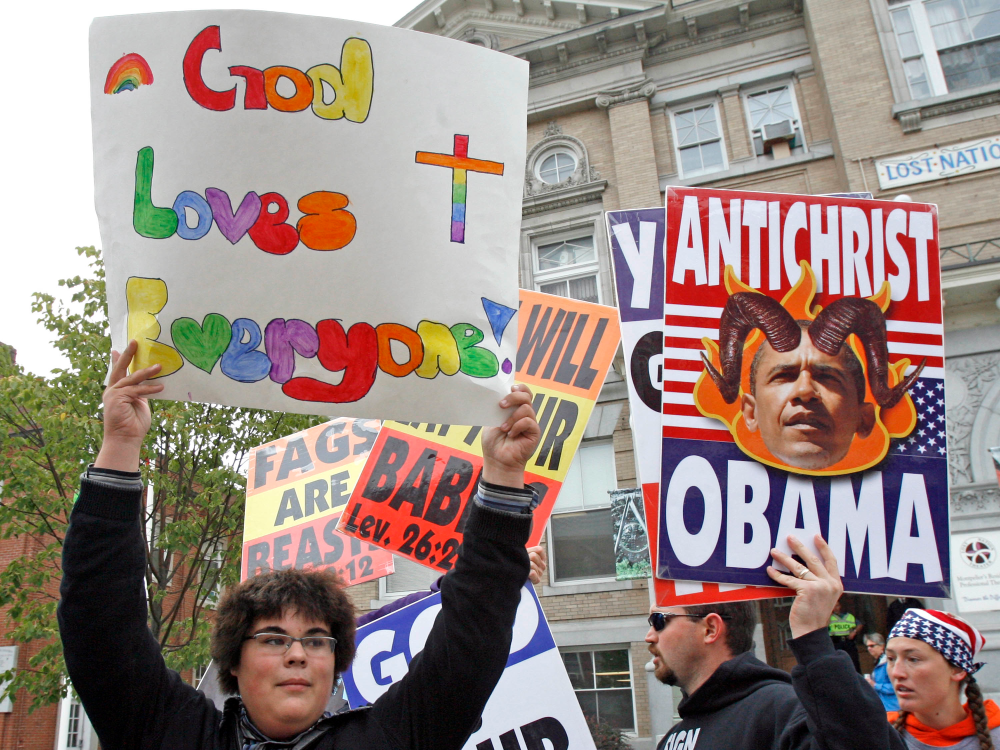
When Sen. Rob Portman, R-Ohio, decided to publicly reverse his stance on marriage equality, he rooted his change of heart in several factors. Some were external, such as the growing support among Americans for marriage equality, and the declining divorce rate since same-sex marriage was introduced nearly a decade ago. Others were internal and more powerful–the love he feels for his son Will, who came out to his parents two years ago.
But arguably the most surprising influence Sen. Portman credited with swaying his position on marriage equality was his faith as a Christian.
“I wrestled with how to reconcile my Christian faith with my desire for Will to have the same opportunities to pursue happiness and fulfillment as his brother and sister,” wrote Portman in an op-ed for the Columbus Dispatch on Friday. “Ultimately, it came down to the Bible’s overarching themes of love and compassion and my belief that we are all children of God.”
Portman’s embrace of marriage equality, the first from a sitting Republican senator, comes at a critical time for the GOP. Grappling with having lost the popular vote in five out of the last six elections, Republican leaders are trying to figure out exactly how to broaden their party’s appeal without compromising the values of their mostly white, Christian base. Portman’s interpretation of the Bible, however, may hold the key to bridging the GOP’s evangelical wing with groups it has traditionally shut out.
“There is a growing group of Christians who believe the Bible has been misinterpreted, and that’s the debate going on right now,” said Justin Lee, founder and executive director of the Gay Christian Network, to msnbc.com. “One interpretation is that [the Bible] condemns gay sex and relationships. Period. End of story. The other interpretation is that these passages are all within specific contexts of rape, idol worship, and pedophilia, and that those behaviors are condemned–rightfully so–but that none of these are depictions of monogamous, loving, committed relationships.”
Lee, who grew up Southern Baptist, used to firmly believe that homosexuality was sinful. But after coming to terms with his own sexuality, Lee learned to accept his identity as both a gay man, and a man of faith. “I’m definitely a religious person,” he said. “My faith was always the most important thing in my life and continues to be, but my views on this particular issue have changed.”
Traditionally, religious conservatives have overwhelmingly opposed the idea of marriage equality. According to a poll from last November by the Pew Forum on Religion & Public Life, only 19% of white evangelical Protestants (who in the last election made up nearly 40% of the Republican voting bloc) favor same-sex marriage.
What this opposition to marriage equality creates is a major catch-22: the GOP can’t win unless it appeals to more voting demographics (including LGBT voters,) yet becoming more inclusive runs the risk of alienating the very core of the party.
Already, this conflict was on full display at the American conservative Union’s annual conference last week, when Republican leaders sent a split message about which direction their party should head. Some advocated for change, like Kentucky Senator Rand Paul and former Florida Gov. Jeb Bush, while others preached for more of the same.
“We don’t need a new idea,” said Florida Senator and rising star Marco Rubio during his speech at CPAC on Thursday. “The idea is called America, and it still works.” Rubio reaffirmed his support of “traditional” marriage, and added that his belief “does not make me a bigot.”
Jeb Bush, another potential 2016 contender, argued a different approach. “We’re associated with being anti-everything,” he said on Friday. “Way too many people believe that Republicans are anti-immigrant, anti-woman, anti-science, anti-gay, anti-worker. Many voters are simply unwilling to choose our candidates because those voters feel unloved, unwanted, and unwelcome in our party.”
Despite Bush’s message of acceptance, however, the conference itself was not a picture of inclusion. GOProud, the gay conservative organization, was not invited to participate at CPAC, and banned as an official sponsor. Nevertheless, Jimmy LaSaliva, GOProud’s co-founder and president, managed to attend the conference as a guest of the Competitive Enterprise Institute, which hosted a panel on Thursday called, “A Rainbow on the Right: Growing the Coalition, Bringing Tolerance Out of the Closet,” where he had some tough words for his party’s position on gay rights. “I’m embarrassed to call myself a Republican right now,” said LaSaliva on Thursday’s panel, the day that Portman publicly came out in support of same-sex marriage. “There are a few in our movement who just don’t like gay people. And in 2013, that’s just not OK.” Before his reversal on marriage equality, Sen. Portman maintained an excellent record as a Christian conservative. He voted for the Defense of Marriage Act, the 1996 law under review by the U.S. Supreme Court which blocks the federal government from recognizing any marriage not between a man and a woman. And he scored a 92% by the Christian Coalition for his voting record on family issues. Roberta Combs, president of the Christian organization, said to msnbc.com that Portman’s rating is subject to change depending on how he votes in the future, but added that the official position of the coalition remains unchanged. “Marriage is between a man and a woman,” she said. “I think the Bible is clear on that issue.” While Portman found a way to embrace marriage equality without personally compromising his Christian values, the senator and VP shortlister faced major backlash for his reversal–especially from the religious right. Conservative Baptist minister William Murray released a critical statement through his Government Is Not God PAC, warning that Portman’s son would contract AIDS unless he was subject to ex-gay therapy. “Portman has conveniently ignored the warnings against the sin of homosexuality in both the Old and New Testaments–and is accepting a behavior that may eventually kill his son from AIDS, other sexually transmitted diseases, or oral cancer,” read the statement. “No one is ‘born gay’ and there is hope for those who want to overcome these destructive behaviors.” And RedState’s Erick Erickson launched into a heated Twitter lecture following Portman’s announcement, saying that the senator was “hiding behind the Bible“ to support same-sex marriage. “Senator Portman speaks like so many who call themselves Christians but actually don’t spend much time dwelling on the Word of God,” said Erickson in another tweet. But just because religious conservatives are largely closed off to the idea of marriage equality now doesn’t mean they always will be, reformists argue. There may come a time when embracing both Christianity and gay rights as Portman has won’t be so difficult, and the GOP won’t be so divided. “Right now in the church, support of same-sex marriage is in the minority, but it’s a growing minority,” said Lee. “I’m really committed to making sure that Christians on both sides continue to have a place at the table. I believe that’s important.”
Emma Margolin
Emma Margolin is a reporter at MSNBC.com. Recommended


