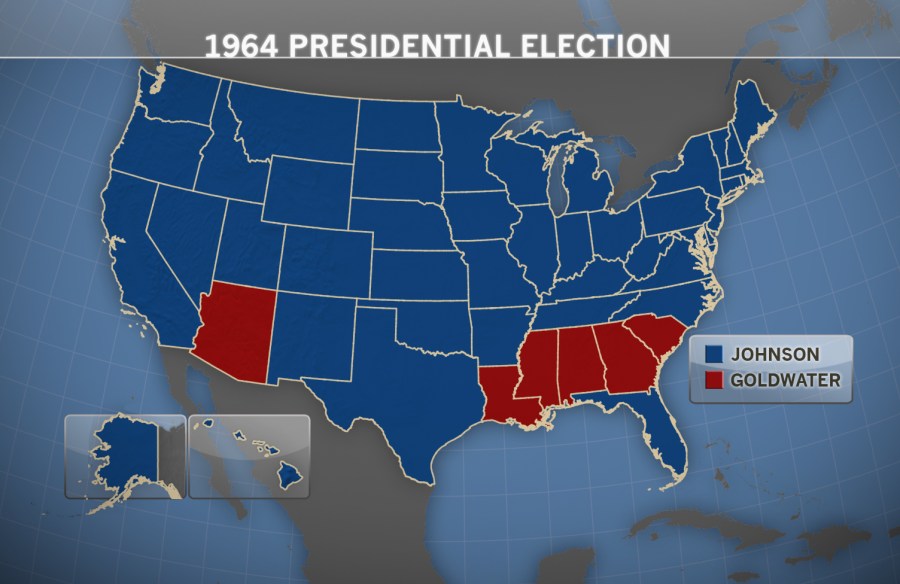
Let me finish tonight with the 50th anniversary of the most prophetic statement ever made by a leader.
As we talked about earlier, it was 50 years ago today that Lyndon Johnson signed the Civil Rights Act of 1964. And while he was signing that bill into law, LBJ supposedly turned to someone and said, “There goes the South for a generation.”
History has proven LBJ dead right on that one. Actually, if anything, he was guilty of understatement.
We talk about political shifts that have taken place in this country or that might take place, but really, there’s nothing like what happened to the South over the last half-century, what happened because a Democratic president from Texas–a Democratic president who had been a segregationist for most of his career–finally and firmly embraced civil rights.
It’s almost unimaginable right now, but the South before 1964 was a Democratic bastion. It was the most reliably Democratic part of the country. This was because of Reconstruction, that brief period immediately after the Civil War when civil rights and racial equality were imposed on the newly reconstituted South.
But the resistance from the white South was furious. Reconstruction ended with the Hayes-Tilden election of 1876, and the Jim Crow era began: segregation and poll taxes and literacy tests and all of the other forms of legal oppression that white southerners used to maintain their power over the people who’d once been their slaves.
Reconstruction had been a Republican project, a project of liberal Republicans from the North. They existed back then and, because of that, almost every white southerner of the Jim Crow era was a Democrat. They were segregationist and generally very conservative, yes, but they were Democrats. And the national Democratic Party catered to them, cut deals with them. It relied on them.
How Democratic was the Jim Crow South? Look at this:

In 1936, FDR won 99% of the vote in South Carolina. He got 97% in Mississippi, 87% in Georgia. Essentially, there was no Republican Party in the South back then.
But the civil rights movement changed everything. Blacks couldn’t vote in the South, but they could in the North, and along with their white allies they ratcheted up the pressure on northern Democratic leaders to stop appeasing the Jim Crow Democrats, to make the national Democratic Party choose sides on this basic, fundamental issue. There was a walkout at the 1948 Democratic Convention, when northern Democrats led by Hubert Humphrey pushed through a civil rights plank. The Democrat who led his fellow southerners out of that convention: Strom Thurmond. And in 1964, LBJ made the ultimate choice. As an up-and-coming Texas politician, he’d been as pro-Jim Crow as anyone. But his heart was somewhere else, and when fate made him president in November 1963, LBJ made civil rights his priority. He did what no president had been able or willing to do: he broke the southern filibuster, he got the bill through, and he signed it. That shift that he predicted took shape right away. To run against LBJ that year, Republicans picked Barry Goldwater, who’d joined the southern Democrats in their filibuster. Goldwater got crushed nationally, but in the South–the solidly Democratic South–it was a different story: he won five southern states outright. In South Carolina, where FDR had once racked up 99%, Goldwater got 58%. In Alabama, he got 69%. And in Mississippi, he got 87% of the vote. And it’s only gotten more hopeless for Democrats in the South–especially the Deep South–in the 50 years since then. LBJ had no idea just how right he was.
Steve Kornacki
Steve Kornacki, author of "The Red and the Blue: 1990s and the Birth of Political Tribalism," is a national political correspondent for NBC News and MSNBC. Recommended