








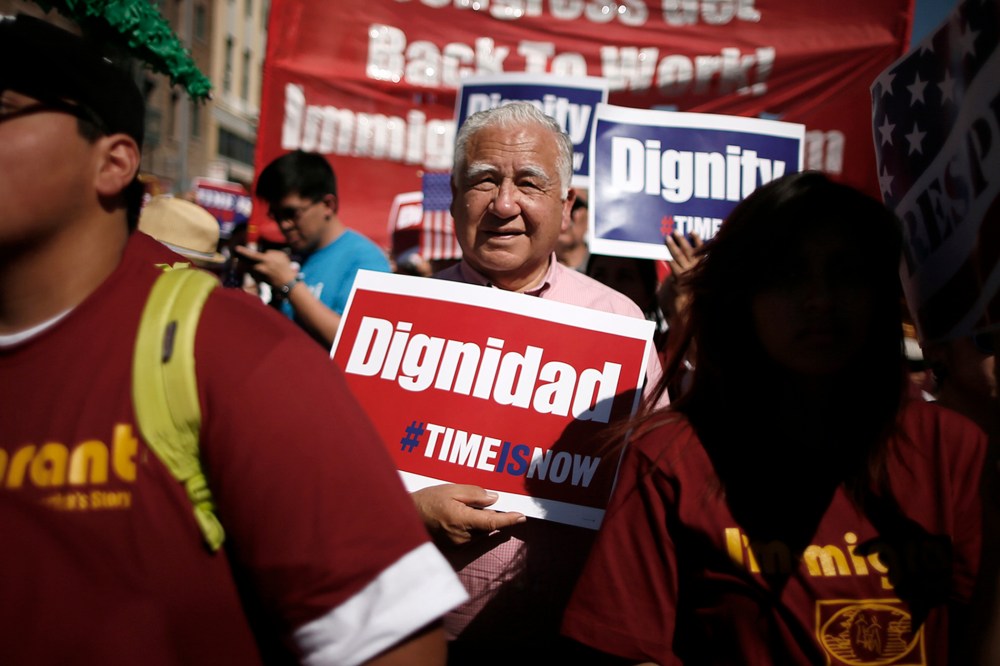
It may come next week or maybe six months from now, but House Republicans will decisively determine whether to kill immigration reform or make a real attempt at passing it. No one would be surprised if Speaker John Boehner chose the former option.
But the longer Boehner takes to decide, the more ground he cedes to states dominated by single party politics and eager to craft immigration laws in the face of a crippled Congress.
Congressional inaction has left millions of families increasingly living in two parallel universes. Republican-run states turn cops into border patrol agents and cut undocumented immigrants off from housing, school, employment, and private charities. But in states dominated by Democrats, the same immigrants are gaining access to drivers’ licenses, better wages and college educations for their children.
Just three years ago, Republican statehouse victories prompted a wave of efforts by conservative legislatures to expel their immigrant populations. Led by Arizona, governors signed laws aimed at making daily life for the undocumented especially difficult.
But a combination of judicial rulings and public backlash helped to significantly weaken those laws and now restrict states from passing harsher ones. While life is harder for migrant workers in these places, undocumented communities have mostly toughed out the changes, compelled by work opportunities and family ties to stay put.
And just as red states moved to crack down on immigrants in the wake of the 2010 tea party revolution, a number of blue states interpreted Democrats’ 2012 success with Latino voters as a signal to move in the opposite direction. Today, entire states, cities, towns, counties and school boards, mostly in Democratic pockets across the country, are passing laws designed to protect unauthorized immigrants from deportations and harassment.
The leading player in this burgeoning trend is California, where Gov. Jerry Brown has signed a slew of legislation aimed at expanding access to education, work, and transportation.
“The year 2013 was a complete reversal on this issue,” said Muzaffar Chishti, who researches states immigration policy as director of the Migration Policy Institute’s office at New York University, told msnbc. “In many ways, you could say California has become the anti-Arizona.”
California’s laws represent a huge political shift – the state is only two decades removed from leading the modern anti-immigration movement. But its policies face many of the same problems that bedeviled red states’ unsuccessful attempts to impact immigration from the other direction. Without the help of Congress and the White House, they can only strike out so far on their own.
The Golden State is hardly alone: places like Illinois, New Jersey and Colorado are rapidly revamping their policies to be more immigrant-friendly. Most of the latest immigration laws were tested elsewhere first, but they’re gaining traction like never before as demographics and public attitudes push state lawmakers into the pro-reform camp.
Driving while immigrant
For many immigrants, simply driving to work is the most stressful thing they do each day. In most states, undocumented immigrants are barred from obtaining a drivers license. Getting behind the wheel without a license means risking more than a fine. If a local cop passes their information on to federal immigration authorities, they could be deported.
In states like Arizona and Alabama, anti-immigration laws envisioned traffic violations as the best opportunity for police to investigate and arrest suspected violators. But California is going another direction.
Beginning in 2014, the nation’s most populous state will grant drivers licenses to undocumented immigrants, allowing them to drive and obtain auto insurance without fear. In this, California joins Illinois, Colorado, Nevada, Maryland, Connecticut, Oregon, and the District of Columbia, all of which passed similar legislation in 2013. Only three states — New Mexico, Washington, and Utah — offered such licenses at the start of the year.
Just a few years ago, licenses for unauthorized immigrants were a political minefield, even in Democratic primaries. Hillary Clinton struggled to manage the issue in her 2008 presidential run, saying in a debate that she supported then-Governor Eliot Spitzer’s decision to explore the policy even as she opposed it herself. Spitzer’s plan fell apart amid a backlash but looking back, New York had clearly identified a path that other blue states would eventually follow.
The California bill’s backers employed the same arguments to pass the license laws that red state legislators used to justify their crackdowns: if Washington isn’t going to pass immigration reform, it’s up to them to find alternatives.
“It forces states like California, which has the largest undocumented immigrant population, to look at what they can do at their level to improve the lives of immigrants,” California assemblyman Luis Allejo, who authored the license bill, told msnbc. “The drivers license bill is a perfect example: it helps undocumented immigrants go to work, take their kids to school, go to church.”
There’s another important facet to the drivers license debate: it can be extremely valuable as a piece of identification. Without a valid form of ID, immigrants may find it difficult to open a bank account or sign a lease.
With this in mind, Oakland and San Francisco offer municipal ID cards at the local level, taking a cue from an older ID program in New Haven, Connecticut. Los Angeles is considering issuing identity cards as well.
The hope is to encourage undocumented workers, who are often paid in cash, to deposit their money. In fact, the Oakland IDs include a built-in checking account and can be used as a debit card. This focus on financial security is based on concerns that immigrants are easy prey for muggers who assume migrant workers carry cash and are afraid to report crimes.
But there are limits to how far these efforts can go. The REAL ID Act, passed by Congress in 2005, requires states to verify an applicant’s legal status before issuing federally recognized identification. As a result, California’s new cards will look different than those held by citizens and have fewer uses. They cannot be used to board a plane, for example.
TRUST, but verify
One of the odd features of the last few years for immigration policy is that even as Latino voters have helped push national reform closer than ever to passage, deportations have hit record numbers under President Obama, receding only recently.
Behind the surge in deportations are new measures aimed at quickly identifying and removing suspected unauthorized immigrants. The most notorious among immigration activists is Secure Communities.
Under that program, local police who arrest a suspect then pass on the suspect’s fingerprints and information to the FBI to check against federal databases. But the information is also shared with the Department of Homeland Security, which can request that police hold onto a suspect if immigration authorities determine they might be eligible for deportation.
According to Immigration and Customs Enforcement, a department under Homeland Security, Secure Communities prioritizes criminal history in deciding which suspects to detain and remove. But immigration activists complain that these crimes are too often nonviolent misdemeanors or immigration violations alone.
In Sacramento, one such case ended up becoming a major statewide story. Juana Reyes, known locally as “the tamale lady,” ran a food cart near Wal Mart. She was arrested while working and charged with trespassing. Despite no prior criminal history, she was held for days at ICE’s request while her two children, both US citizens, were taken in by Child Protective Services.
Protests over stories like Reyes’ prompted California to pass the TRUST Act, a law instructing police not to honor detainer requests from ICE unless the suspect in question has committed serious crimes.
“There are hundreds, if not more, stories of mothers, fathers, workers with family members ending up in deportation proceedings,” said Reshma Shamasunder, executive director of the California Immigrant Policy Center. “The biggest impact the TRUST Act will have is protecting these types of immigrants from starting with a casual confrontation with law enforcement and ending up with their family torn apart.” Cities like New York and Washington, DC have also tried to limit cooperation with federal immigration authorities. Without immigration reform, there’s only so much that local governments can do to slow deportations, however. Releasing immigrant detainees might make it more difficult for ICE to find and remove them, but there is no way to stop federal immigration authorities from pursuing them afterward. Worker rights In contrast to red states that are trying to choke off employment opportunities for migrant workers, California is passing legislation to prevent those same workers from being exploited. Migrant workers often make a living in relatively unregulated industries – day to day contracting work, for example. Their tenuous legal status often makes them more vulnerable to abuse, either through subpar working conditions or wage theft. This year, California enacted a bill to protect an extremely immigrant-heavy class of workers: domestic aids. These include nannies, housekeepers, and home aids to elderly and disabled patients. Under the recently passed Domestic Workers Bill of Rights, these workers are eligible for overtime pay. “At the moment the industry is predominantly immigrant, exists largely in the shadows, and is becoming more and more important as time goes on,” Ai-Jen Poo, director of the National Domestic Workers Alliance that agitated to pass the bill, told msnbc. “The way the 21st Century economy is unfolding, there’s an age wave taking over, baby boomers are retiring, and people are living longer. It means our household needs for caregivers are growing exponentially.” Passing the bill wasn’t an easy task. Governor Brown had vetoed a previous iteration, forcing the legislature to strip added guarantees of uninterrupted sleep breaks and other rest periods. But it represents an acknowledgement that oft-ignored jobs dominated by immigrants are worthy of state attention. New York passed its own, more far-reaching version of the Domestic Workers Bill of Rights earlier as well. In Texas, labor activists have found some success advocating for better regulation in other industries with large immigrant workforces such as construction, where they’ve targeted disproportionately weak safety standards. California has also passed legislation making it harder to detect immigration violators in the workplace. A 2011 law signed by Brown stops local governments from requiring private businesses to run new hires through E-Verify, a federal program that verifies workers’ legal status. In states like Arizona and Alabama, E-Verify is mandatory and the Senate’s immigration reform bill would require its use nationally in exchange for legalizing existing workers. Regulations are only strong if violations are reported and rules are enforced, however. Without immigration reform, Poo told msnbc she’s concerned that too many workers will be unwilling to come forward with claims of abuse by employers for fear the attention will lead to their removal. “We hear of modern day slavery cases on a regular basis,” Poo said. “There’s essentially nothing mediating that relationship as long as workers live in fear of employers being able to call ICE and have them deported at a moment’s notice.” Looking Forward Five years ago, as he sought the presidency, Barack Obama declared: “we are not a collection of red states and blue states. We are the United States of America.” For undocumented workers, the last three years have challenged that notion. Blue states have placed their bet on immigration to infuse their economy with young workers, laying the groundwork for what they believe is an inevitable immigration reform bill that solidifies migrant families’ place in the country. Red state lawmakers see undocumented immigrants as a drain on resources who steal jobs from natives, despite protestations from business groups and labor economists that they benefit the economy overall. Labor and immigrant rights groups hope to keep up the momentum for their side in 2014 and list a number of possible areas where immigrant-friendly legislatures might move next. One is education – California grants in-state tuition to residents regardless of immigration status, a benefit an increasing number of states now offer. Another is health care, where unauthorized immigrants are barred from buying even private unsubsidized insurance through the Affordable Care Act exchanges and often must rely on emergency rooms and charity clinics for care. None of these are substitutes for immigration reform along the lines of the bipartisan Senate bill that passed in June, which would grant millions of immigrants the ability to legally stay and work in America long term. But the longer immigration reform waits to pass, the farther states will grow apart in their own approaches. Migrants will find there are two Americas, one in which their state leaders actively look for new ways to kick them out and another in which they openly encourage them to stay.
Benjy Sarlin Recommended


