








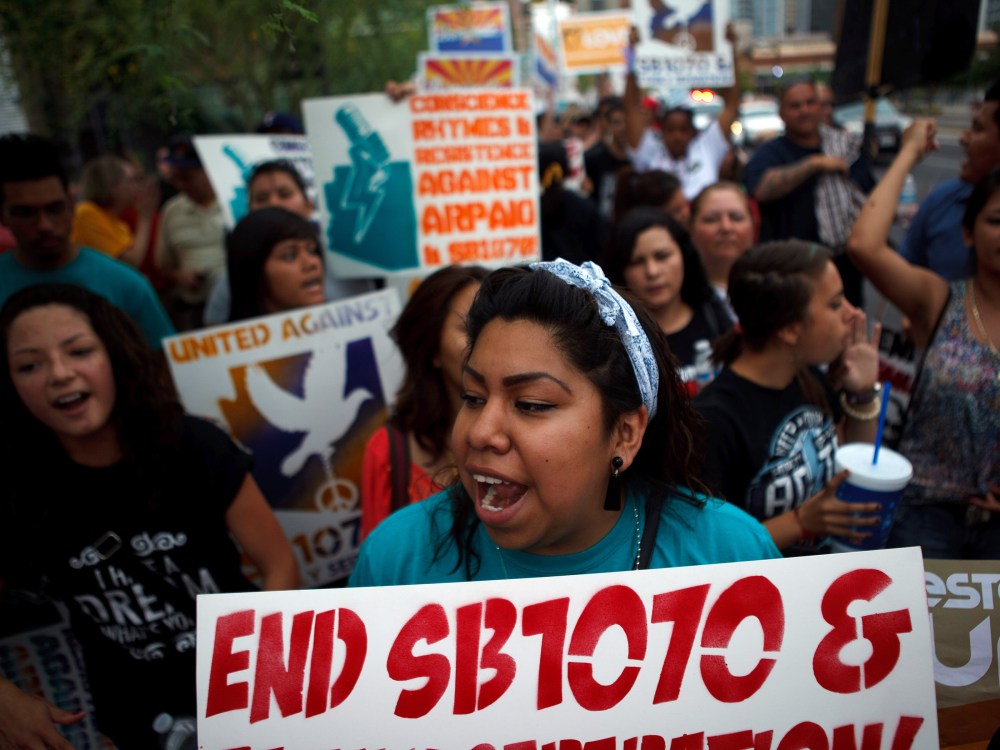
Arizona became synonymous with hardline immigration policy in 2010, when legislators passed SB 1070, a groundbreaking law that deputized local police to investigate and report suspected immigration violators–a job previously reserved for the federal government. The bill was popular with Arizonans and national Republicans at the time, but the resulting backlash from Latino voters around the country helped spark the current national conversation over immigration reform. Now, as Congress considers whether to pursue Arizona’s hawkish path or the “Gang of Eight’s” legalization plan, the state could once again prove a bellwether for where the debate in Congress is headed.
Politically, while the bill ignited a firestorm, the GOP’s hold on the red-leaning state was largely unchanged. Governor Jan Brewer, who took over after her predecessor Janet Napolitano left to become Secretary of Homeland Secretary, rode SB 1070’s popularity on the right to dominate the Republican primary field in 2010 and cruise to her first election victory. Republicans still hold solid majorities in both the Senate and House of Representatives, although they lost some ground in the last election from their post-SB 1070 peak. And despite boasts from Democratic strategists that Arizona’s Latino voters could turn the state blue in 2012, the presidential race never became truly competitive; Mitt Romney won the state 53%-44%.
But the relative stability of the state’s partisan balance masks a sea change within the GOP itself. In the wake of SB 1070, major Republican constituencies grew uncomfortable with the direction the state was heading on immigration.
Related: Democrats let GOP name their price on immigration
Among the business crowd, CEOs and investors became concerned that Arizona’s reputation as a harsh place for Latinos was affecting their bottom line. Groups opposed to the state’s immigration laws led successful boycott efforts against products, tourism, and conferences. In Phoenix, bookings for the local convention center plummeted, costing the economy as much as $132 million by one city estimate.
“Elected officials became Fox News superstars because they offered a lot of red meat,” Phoenix Mayor Greg Stanton told msnbc in an interview. “But instead of looking at the overall impact for the economy, bills were passed to reinforce a point.”
Alarmed by the trend, businesses organized to push back. In 2011, SB 1070 champion and Senate president Russell Pearce introduced a new slate of legislation aimed at cracking down on immigration, including a bill that would require hospitals to report undocumented patients and another calling for an end to birthright citizenship. Fearing a new wave of embarrassing publicity from his agenda, 60 business leaders from Arizona’s largest companies signed a letter demanding Pearce back away from the issue due to the “undeniable fact that each of our companies and our employees were impacted by the boycotts and the coincident negative image.”
The Senate responded, voting down five immigration bills. But it didn’t stop there–a group called Citizens for a Better Arizona led a successful petition to organize a recall election against Pearce. Moderate Republicans united behind a Republican rival, Jerry Lewis, and defeated Pearce in an open primary. Pearce’s weakness wasn’t only business opposition–the local Mormon community, of which Pearce is a member, raised concerns that Arizona’s laws had made missionary outreach in Latin America more difficult. Pearce lost again in a 2012 comeback attempt to another Republican rival, Bob Worsley. Many of the state’s most prominent anti-immigration figures have faded into the background along with him.
As Pearce’s power dissipated, so did the popularity of his signature law, which was also severely limited by the Supreme Court. An October 2012 poll by Arizona State’s Morrison Institute found only 32% of residents believed the bill had benefited them, versus 41% who thought it had damaged the state. The political climate has become relaxed enough that Arizona’s two Republican Senators, John McCain and Jeff Flake, feel comfortable taking lead roles on the bipartisan “Gang of Eight” bill that would provide a path to citizenship for undocumented immigrants.
Related: Can the Tea Party stop immigration reform?
Robert Graham, chair of the Arizona Republican party (Pearce is a vice-chair), told msnbc that “immigration is still a very hot topic” in the state and residents were especially concerned about border security. But he thought that the GOP had improved its “tone” in reaching out to Latino voters and that state lawmakers were more focused on pressuring the federal government to fix immigration.
“It’s possible other things could arise within our state legislature, but right now we’re keeping an eye on what’s happening with Congress,” he said.
But the GOP-led Congress is starting to sound more like the Arizona legislature in 2010, causing alarm among some immigration reform supporters. Recently Republicans overwhelmingly voted to oppose President Obama’s decision to halt deportations for young unauthorized immigrants, and the House Judiciary Committee is working on a bill that would encourage states to follow Arizona’s lead in enforcing federal immigration law. It’s possible they could face similar consequences if they continue down Arizona’s path. The Chamber of Commerce is heavily backing the immigration bill, as are a raft of industries from hotels to agriculture to high-tech firms, in the hopes that it will help provide a steady source of labor and talent for hard-to-fill jobs. Religious leaders, including a variety of evangelical groups, are publicly lobbying for it as well. Republican donors and strategists are backing efforts to support immigration reform with radio and TV advertising designed to give political cover to wavering lawmakers. If the House goes the other direction, they could face a backlash from these constituencies akin to Arizona’s. “We’re probably five years ahead of the rest of the country on immigration,” Nathan Sproul, a Republican strategist in Arizona who supported efforts to unseat Pearce, told msnbc. “Now the wave is going out here, but not yet nationally.” Part of the reason Republicans are so concerned about getting it right–in Arizona and around the country–is that the political consequences are likely to be more severe the longer they wait. In Arizona, Republicans were able to weather the Latino surge better than nearby blue-tilting states like Nevada, New Mexico, and Colorado. Similarly, Latino voters–while a factor in President Obama’s 2012 win–were not on their own responsible for his healthy margin, nor did they make much of a dent in the House, where Republicans are insulated in safe districts. But both Arizona and the national GOP are unlikely to be able to keep that feat up forever. That’s because the Latino population is not only growing, but disproportionately young, meaning it will take up a larger portion of the electorate over time as more residents turn 18. In Arizona, the median age for Latino residents is 25 while the median age for white residents, the GOP’s backbone, is 44. “That population is going to disappear rather quickly and be replaced by a young Latino cohort being socialized in an environment that is telling them the Republican party does not want them,” Rodolfo Espino, an associate professor of political science at Arizona State University, told msnbc. The combination of factors means that Republicans might easily be misled by short-term success into thinking they dodged a bullet. Arizona Republicans are starting to wake up to the threat to their future viability. Will the House GOP? Related stories:
Benjy Sarlin Recommended


