








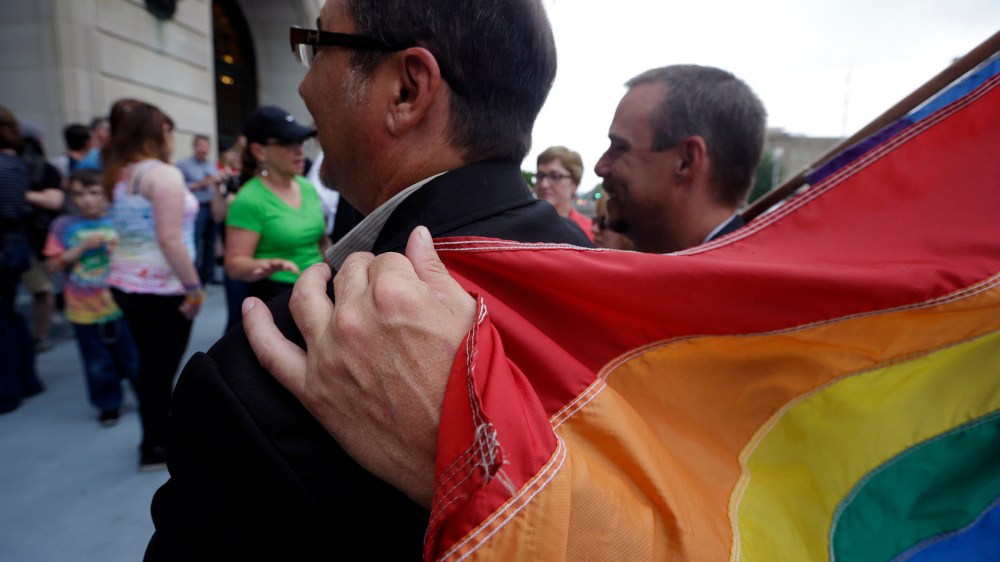
With a recent spate of victories in courts of law, gay rights activists are looking to increase victories in the court of public opinion and they’re making dents in solidly red states. On Tuesday, the City Council in Topeka, Kansas, narrowly approved two LGBT anti-discrimination bills. It was a 4-month process that ultimately came down to a 4-3 vote in a standing-room only council chamber after an extensive public comment time.
The packages were written by February by Councilman Chad Manspeaker, who then consulted with the city’s Human Relations Commission on getting language that could successfully make it through a council vote. The two sides ran into trouble when it came to creating a registry for same-sex domestic partners. Manspeaker and the activists wanted same-sex couples to be able to obtain paperwork to prove their relationship, but didn’t initially want to make a list of gay couples available for anyone to see and read.
“Having the government say we’re going to put you on a list and make it public doesn’t scream good government,” Manspeaker told msnbc Wednesday. “We tried to make the list private, but failed because of Kansas state laws on public records.”
The partnership registry was a key point for activists and couples because it’s the only way many in same-sex relationships can obtain certain types of insurance. Apart from the city of Lawrence, Kansas law does not recognize any type of same-sex relationship, so companies and employers have previously had to go on a couples’ word when trying to validate their relationship. City employees on the registry will now be eligible for health insurance coverage.
“This registry provides at least one channel where these relationships can be legitimized by the city of Topeka,” Manspeaker said. “The big thing here is people will no longer be able to discriminate against people based on their gender identity.”
In 2007, then-Kansas Gov. Kathleen Sebelius added sexual orientation and gender identity to the list of protected classes for state government employees. But, LGBT activists in the private sector say Sebelius’ executive action left them with an empty seat at the table.
“A lot of people [at the council meeting] were very passionate that this was anti-Christian or anti-God, and a lot of people on the other side were equally as passionate,” said Stephanie Mott, the former state chair of Equality Kansas. Mott is a transgender woman and member of Topeka’s Human Relation Commission. She spoke at Tuesday’s City Council meeting along with dozens of other citizens, who were both for and against the measure.
“A few more people spoke against the ordinance, than for it and I could see the reaction on City Council members faces while opponents were testifying and after those reactions, I knew it would pass,” Mott told msnbc Wednesday. “So much of what was said against [the ordinance] was not focused on what the ordinance did; that somehow this was a precursor to marriage equality in Kansas. Education is not enough and political activism is not enough.”
When Topeka has gained national attention in the past, it’s usually been coverage of the controversial Westboro Baptist Church. The church is based in Topeka and constantly tries to get headlines for its protests at funerals of fallen American military members. It’s run by the members of the Phelps family, who began the organization in 1955.
“We aren’t the Phelps, we aren’t the Kansas legislature, we are a progressive-thinking group of people,” Manspeaker said. “Even in the face of [the Westboro Baptist Church], I’m willing to do whatever it takes for full marriage equality.”
The move in Topeka is not dissimilar from what’s currently going on in other cities across the nation. Two other cities – Saginaw, Michigan, and Houston, Texas – are other battlegrounds over anti-discrimination tactics. If LGBT activists want to see progress, they should look away from Saginaw. After a big victory in Topeka, gay rights were dealt a significant blow in Saginaw, when the city council unanimously rejected a non-discrimination ordinance. Even supporters of the measure voted it down, saying it was prematurely brought up for debate.
“I started on this in August 2013 because I thought it was sort-of a no-brainer – that we were filling a gap,” said Saginaw Councilwoman Annie Boensch, who championed the ordinance. “These are inclusive policies that are good for a community that really needs them right now.”
Boensch, like other lawmakers, sees anti-discrimination laws as an economic booster. The city has seen a steady drop in population since 1990 from 70,000 to around 50,000 now, according to the 2010 Census. Boensch links a big part of the loss to the Great Recession when many of the city’s factories closed and manufacturing jobs were lost.
“My stance is that no one should be discriminated against,” Boensch told msnbc Wednesday. “I see the benefit for the gay community as good for the public. This is a city that desperately needs economic development.” Boensch concedes that activists in Saginaw have an uphill battle to pass the ordinance. After Tuesday’s vote, the measure is effectively dead and lawmakers are now back at square one. Supporters hope to get the bill rewritten and address concerns from dissenting council members, but they don’t expect it to be come back up for a vote anytime soon – or even before the city’s next Council election in 2016. Meanwhile, the city of Houston, the nation’s fourth largest, is currently grappling with its own anti-discrimination bill. Houston is the country’s largest big city without any kind of legislation on the books to protect gays, lesbians, and transgendered persons from discrimination. Mayor Annise D. Parker, an open lesbian, is backing the Equal Rights Ordinance, but the measure has been met with stark opposition in a city many political analysts see as a liberal oasis in a deeply red state. Supporters say it will provide sexual minorities with much-needed protections in housing, on the job, and as consumers. However, opponents feel they can defeat the measure because of how a certain clause in the ordinance can be interpreted. Conservatives and church groups are raising issue with the so-called “bathroom clause” – a paragraph in the bill they say would allow transgendered people to use a public restroom based on sexual identity and not gender. Parker has since removed the clause from the ordinance. “This is a vote on a matter of conscience and it’s very clear that to members of Council, both my gay colleagues on Council, my African-American colleagues on Council, my Hispanic colleagues on Council, my Jewish colleagues on Council, very fundamentally get that this is a matter of conscience for all of us and we think it is important to make a statement,” Parker said at a May 14 news conference after the vote was postponed for two weeks. Opponents successfully forced a delay of a vote earlier this month, but certain amendments have already been approved. Once the full package is passed, it will apply to companies with 15 or more workers; an original amendment had set the number at 50. Movement to change personal attitudes toward the LGBT community is becoming a growing concern for activist organizations. The Human Rights Campaign recently opened offices in Alabama, Arkansas, and Mississippi. The hope is to change people’s attitudes with a personal approach to gay rights. A vote on Houston’s ordinance is expected at the next City Council meeting on Tuesday.
David Ingram Recommended


