
When Carnegie Mellon professor Linda Babcock realized her schedule was consistently filled with back-to-back meetings, leaving no time for the research that would advance her career, she realized she had lost control of her professional life.

The economics professor then compared her calendar to that of a male colleague’s and found that he devoted considerably more time – entire days, in fact – to research, where she could not.
Then she noticed why: Whether it was a committee meeting or a student presentation, Babcock simply couldn’t say no to a request for assistance.
She needed an intervention, she recalled. That first step took the form of an email to four of her trusted (but similarly overwhelmed) friends.
“Hi Brenda, Lise, Laurie, and MJ:
This email is to invite you to the inaugural meeting of the ‘I Just Can’t Say No Club.’ I’ve decided to start this club so that a group of smart women can have a few drinks and talk about the difficulties we all have in saying no to things that we ought to. This is one of the hardest things I face and I think we can all help each other out a lot on this.”
Twelve years later, those meets-ups became the basis of the book, “The No Club: Putting a Stop to Women’s Dead-End Work,” co-authored by Babcock, along with fellow academics Laurie Weingart, Lise Vesterlund and Brenda Peyser.
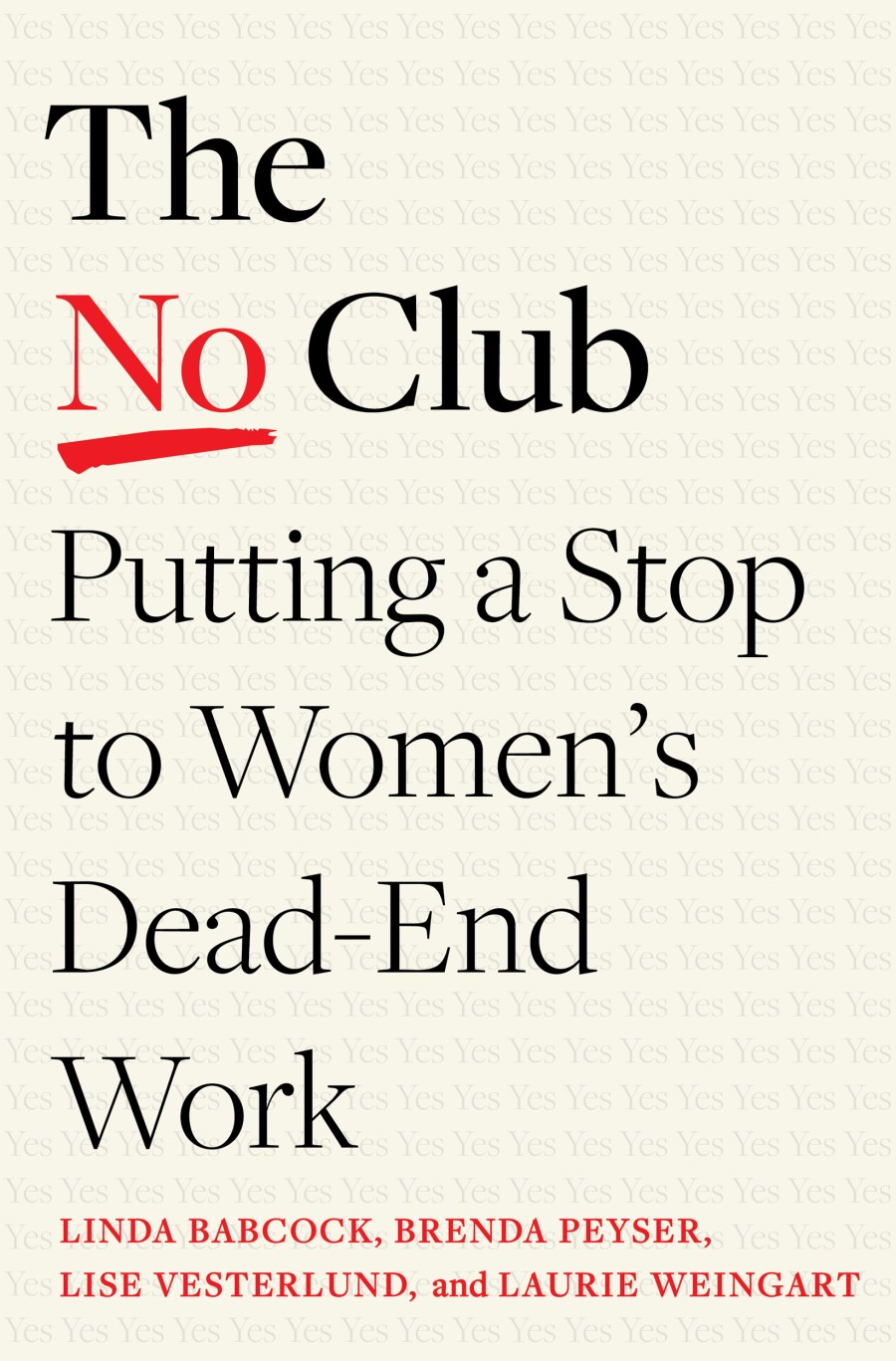
The book, which came out last week, defines what the authors call “non-promotable tasks” – the jobs that matter to your organization but do not advance your career.
Babcock shared with Know Your Value via email how women can decline these dead-end obligations without facing a backlash and instead focus on the tasks that will elevate their careers.
Know Your Value: All of you were high-achieving women doing important work in your fields. Why was the No Club necessary?
Babcock: In 2010, my work life was spiraling out of control. I felt exhausted from working so much while also feeling like my career had stalled. I asked a group of female colleagues who I suspected were feeling similarly to form a club to figure out how to get our work lives back on track.
We pledged to say “no” more often and thus The No club was born. Although we were all accomplished in our fields, we were drowning in our jobs. We realized that was because we were overwhelmed with what we call “non-promotable tasks” (NPTs). This is work that organizations need and that matters to their success, but brings no reward to the person who does the task.
It turns out that we weren’t alone. Women, more than men, do more of these jobs for one simple reason: we all expect them to. Women are asked 44 percent more than men to take on unrewarded work, and they are 50 percent more likely to say yes.
Know Your Value: What are the most common non-promotable work tasks women take on?
Babcock: Helping others with their work, filling in for absences, and organizing and coordinating the work of others. If you’re involved with governance committee work like ethics, safety, diversity, climate, and review committees, that is considered non-promotable. Other non-visible tasks include recruiting, training and mentoring (if you’re not in HR) as well as office housework, like getting coffee and cleaning.
Know Your Value: What does promotable work look like?
Babcock: Promotable work will bring you praise, a raise or a promotion.
These tasks have three important features:
- They are directly tied to the organization’s mission and business goals. A task that has clear and immediate impact on success is promotable: for example, one that increases revenue or profitability, enhances reputation, furthers the mission of a non-profit, or increases market share.
- They are visible. A task is promotable when others can see your efforts or the results of your work.
- They often require specialized skills. You were hired because you brought a set of talents and abilities to the organization. A task that uses those skills will be promotable for you, while a task that many other people can do may not be.

Know Your Value: How can women say no to dead-end work without facing a backlash?
Babcock: When a woman says no, she can be thought of as “not a team player” or “out for herself” because we all expect women to be cooperative and helpful. So saying no can be problematic, putting women in a no-win situation — a situation that men do not have to face because they are less likely to be asked to do unrewarded work and do not face the same negative consequences for saying no. Therefore, organizations that must take responsibility for changing the way they manage NPTs. This can entail simple solutions to redistribute the work such as taking turns doing it, assigning the work to the person for whom it would be promotable, or changing the reward and incentive structure for taking on NPTs. In addition, negotiation expert William Ury has a good recipe for saying no. A positive no follows a “yes, no, yes” strategy. First, say yes to yourself by respecting and prioritizing your time. Second, say no to the NPT (you can provide a brief explanation why). Last, say yes and build your relationship with the person who asked by offering a solution, perhaps nominating someone else who could help (who is not already overburdened with NPTs) or by taking on a much smaller piece of the project that fits better with your work portfolio. Know Your Value: What should employers recognize – and respond to – about the gendered imbalance of non-promotable work? Babcock: Organizations should recognize that they are likely leaving money on the table if they are not using their human capital in the most efficient way. For example, a law firm that assigns a lawyer to administer the summer intern program is losing out on the billable hours (the promotable work) that could have been generated with the time spent on the program. When female lawyers are more likely than male lawyers to do that type of unrewarded work, the firm will see a gender imbalance in who succeeds in the firm. This imbalance will not arise because of differences in skill but due to differences in the type of work they are assigned. Know Your Value: What have you learned personally about decision-making, navigating expectations and being respected in the workplace? Babcock: I’ve learned a lot about cultural norms in the workplace and how large a role they play in holding women back. Because of gendered norms, women are the “go-to” people to do unrewarded work and this can derail their careers. That happened to me and I almost quit my job because of how dissatisfied I had become with the work I was doing. A little awareness about this issue can go a long way and start to change decisions about how non-promotable work is assigned and rewarded. I’ve seen this happen in my own organization and the culture has started to change about who is expected to do unrewarded work. This will ultimately create equal opportunity for both men and women to succeed.
Bianca Brosh Recommended