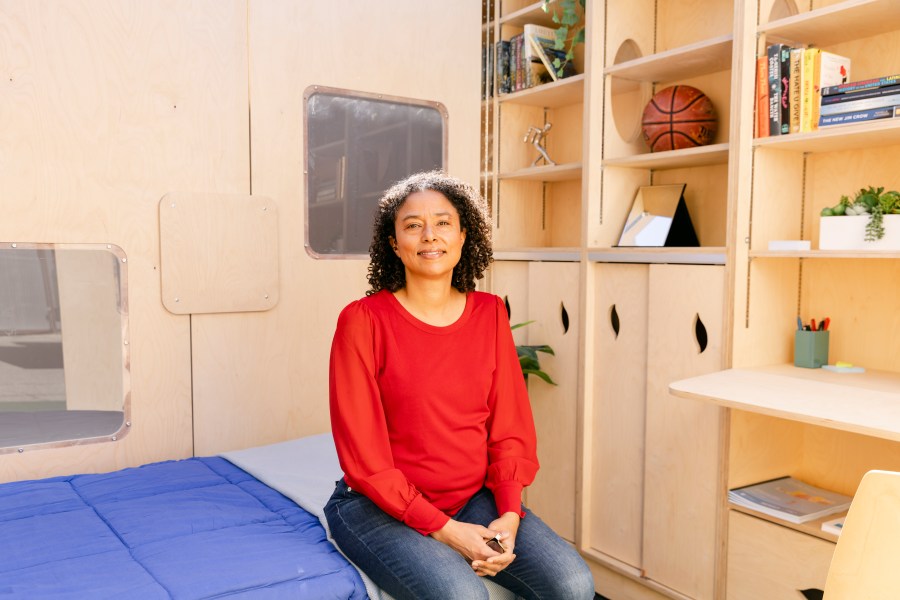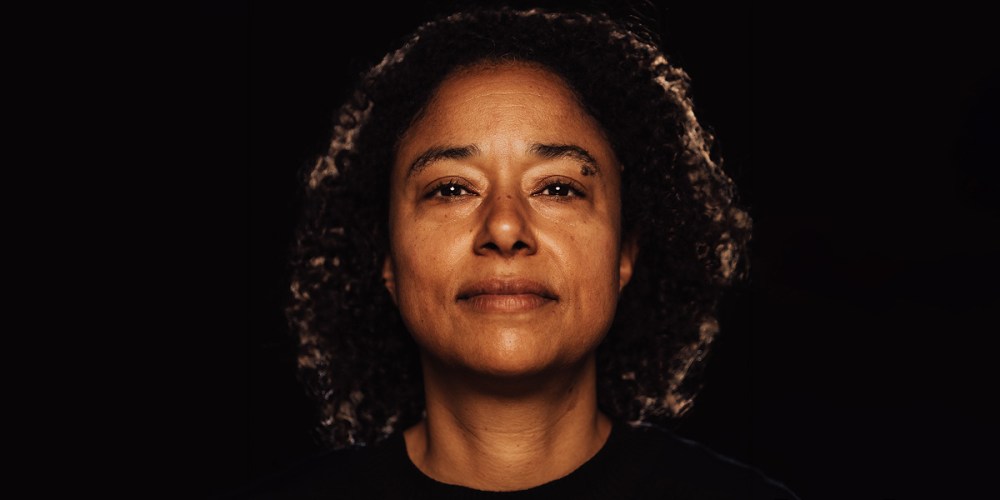
Deanna Van Buren was drawn to architecture before she even heard the term. As the only Black family living in a white Virginia neighborhood, she often found herself playing alone — spending many hours in her basement building cities out of refrigerator boxes and Tinkertoys.
The young Van Buren would go on to become an architect who designed luxury shopping malls, upscale office buildings and even an acclaimed video game. But throughout her career and life, she increasingly felt called to use her talents to create true change in the world around her.
Today Van Buren, 49, is an architect-artist-activist who creates spaces in the spirit of restorative justice. She works to end mass incarceration by designing physical environments that support programs to address the underlying causes, whether it be poverty, racism, a lack of access to education, a dearth of role models or the criminal justice system itself.
Where the U.S. criminal justice system is developed around jail time and other punishments as deterrents, restorative justice seeks to repair the tear in the relationships between the people impacted by crime by understanding victims’ needs and holding the accused accountable in a way that addresses those needs.
The goal of Van Buren’s restorative justice spaces are twofold: Create a space for community members to come together, to learn, and to support one another so people don’t enter the criminal justice in the first place. And if a crime is committed, everyone involved can be encouraged to come together at the center in the spirit of reconciliation.

“From an architect’s point of view, the built environment really impacts us,” Van Buren told Know Your Value in an interview. “We’ve manifested our values, which includes structural racism, into the architecture around us. It matters for us to create spaces that promote wellness and that are built in an equitable way.”
Van Buren is one of the leading activists seeking to unbuild the punitive system and develop a new one around restorative justice — around people coming together, having dialogue and trying to work toward a reconciliation — through her firm Designing Justice + Designing Spaces, which she co-founded with developer Kyle Rawlins. The community spaces DJDS has designed include Restore Oakland, which in 2019 became the first American center dedicated to restorative justice and restorative economics.
Restore Oakland has become a community hub, welcoming people in with its brightly colored exterior. Inside, the center provides community members with all kinds of resources in intentionally designed spaces: Sun-drenched rooms where community groups and clubs can scribble plans on chalkboard-paint walls. Cozy chairs lining the hallway where friends might bump into one another. Conference tables where an executive can offer business skills training or interview tips to local jobseekers. Intimate, comfortable, private spaces where victims of a crime and the accused might come together to talk, and to heal.

The current American criminal justice system has led to mass incarceration — particularly of Black and Latino people, Van Buren said. According to a 2021 report from The Sentencing Project, Black Americans are incarcerated in state prisons at nearly five times the rate of white Americans, while for Latinos it’s 1.3 times. Nationwide, one in 81 Black adults in the U.S. is currently in state prison. In 12 states, more than half the prison population is Black.
“The messaging I got as a young person was that the criminal justice system is not for you. My dad would say driving past the courthouse, ‘You never want to be there. It’s not fair to Black people,’” Van Buren said. “So when I heard about restorative justice, it was like, wait a damn minute. This is justice: this repair and healing.”
Beyond Restore Oakland, Van Buren helped lead the design of the Near Westside Peacemaking Center in Syracuse, New York, including Native American peacemaking processes and inmate feedback into the framework. Other projects include spaces designed for community programs through the nonprofits Restorative Justice for Oakland Youth and Writer’sCorps, as well as workshops in prisons nationwide and a toolkit for reimagining institutional spaces like prisons.
Van Buren had detailed her vision two years before founding DJDS in a 2017 TED talk that went viral, inviting people to imagine a world without prisons. It wasn’t a path she could have foreseen as a child, when restorative justice wasn’t a term, much less a concept. But as she looks back over her career, she can connect the dots.
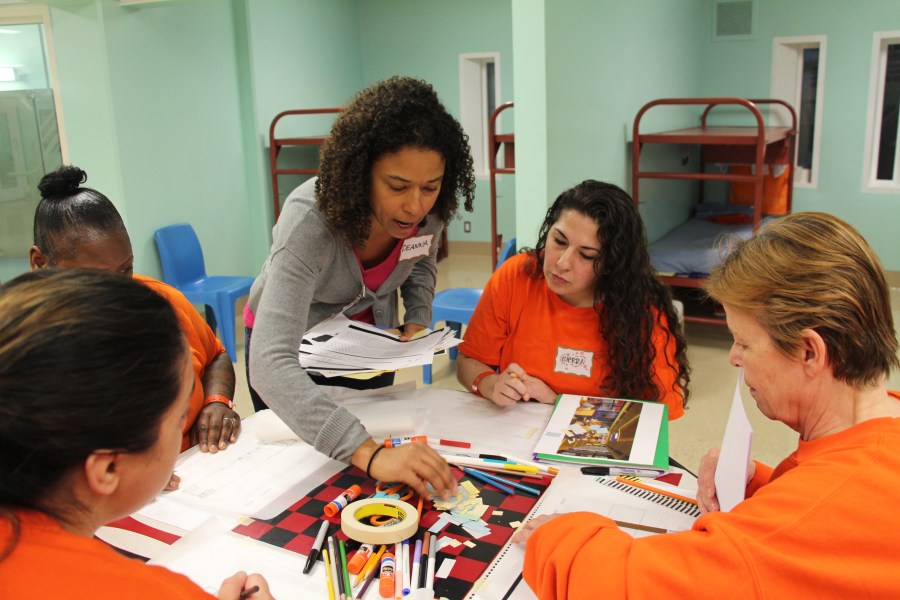
There was no “lightbulb moment” when Van Buren decided she would use her architecture skills to be an activist, she explained. Rather, it was the slow burn of being a Black person moving through the U.S. and later the world at large. As a child, when she wasn’t working with her Tinkertoys in that white Virginia neighborhood, she was visiting family who lived in Black communities in Queens and in Raleigh.
“I grew up with a lot of multiple cultural class contexts and was often isolated,” Van Buren said. “When you’re not indoctrinated into the socialization in the tribe, you tend to start to think outside of it.” It was good training, as Van Buren felt isolated throughout her architecture career — starting with her education at the University of Virginia and Columbia University graduate school in New York City. She was typically the only Black student or one of very few, and received little support from professors. “Especially in grad school, I was questioning the work that we were doing there,” Van Buren said. “Why are we trying to design stuff in China? I don’t have any cultural context for that; we’re near Harlem and I see some huge, gross disparities there. Questioning of how we practice was met with, ‘You’re at the wrong school.’” She pushed forward and became a designer at the firm Eric R. Kuhne & Associates, which later moved her to London and sent her around the world working on projects like luxury shopping malls. She enjoyed the job, which included “starting to get deprogrammed” from American conditioning as well as a collegial, respectful rapport. But after that she moved to work in Australia — where she found rampant racism and discrimination, yet felt she personally was treated with outsize respect because she was American. All the while Van Buren was often the only woman in the room, or the only Black person, or the only person or color, or all of the above. She returned to the U.S. in 2005 and went on to work for several American firms, but her time abroad had solidified the questions she asked in graduate school. Why are we displacing people when we could build on another site instead? Why aren’t we soliciting community member feedback before designing? What could architects do to change the inequities in the built environment? An answer began to form in 2006, when she attended a Martin Luther King Jr. Day event at Taylor Memorial United Methodist Church in West Oakland. Activists Angela and Fania Davis were speaking about “restorative justice,” the first time Van Buren had heard the term. She thought of her Aunt Bertha, who told her as a child: “God doesn’t want you to bury your gifts in the sand.” It all led her here, and to founding DJDS. As for other women who want to do more activism work in their lives or careers, Van Buren said they don’t necessarily need to work for years on the side with the goal of launching their own businesses. “What’s key is consistently carving out time to do something you’re excited about, whether it’s volunteering or otherwise helping build up a community,” Van Buren said. “Ask yourself, what am I doing to feed my soul? Small things can make an impact, and there are lots of opportunities to engage.”
Julianne Pepitone
Julianne is the senior technology writer for NBC News Digital, covering large consumer tech companies' (Apple, Google, Facebook, etc.) news and trends, as well as cybersecurity. She also writes and appears in original videos for NBCNews.com, and speaks as an expert guest on live shows across the NBC and MSNBC networks.
She previously worked at CNNMoney.com where she covered large techs from a business angle, as well as the intersection of the tech and media industries.
In addition to NBC and CNN online properties, Julianne has written for several national magazines and online publications including Esquire, Self, Popular Mechanics and Cosmopolitan. Recommended