Women are making gains in the workplace. But the picture is complicated.
That was the takeaway from LeanIn.org and McKinsey’s annual Women In the Workplace report, which came out this week. It showed women today make up 29 percent of C-suite roles, up from 17 percent in 2015.
Yet that progress is fragile. Researchers also found that too few young women — especially women of color — are advancing to management positions in comparison to their male counterparts.
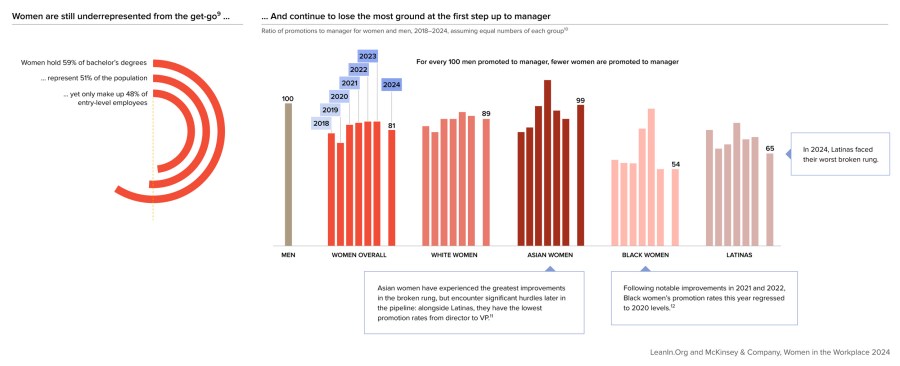
Despite women making up half the population (51 percent) and holding nearly two-thirds of bachelor degrees (59 percent), young women make up less than half of entry level hires (48 percent). And for every 10 men that get their first promotion, only eight women do.
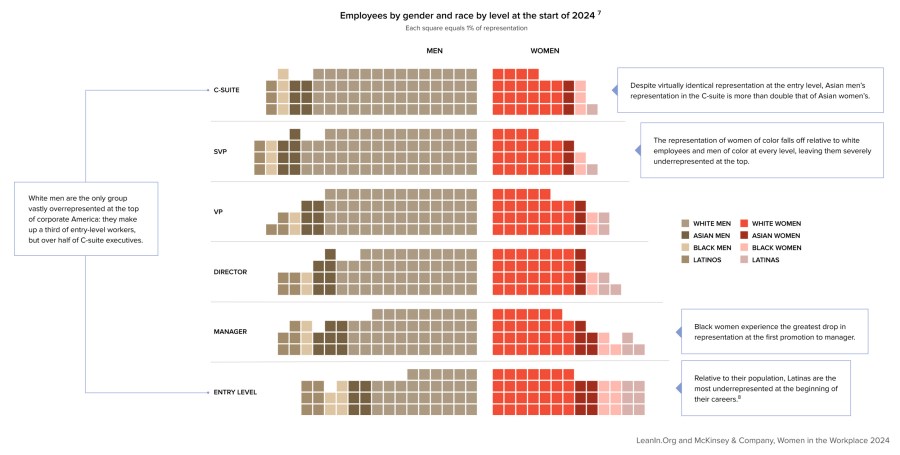
And for every 100 men promoted to management, 65 Latina women received the same opportunity. For Black women it was 54. Despite notable improvements in 2021 and 2022 for Black women, their promotion levels have fallen behind to 2020 levels.
When I wrote “Earn It!” in 2019 alongside Mika Brzezinski, we spoke to many young women experiencing a similar predicament. They would see their male counterparts, whom they started out with, get promotions and pay raises — all while they stayed in the same roles.
And it’s not because they’re not asking for greater roles and more money. Young women, particularly women of color, are highly ambitious — eight in 10 have sought out a promotion.
As a woman in my early 30s, I’ve learned to know my worth and act on it. That’s in large part due to the number of women who have come before us and have fought for an even playing field.
Take, for example, women like Mika who started the Know Your Value movement to encourage women to better advocate for themselves. She detailed her journey and provided tools in her 2011 book, “Know Your Value.” Or Sheryl Sandberg, who in 2013, founded LeanIn.org. The former chief operating officer for META wrote “Lean In,” which served as a guidebook for women in corporate America to assert themselves at work.
According to Sandberg, women won’t have a problem with ambition. They have a problem with “the broken rung” — the term used to describe how entry level men are promoted to manager roles at higher rates than women.
“There’s no way to get to the C-suite when you fall behind the first promotion to manager,” Sandberg told me.
“Men get promoted for potential, women get promoted for what they’ve already proven. You can’t prove you’re a good manager until someone lets you be a manager. So it makes sense that that first step up is where women really fall down,” Sandberg added.
Factors like getting stuck with administrative work, being confused as the secretary in company meetings, and unfair stereotypes placed on women with intersecting identities (for example, the “hysterical” Latina or the “angry” Black woman), are just some of the compounding obstacles I’ve written about that further hinder early career growth for women. Sandberg added that gender biases start early and are deeply ingrained, “You can walk onto the playground and say ‘that little girl has executive leadership skills’, and everyone laughs but it’s not funny. You say ‘that little boy has executive leadership skills’ and everyone takes it really seriously and so that bias against ambition, that bias against women getting into leadership roles, is incredibly deep.” The report also showed a surprising new insight — young women battle with ageism in their own career advancement. “When I when I hear ageism I think of bias against older women maybe because I’m older, but actually women or younger women are facing even more,” Sandberg said. The report showed young women under the age of 30 are more likely to say their age has played a role in missing out on opportunities (49 percent) compared to men their own age (35 percent). This makes sense, with the broken rung effectively telling women “to wait” for their first promotion while the research shows their male counterparts don’t have that same experience. Overall, we have a long way to go. We have approximately 50 years — roughly two generations — until we achieve real parity in the workplace, according to the data. LeanIn.org co-founder and CEO Rachel Thomas said if we want to speed up that timeline it means “really getting young women, particularly young women of color into leadership roles. It means [doing] the hard, systemic, sustained work of changing the entry level and changing that first promotion to manager because if not, women are left behind at the starting line” Daniela Pierre-Bravo is a journalist, author, and founder of Acceso Community — a mentorship program for professional women. She is the co-author of “Earn It” with Mika Brzezinski. Her solo book, “’The Other: How to Own Your Power at Work as a Woman of Color,” is out now. Follow her on Twitter and Instagram @dpierrebravo.
Daniela Pierre-Bravo
Daniela Pierre-Bravo is a journalist and author and founder of Acceso Community. She is a co-author of “Earn It” with Mika Brzezinski. Her solo book, “’The Other: How to Own Your Power at Work as a Woman of Color,” is out now. Follow her on X and Instagram @dpierrebravo. Recommended