








As calls for congressional input on a possible strike on Syria grew louder, Obama administration officials said they would brief ranking members of both houses on Thursday. The administration is also expected to release–as Secretary of State John Kerry promised on Monday–further evidence of the use of chemical weapons by the Bashar al-Assad’s regime to the public possibly Thursday.
President Obama said in an interview Wednesday that there was little doubt Bashar al-Assad’s regime has used chemical weapons against civilians and that the U.S. was consulting with allies to coordinate a response.
“I have no interest in any kind of open-ended conflict in Syria, but we do have to make sure that when countries break international norms on weapons like chemical weapons that could threaten us, that they are held accountable,” Obama said in an interview with Gwen Ifill for PBS NewsHour.
Obama said that his administration has been “very restrained” in Syria because officials have determined that direct military engagement would not be a good approach to stabilizing the region. While the U.S. has remained diplomatically engaged in Syria, the president added that the use of chemical weapons would change the calculus on the country’s approach.
“So what I’ve said is that we have not yet made a decision, but the international norm against the use of chemical weapons needs to be kept in place,” he said. “And nobody disputes—or hardly anybody disputes that chemical weapons were used on a large scale in Syria against civilian populations.”
The interview came as House Speaker John Boehner questioned how a military action in the region would be carried out.
“I respectfully request that you, as our country’s commander-in-chief, personally make the case to the American people and Congress for how potential military action will secure American national security interests, preserve America’s credibility, deter the future use of chemical weapons, and, critically, be a part of our broader policy and strategy,” Boehner wrote in a letter Wednesday. “In addition, it is essential you address on what basis any use of force would be legally justified and how the justification comports with the exclusive authority of Congressional authorization under Article I of the Constitution.”
Article I of the Constitution contains the War Powers Clause, which states that only Congress may declare law. The last time Congress declared war was in 1941 for World War II.
Earlier, Britain urged the United Nations Security Council to authorize the “necessary measures to protect civilians” in Syria after Western allies, including the United States, accused al-Assad’s regime of using chemical weapons in an attack that killed hundreds and wounded thousands last week.
British Prime Minister David Cameron said a draft resolution condemning the attack would be presented to the five permanent members of the Security Council as they met in New York Wednesday morning.
The Obama administration is considering a limited missile strike against Assad as early as Thursday. It would not be without precedent for it to go ahead with the strike without UN approval, but some speculation has suggested the U.S. would wait until the UN inspectors now on the ground investigating the site of the most recent suspected chemical weapons attack have left.
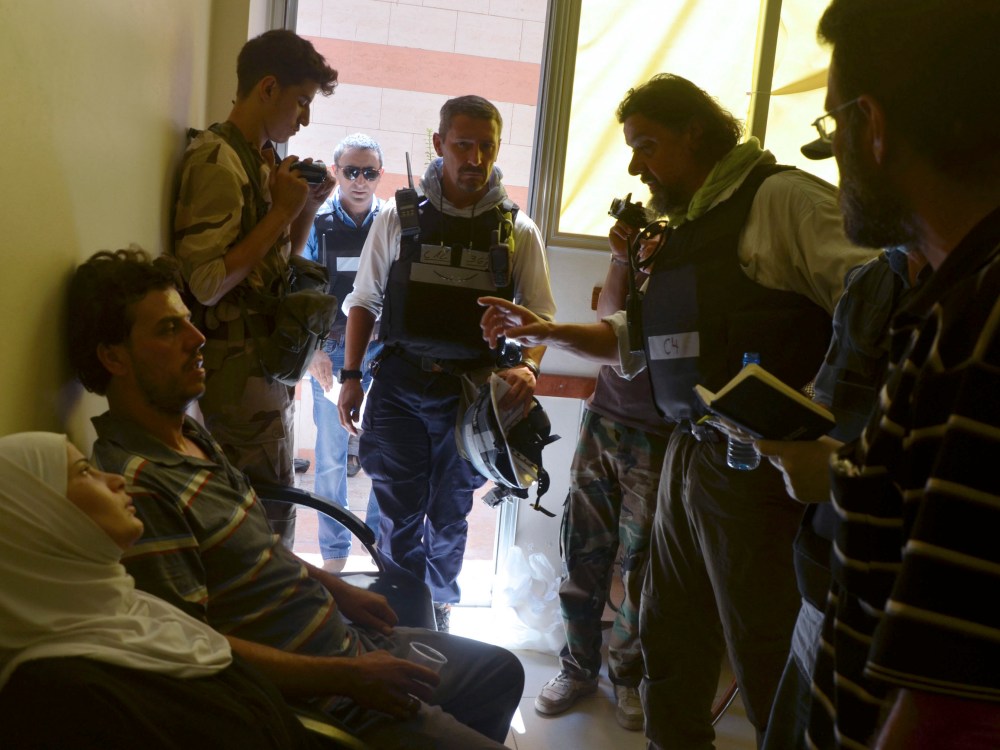
U.N. Secretary General Ban Ki-moon urged world powers to respect their safety. One of the vehicles for the U.N. team was shot at by an unknown sniper during their first day of inspections on the outskirt of Damascus. The U.N. team is expected to depart on Sunday.
In recent days, the U.S. has huddled with allies, placing more than 80 phone calls to leaders around the world in an effort to rally support for retaliatory measures toward Assad’s regime that is engaged in an ongoing civil war that has left more than 100,000 Syrians dead and millions more displaced.
The Arab League on Tuesday joined the U.S. and allies in blaming Assad for the chemical weapons attack launched on Aug. 21, but fell short of endorsing military action. The U.N. and Arab Lague envoy for Syria, Lakhdar Brahimi, told reporters in Geneva Wednesday, “I think international law is clear on this. International law says that military action must be taken after a decision by the Security Council.” Russian Foreign Minister Sergei Lavrov warned that U.S. military intervention “will lead to the long-term destabilization of the situation in the country and the region,” on Wednesday. Defense Secretary Chuck Hagel said Tuesday that the U.S. military is prepared to act. “The options are there, and the United States Department of Defense is ready to carry out those options,” Hagel said. He stressed, as has the White House, that action would occur “in coordination with international partners.” The British Parliament is expected to vote Thursday on possible military action as well. Notably, foreign travels will keep President Obama away from the White House beginning Tuesday and through next week, as he first visits Stockholm, then St. Petersburg for the G-20 summit. A strike while Obama is on Russian turf would strain an already tense relationship, after Obama canceled a meeting with Russian President Vladimir Putin amid controversy over harboring fugitive U.S. national security leaker Edward Snowden. NBC News’ Andrea Mitchell and Kristen Welker contributed reporting to this article.
Erin Delmore Recommended


