








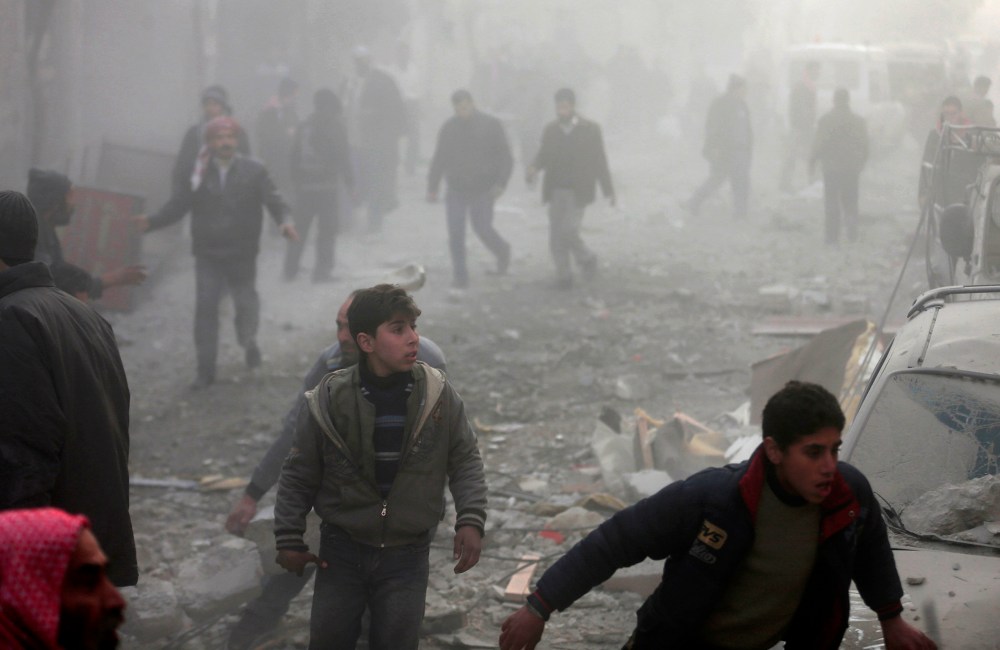
As the Syrian civil war closes in on the three-year mark, a Senate Judiciary subcommittee convened Tuesday to discuss the path forward in what Chairman and Illinois Democratic Sen. Dick Durbin called “the world’s worst ongoing humanitarian crisis the worst refugee crisis since the Rwandan genocide of 1994, and perhaps since WWII.”
Durbin argued that the U.S. has a “moral obligation” to assist in Syria and to “find a path to stability in the region,” but he criticized the relatively small number of people who have been granted refugee status in the U.S. While one-third of Syria’s population is displaced internally, more than 2 million Syrians have fled their country, straining the resources of neighboring nations. Under the influx of Syrian refugees, Jordan’s population has grown by 9%, and Lebanon’s by 19%, according to Amnesty International. The organization also reported that these two nations — along with Turkey, Iraq and Egypt — neighboring Syria host 97% of the 2.3 million registered refugees, more than half of whom are children.
“Schools have moved to double shifts,” Assistant Secretary of State for Population, Refugees and Migration Anne Richard said in testimony. “Rents have risen. Wages have fallen.” She cited water shortages in Jordan and Lebanon, and hospitals crowded with Syrian patients.
Durbin called on the U.S., which he said only accepted 31 Syrian refugees in the last fiscal year, along with the U.K. and the Gulf countries, to “step up and do their part” by hosting more Syrian refugees. He said that U.S. law prohibiting refugees who have provided support to a rebel group “would prevent a Syrian who gave a cigarette or a sandwich” to an opposition fighter from resettling in the U.S. – despite the fact that the U.S. is providing support to anti-government forces.
Acting Deputy Assistant Secretary of Homeland Security for Immigration and Border Security Molly Groom called refugee resettlement “a cornerstone of our national character” that “reflects our country’s commitment to humanitarian ideals.” Syrians are granted refugee status after extensive consideration including interviews and security checks, she added.
Richard attributed the relatively small number of refugees in the U.S. to “our hope, now discarded … that they would be able to go home quickly.”
“We are working very quickly now to respond to referrals from UNHCR and start that process of bringing in refugees,” Richard said, calling the U.N. committee’s stated goal of resettling 30,000 refugees this year “ambitious.” The U.N. announced Tuesday that it would stop updating the death toll in Syria, which has climbed well beyond 100,000 since the spring of 2011. “With the situation on the ground growing ever more complex and dangerous, and without access into the country to conduct fact-finding on the ground, it has become increasingly difficult for us to source and analyse the casualty figures in order to update them,” Rupert Colville, a spokesperson for the Office of the High Commissioner for Human Rights, said in a statement obtained by NBC News. A first portion of Syria’s chemical weapons arsenal was removed from the country’s Mediterranean port of Lattakia via a Danish commercial vessel Tuesday under a deal brokered by the U.S. and Russia last summer. The agreement was crafted amid western accusations that Syrian President Bashar Assad used sarin nerve gas against civilians in an Aug. 21 attack outside Damascus that killed nearly 1,500 people, including more than 400 children.
Erin Delmore Recommended


