








Updated 9:50 p.m.
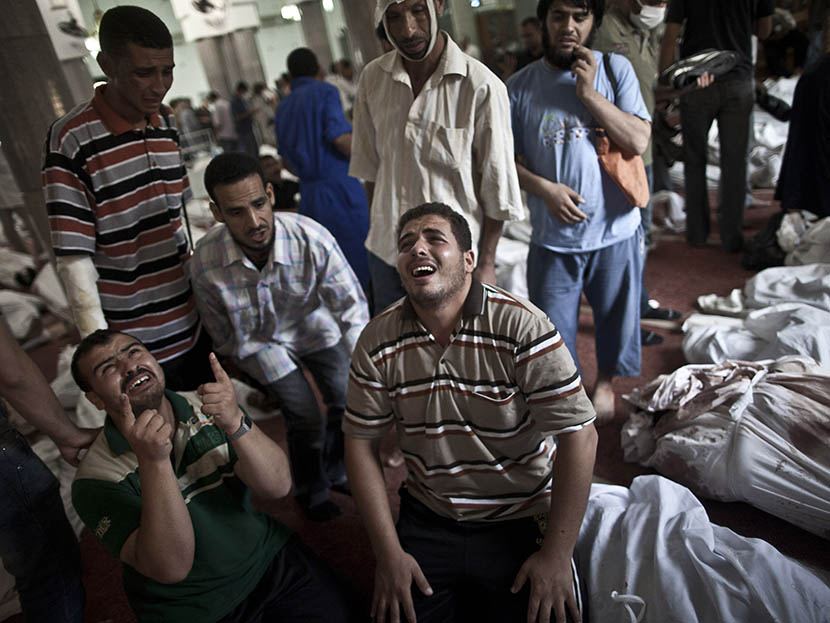
President Obama strongly condemned Egypt’s bloody crackdown against Muslim Brotherhood supporters that has so far left 638 people dead and thousands more injured but stopped short of saying the U.S. would pull foreign aid from the country. Instead, he canceled a joint-military exercise with the Egyptian army scheduled for next month and said his administration would continue to “assess” the situation for other possible punitive actions against the country.
“We’ve sustained our commitment to Egypt and its people,” Obama said Thursday in remarks. “But our traditional cooperation cannot continue as usual when civilians are being killed in the streets.”
The United States sends $1.5 billion in aid every year to Egypt, a strategic ally in the Middle East, second only to Israel.
“The Egyptian people deserve better than what we’ve seen over the last couple of days,” he continued. “We call on those who are protesting to do so peacefully.”
The interim government issued a fiery rebuttal to Obama’s remarks in statement read on state TV, NBC News reports.
“The presidency fears Obama’s statements are not based on facts and encourages violence and flourishing of armed groups,” the statement from interim President Adli Mansour said.
Obama, who had not publicly addressed Egypt since the military ousted President Mohamed Morsi, spoke from his vacation on Martha’s Vineyard. Despite dispatching Secretary of State John Kerry to strongly condemn the violence on Wednesday, Obama had been under growing pressure to address the situation as the death toll continued to rise. In separate editorials Thursday, both the New York Times and Washington Post urged President Obama to cut off military aid to the country.
Although he canceled the Bright Star military exercise between the U.S. and Egypt, Obama did not detail who from his administration would lead the peace efforts. Rather, the president indicated that his national security team, including National Security Adviser Susan Rice, were monitoring the situation to determine, “further steps that we may take as necessary with respect to the U.S.—Egyptian relationship.”
Most tellingly, Obama did not refer to Morsi’s ouster by the military as a coup. Had he used the word “coup,” Obama would have legally jeopardized U.S. aid to the country—a strategic ally and stabilizing force in the Middle East. By law, the United States cannot give aid to countries where militaries play a “decisive role” in removing democratically elected officials, the Washington Post reported.
While acknowledging that deposed President Mohammed Morsi’s administration had not been inclusive, the president emphasized the United States would not takes sides in the democratic battles of the country.
“America cannot determine the future of Egypt,” Obama said. “That’s a task for the Egyptian people…We want a peaceful, democratic, prosperous Egypt, that’s our interest. We recognize that change takes time.”
At a State Department briefing Thursday, Jen Psaki, a spokeswoman, reflected the White House’s cautious approach to Egypt in the weeks ahead.
“We are evaluating our aid and that is ongoing, but at the same time continuing to engage,” Psaki said, adding that the end goal is for a sustainable Egyptian democracy.
Defense Secretary Chuck Hagel called Egypt’s minister of defense, Abdel Fattah Al-Sisi, Thursday to follow up on the president’s decision to cancel Bright Star.
“The Department of Defense will continue to maintain a military relationship with Egypt, but I made it clear that the violence and inadequate steps towards reconciliation are putting important elements of our longstanding defense cooperation at risk,” Hagel said.
Ambassador Dennis Ross, the special Middle East coordinator under President Bill Clinton, said after the president’s remarks that the U.S. has a difficult strategic balance to strike in Egypt. “How do we ensure that we still have a voice that many in Egypt will listen to?” Ross said of using aid leverage to stabilize the country. Ross added that, prior to the Arab Spring of 2011, Egypt had functioned under 40-year military dictatorship that prevented the development of civil society. “We’re working in an environment that doesn’t lend itself very well to build a coalition,” he said. The bloody crackdown against supporters of Morsi began Wednesday morning when government security forces stormed two camps resulting in the deaths of 525 people. Military-backed government officials quickly declared a month-long state of emergency, prompting interim Vice President Mohamed Mustafa El Baradei to resign his post. Authorities also instituted a military-curfew for everyone except journalists across the country’s major cities. By Thursday morning, the Morsi faction had struck back against the government attacking the Giza Governor’s building a short distance from Cairo. Protesters there attacked the building with Molotov cocktails and live ammunition, according to police. The Egyptian Initiative for Personal Rights reported that 20 Christian Coptic churches had been burned with seven more across the country damaged, NBC News reported. An attack from protesters at an army checkpoint in the city of Arish in North Sinai killed seven soldiers Thursday, Moyheldin reported. Egypt’s Ministry of the Interior authorized officials to use live ammunition in order to protect government buildings. Tensions between the military government and protesters had been building over the six weeks since Morsi—Egypt’s first democratically elected president—was ousted July 3. At the time, the Obama administration said that it would not suspend the $1.5 billion in aid to Egypt, saying that the situation was “complex” and that pulling the funds could in fact result in worse conditions for the Egyptian people. The president faced pressure to pull the funds from officials including Republican Sen. Lindsey Graham of South Carolina, who said that Egypt’s instability could provide an opening to al Qaeda and pose a significant national security threat to the United States. France, Germany, and England held meetings with their Egyptian ambassadors Thursday and cautioned against a civil war. Foreign ministers with the European Union said they would meet Friday to discuss the situation. Previously, the EU’s foreign affairs chief, Catherine Ashton, had urged the Egyptian government to end the state of emergency. Within Egypt, however, at least one press outlet welcomed the crackdown, the Al-Akhbar newspaper ran the headline “The nightmare of the Brotherhood is gone,” according to The Telegraph. The United Arab Emirates also signaled support for the crackdown, praising security forces for having “exercised maximum control.”
The place for in-depth analysis, commentary and informed perspectives. Recommended


