








All eyes were on the Supreme Court this week for signs that the nation’s same sex couples might soon be granted the same rights as their opposite sex counterparts. Yet another social justice issue that many thought had been resolved decades ago could once again take center stage in the court’s hard look at divisive cultural issues. Forty years after the highest court in the land handed down its landmark decision in Roe v. Wade, new restrictions in a string of states could send abortion back to the Supreme Court justices.
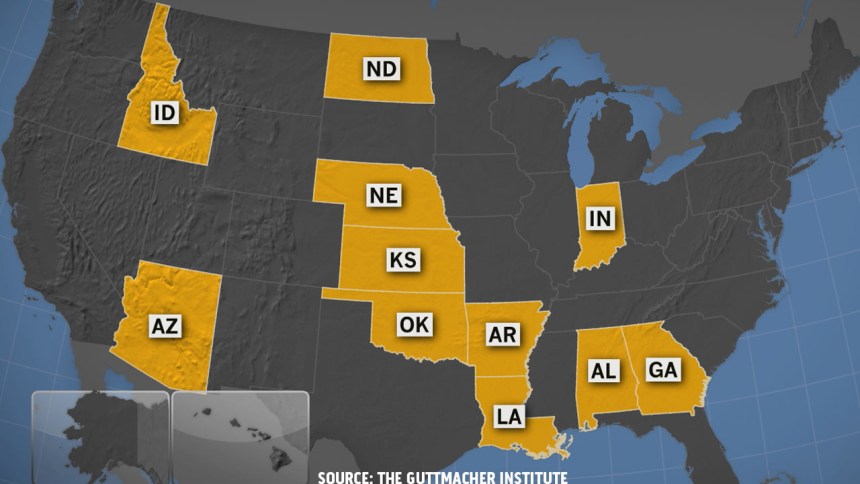
As the justices weighed the future of same sex marriage, efforts to reverse the court’s ruling on abortion flew relatively under the radar. On Tuesday, the same day the court heard arguments over Proposition 8, North Dakota passed a law that would ban abortions as early as six weeks after fertilization. Earlier this month, Arkansas enacted a law to ban abortions after 12 weeks of pregnancy.
These states are just the latest examples of efforts to chip away at Roe v. Wade. In just the past two years, 11 states have enacted bills to ban abortion earlier than the time established by the court 40 years ago. Alabama, Georgia, Idaho, Indiana, Kansas, Louisiana, Nebraska and Oklahoma have all enacted bans on abortion 20 weeks after fertilization. Arizona’s law would prohibit abortion after 18 weeks of fertilization.
The Supreme Court’s 7-2 decision in 1973 declared that abortion is only illegal once a fetus is viable outside the womb, typically about 24 weeks. Under those conditions, all of these state bans are in effect unconstitutional. Those caught up in the debate are left wondering not if, but when the court will revisit the issue.
“Whether it’s a North Dakota case or another, something will be going to the Supreme Court,” Planned Parenthood president Cecile Richards told Mitchell Reports on Thursday.
After signing North Dakota’s sweeping new law, which could also close the state’s only abortion clinic by setting new regulations, Republican Governor Jack Dalrymple called the law a test on the limits of Roe v. Wade. “Although the likelihood of this measure surviving a court challenge remains in question, this bill is nevertheless a legitimate attempt by a state legislature to discover the boundaries of Roe v. Wade,” Dalrymple said in a statement. “Because the U.S. Supreme Court has allowed state restrictions on the performing of abortions and because the Supreme Court has never considered this precise restriction…the constitutionality of this measure is an open question.” Not all efforts to restrict abortion access challenge Roe v. Wade. In fact, many of the latest state provisions aim to end abortion by drawing outside the lines of the Supreme Court’s decision. In Virginia this week, Republican Governor Bob McDonnell introduced an amendment to bar abortion from insurance coverage under the state’s federally run health care exchange. Roe v. Wade never addressed the issue of insurance coverage, but merely the legality of abortion itself. Republican lawmakers across the country, most notably in Texas, have waged broader assaults on reproductive health by seeking to close clinics that provide birth control counseling. For women’s rights advocates, efforts to restrict abortion access aren’t just an affront on women’s choice, but a threat to women’s lives. “We don’t want women in North Dakota or any other state to resort to desperate measures because they can’t legally go to a doctor,” said Richards. Unfortunately, she told Andrea Mitchell, “Governor Dalrymple has managed to make North Dakota now the most unsafe state in the country for women’s health.”
Yardena Schwartz Recommended


