








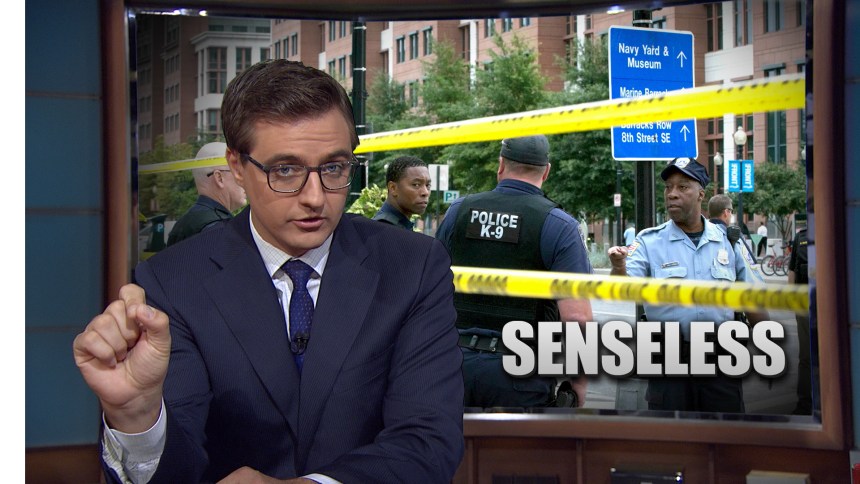
When I heard the very first reports of the Navy Yard shooting yesterday on my way to work, there were headlines about three shooters dressed in fatigues on a naval base. And my first awful thought was that we were witnessing some kind of “Homeland”-style domestic terror cell inside the Armed Services. I reeled at that and imagined what the fallout and investigations and recriminations would look like, what a huge, dominating story it was likely to be and how we would cover it.
Then, as the morning rolled on, that initial reporting was shown to be wrong. There weren’t three shooters in military fatigues; there was a single shooter, a former Navy reservist and current contractor who it now seems had a pretty long history of erratic behavior, gun ownership and mental health issues.
And as the story migrated, the scope of it shrank. Not because the horror of the act shrank, or the death toll, which was three times higher than the Boston Marathon bombing, but because of the way we as a society and political system have come to look at this kind of violence.
President Obama issued a proclamation ordering flags flown at half-staff, “as a mark of respect for the victims of the senseless acts of violence.” It’s a phrase we have heard after similar mass shootings. What exactly, I always wonder, is the opposite of senseless violence? The kind of violence we can comprehend and make sense of. Violence tied to some ideological commitment or strategic aim no matter how morally heinous.
Bashar al-Assad allegedly gassing 1400 Syrians isn’t senseless because we understand exactly what he was doing. He was attempting to brutally win a civil war and punish anyone even remotely associated with the rebels.
Al Qaeda murdering 3000 Americans in 2001 wasn’t seen as senseless. It was seen as an act of war and mass murder executed by evil radicals who wanted to destroy America and make its citizens cower. It had purpose–as monstrous as that purpose was.
When we encounter violence we see as having a purpose, we marshal resources and political will to fight it or prevent it or punish its perpetrators. When we encounter the “senseless,” we succumb to paralysis. We shake our heads and summon our pity, the same way we do when we hear a story of a friend’s cousin who died at 30 of cancer, or a child hit by a car or someone struck by lightning.
President Obama was asked about this feeling of helplessness during an interview with Telemundo’s Jose Diaz-Balart Tuesday. And yet those gun control laws are not forthcoming.
It is the great success of gun advocates to place not just mass shootings but most gun deaths into the senseless category. There were more than 31,000 of them in 2010, the most recent year on record.
But human progress requires that we simply do not accept the category of “senseless” as something that cannot be changed. We spend billions of dollars on cancer research every year because we refuse to accept that cancer will continue to steal people in their prime from us, and we have developed all kind of laws and engineered solutions to make cars and roads safer and safer over the years.
Heck, we even work to prevent deaths from lightning. The NFL showdown between the Niners and Seahawks was put on pause for an entire hour while a thunderstorm rolled through the area. They stopped the game to protect the players’ safety. But then again, lightning doesn’t have a lobby, now does it. What happened yesterday will happen again. In fact, the statistical evidence is pretty terrifying. A study on mass shootings by The Atlantic concluded that “if such incidents occur at the same pace for the rest of President Obama’s term as they have since 2009, there could be 14 more before he leaves office.” And yet, when the president spoke briefly about the Navy Yard shooting Tuesday before making remarks on the state of the economy five years after the economic collapse, the reaction was fast and furious. Beltway media and Republican opponents were quick to criticize him. One Republican Party official said, “Most expect the president to act as a consoler-in-chief in the face of tragedy, not to take to the podium and launch into a partisan tirade aimed at his political opponents.” The fact is, the president was just acting the way Republicans, and the NRA, and the elite media have conditioned all of us to act. It’s a tragedy. We shake our heads. Move on. It’s senseless. Because if we try to make sense of it, we’re not going to like what we find.
Chris Hayes hosts “All In with Chris Hayes” at 8 p.m. ET Tuesday through Friday on MS NOW. He is the editor-at-large at The Nation. A former fellow at Harvard University’s Edmond J. Safra Foundation Center for Ethics, Hayes was a Bernard Schwartz Fellow at the New America Foundation. His latest book is “The Sirens’ Call: How Attention Became the World’s Most Endangered Resource” (Penguin Press). Recommended


