








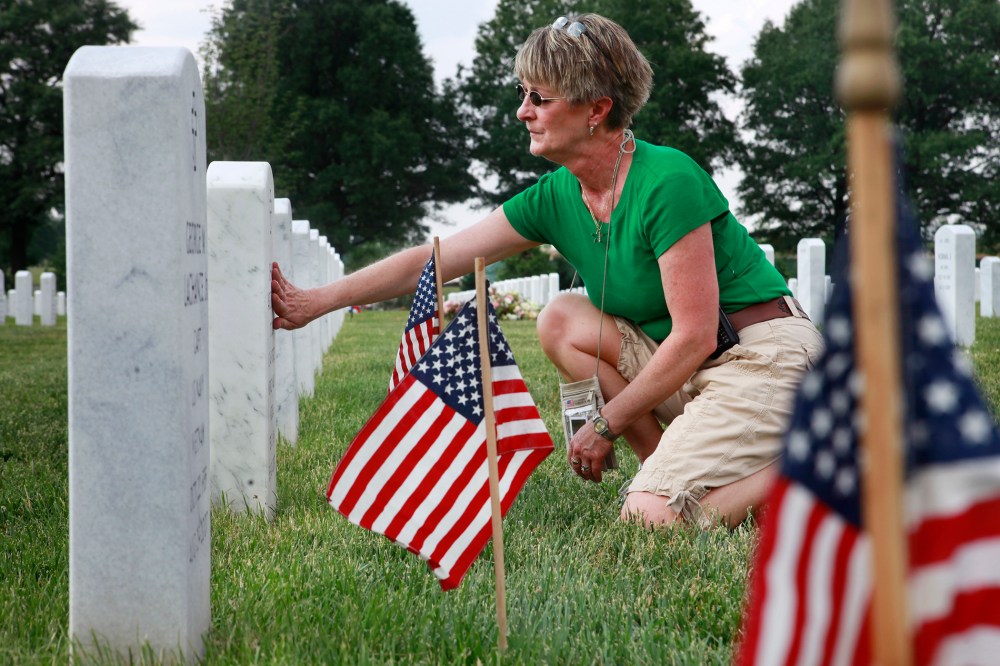
Reneé Britton wears a striking gold pendant on a chain around her neck — and for the last decade, it has attracted attention.
“A lady told me, ‘Your necklace is really pretty. Where did you get it from?’” Britton recalled of an encounter at a Dillard’s department store near her home in Shreveport, La. “And I told her, you don’t really want this jewelry. Not at all.”
Britton wears the gold star pin that she was given by the Army in honor of her son, Sgt. Bernard Sembly, who died from small arms fire in Baghdad on May 19, 2005. He left behind an 18-month-old son.
The symbol of remembrance, presented to family members of the men and women killed on active duty, goes largely unrecognized, survivors say, adding that it has fallen to them to educate the public on its meaning – and the human cost of war.
The U.S. Army is looking to showcase the pin’s significance in a 30-second ad that will air during pre-game programming ahead of the Super Bowl on Sunday. On a day when game-time ads can cost as much as $4 million a buy – or $133,000 per second – the public service announcement is running on air time donated by FOX between 11:30 a.m. and 3:30 p.m.
Fifty-two surviving mothers and fathers, brothers and sisters, and sons and daughters filmed three versions of the ad, which was produced by Newport Beach-based Aperture Films in southern California last fall. MSNBC got an early look at the ad, which shows family members wearing the pins and some holding pictures of their loved ones. In documentary-style, straight-to-camera interviews, each person says whom he or she wears the pin for and talks about the sacrifice their family member made.
Family members of fallen soldiers said they hope the ad will resonate with viewers.
“My biggest fear is that when they show this, people are going to be so into watching the commercials that they’re not really going to pay much attention… [that] they’re going to walk away and not see what the message is all about,” said Emily Toro, who lost her son, Private Isaac Cortes, in Iraq in 2007. She is an active member of the American Gold Star Mothers, Inc., an organization of mothers who have lost children in combat.
Lt. Col. Rebecca Eggers lost her husband, Capt. Daniel Eggers, in Afghanistan on May 29, 2004. Eggers said she thinks the ad could spark a wave of recognition, starting with her acquaintances and her sons’ classmates.
“I do know a survivor, that’s what that [pin] means,” Eggers said, imagining what people might think on Sunday.
“I think people just don’t realize, maybe there is somebody that lives right next door to me or in the next town that has a parent that was killed, or a husband, or a wife,” she said.
Philip Warman grew up familiar with the Gold Star Pin. His grandmother wore one in memory of his paternal uncle, whom he was named after. The elder Warman was killed in the South Pacific during World War II.
“I thought they didn’t have them anymore,” Warman said. He wears the pin for his wife, Lt. Col. Juanita Warman, who was killed in the mass shooting at Fort Hood in November 2009.
“For many years, I think it just sort of got eclipsed,” Warman said of the pin’s significance during and after the Vietnam era, “as did all things military.”
“But then I started seeing the pin again just recently, I guess since 9/11. I was glad to see it’s still around and it still meant something,” he added.
The symbol dates back to 1918, when families would pin a gold star over a blue star on flags, and mourning mothers would wear gold stars on black arm bands. The lapel pins were introduced in 1947.
Survivors say they wear the pin “above the heart” on a collar, a lapel, or a chain. Britton wears hers during the months of October and May, to honor her son Bernard’s birth and death. Others said they wear the pin for special events, at memorials, and on holidays like Veterans Day, Memorial Day, and Independence Day. “It isn’t exactly the American public’s fault they don’t know what [the pin] means if they never see it,” Eggers said. She wears her pin on her dress uniform and said her counterparts at the Pentagon often don’t recognize it. “For years and years I just had it in my jewelry box. And I think part of it is because people ask, and I didn’t feel like I was in a place to want to answer anybody who asked for a long, long time,” Eggers said. Billy Eggers, her youngest son, was 3 years old when his father was killed in Afghanistan. Today he’s 13. “When people ask me, I just tell them that my dad was killed and usually they’re silent. I kind of feel like they don’t…they don’t know,” the seventh grader said. “I don’t think they realize people are being killed. They just think they’re fighting…and they come back.” Eggers said he does not know anyone at school with a family member serving in the military. According to a survey published in November 2011 by the Pew Research Center, nearly 80% of Americans between the ages of 50 and 64 said they have a family member who served in the military. For 18-29 year olds, that dropped to 33%. Less than 1% of the U.S. population has been on active duty since Sept. 11, 2001. During WW II, nearly one in 10 Americans served. “Where we are right now, there’s not a lot of military, not a lot of gold star families,” said Rebecca Eggers, who is currently stationed at the Pentagon. “When we were at Fort Knox, it was different. They went to school on post. When we were in San Diego, I lived in Kuwait, and they were in San Diego with my parents for a year, there was no real tie to the military. So it is interesting to see when we move around, even still being in the military, how different the feel is for different cities.” She described the Washington, D.C. area as “out of touch.” “Overall, I think that a lot of the American public does not want to believe that there are people getting killed every day,” Eggers said. Update: The PSA will now air within 25 min prior to kick-off
Erin Delmore Recommended


