








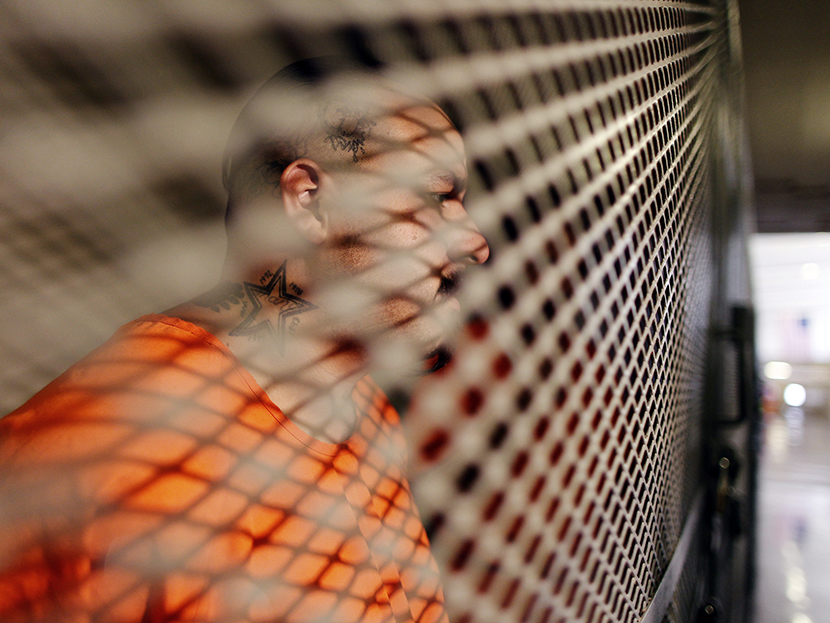
Walter Fortson is a young man with impressive credentials: He graduated with honors from Rutgers University this year and is headed to the University of Cambridge on a prestigious Truman scholarship.
But on a typical job application, the first thing an employer might notice about Fortson is that he’s an ex-felon.
Fortson, 28, served two years in prison for dealing crack cocaine: He got out in March 2010 and has been clean since. Though he’s successfully turned his life around, he says discrimination against those with a criminal record is very real.
“There have been a lot of times that I haven’t been offered an opportunity because of the stigma,” said Fortson, a Philadelphia native. “A lot of companies have a blanket policy that excludes anyone who’s had any contact with the criminal justice system.”
Fortson is now backing a campaign to make employers remove questions about criminal history from job applications, postponing such queries until a later stage of the hiring process–an initiative widely known as “Ban the Box.”
A growing number of states are coming on board. This week, Rhode Island became the eighth state in the country to pass a statewide Ban the Box law, and it’s one of the most expansive versions out there: The state will require all private and public employers to delay questions about criminal history, following Massachusetts, Minnesota, and Hawaii. Four other states and 51 municipalities have already passed similar measures for hiring public employees, according to the National Employment Law Project. Ban the Box bills are now being considered in New Jersey and California, which passed an executive measure covering public employees in 2010.
“People who have made mistakes need to be able to move on, to move forward with their lives, and we need to change our laws to allow them, even encourage them, to do so,” Rhode Island state senator Harold Metts, a Democrat, said in a statement last week. “They are not being allowed to do so if every job application they fill out looks like an instant dead-end because of that one question about criminal history.”
Supporters say the change is a simple, cost-effective way to help ex-offenders who face major barriers to getting their lives back on track, making it more likely that employers will look at their qualifications first.
“We’re not even saying don’t ask us the question–we’re saying don’t ask the question as the first thing that you do,” said Dorsey Nunn, director of Legal Services for Prisoners with Children, an ex-felon-turned-advocate who helped spearhead the movement in the Bay Area. “We are asking for opportunity to compete.”
Ban the Box laws generally make exemptions for schools, law enforcement, and other institutions that already require more stringent screening of their employees. But for other kinds of employers, no matter if it’s violent felony, a sex offense, or misdemeanor–They are prohibited from asking about applicants’ criminal histories when they first apply for a job.
The campaign has come at a time when a record number of Americans have tangled with the criminal justice system. About one in three Americans has some kind of criminal record, including arrests that did not lead to convictions, according to the Department of Justice. And NELP estimates that one in four Americans–65 million people–has a record that would show up on routine background check.
Advocates point out that employment is one of the most effective ways to reduce the recidivism rate and support low-income communities–and they insist there’s an upside for employers as well. “In my experience, a lot of times these folks actually make exemplary employees because they work a lot harder and they have something to prove in a way, or that’s how they feel,” said Rhode Island state representative Michael Chippendale, a Republican who spent decades in the manufacturing industry.
Ban the Box supporters stress that employers are under no obligation to hire such candidates and can still conduct background checks and make the usual inquiries, just later in the hiring process. In Rhode Island, for instance, employers can make such inquiries at the first interview, while Hawaii prohibits criminal history questions until employers make a conditional job offer.
Victims’ advocates haven’t rallied to oppose the Ban the Box laws, arguing that it’s more important to ensure that employers follow through with their background checks when they do conduct them. “Everyone has a right to interview for a job, but there’s an onus on employers to get somebody who’s well fitted,” says Mai Fernandez, executive director of the National Center for Victims of Crime.
But many businesses groups say the new rules are too rigid and time-consuming, on top of newly revised federal guidelines employers must follow in using criminal records in hiring. “If you have an applicant who was convicted of murder, and you were never going to hire that person anyway, why would you go through the whole process of doing an interview to discover that information?” said Michael Kalt, a San Diego employment lawyer and lobbyist for the California branch of the Society for Human Resource Management.
Employers also argue that Ban the Box could lead to excessive litigation. According to Michael Egenton, senior vice-president of the New Jersey State Chamber of Commerce, “People may say, ‘I didn’t get hired because I was asked that question,’ and then there’s a lawsuit.”
***
The effort to downplay criminal records in hiring isn’t new: Hawaii first passed the first statewide Ban the Box law in 1998. But the idea began to spread after 9/11 as employer background checks became increasingly commonplace, at the same time that record numbers of Americans were coming out of prison in many states. Boston and Chicago passed citywide Ban the Box initiatives in 2004, and cities from Carrboro, North Carolina, to Travis County, Texas, have followed suit.
But it wasn’t until the financial meltdown that Ban the Box started to take off at the state level, and the ranks of the unemployed everywhere began to rise.
With far fewer job openings than applicants, employers have been especially picky about who to hire, making it harder for job seekers with any marks against them–let alone a criminal history. Advocates believe this has made it even harder for African-Americans and other minority groups to benefit from the economic recovery, as they’re arrested and convicted at higher rates than the rest of the population. Such pressures seem to have accelerated the pace of change. Massachusetts, Connecticut, and New Mexico passed statewide laws in 2010, followed by Colorado, Maryland, and Minnesota, which expanded a 2009 law to cover private employees as well as public ones. Illinois Governor Pat Quinn has also promised to pass a directive in banning the box for state employees. “The political atmosphere has changed,” said Nunn, the Bay Area advocate. “My measure in terms of the successfulness of the issue is how many people have begun to replicate this.” There’s a good chance that California could become the next state to come on board: a “Ban the Box” bill that would apply to public employees just passed out of committee this month, with hopes for a vote later this year. But the idea has received a more lukewarm reception in New Jersey, whose bill would regulate private employers as well. “We recognize and appreciate the question of whether we should hold a college student who had a keg party at his dorm to the same level that an individual who held up a convenience store and shot the clerk, said Egenton, of New Jersey’s Chamber of Commerce. “But when you legislate something like this, it’s easier said than done.” While simply removing the box asking about criminal history seems simple enough, the fine print is more complex. According to the New Jersey bill, for instance, employers can consider only misdemeanors committed in the last 5 years and felonies that have been committed within the last decade, although they can ask about murder, attempted murder, arson, terrorism and registrable sex offenses at any time. If they withdraw a job offer after a background check, employers must submit a form to the state explaining why. Ban the Box supporters say that such measures are necessary because discrimination can be difficult to pinpoint: Applicants aren’t typically told their criminal histories are problematic, they say–they just don’t get a call back. There’s some research to back up their claims: in one study, Princeton sociologist Devah Pager sent out job applicants with fictitious resumes and found that those with criminal histories received one-half to one-third the number of callbacks for similar kinds of entry-level positions. Black applicants were even less likely than white applicants to get a job interview even when they had the same criminal histories, Pager found. The Obama administration also has flagged some of the more egregious violations. While employers are not prohibited from using criminal records in hiring, the federal government has long held that the discriminatory use of criminal records is a violation of Title VII of the Civil Rights Act, as such hiring practices have a disproportionate impact on racial minorities. The administration has updated its guidelines for Title VII discrimination, but it also hasn’t been afraid to use litigation as well: Last month, it filed suit against BMW for a blanket exclusion of employees with criminal records and against Dollar General for revoking a job offer to a woman convicted for drug possession. The new Ban the Box laws have yet to prompt a wave of lawsuits. But supporters admit there also isn’t a lot of evidence right now to show whether Ban the Box has actually made a difference in lowering barriers for ex-offenders. They assert, however, that it’s a welcome step at a time when Americans are increasingly required to disclose any criminal history–not only when applying for jobs, but also for housing, insurance, and other basic life necessities. For Forton, the Rutgers graduate, talking about his criminal past lets him explain the progress he’s made since then–how he discovered his passion for fitness while in prison, became a certified personal trainer, and ultimately decided to go to college to study exercise physiology, attending classes while he was still in a halfway house. “I can show and explain how far I’ve come,” he said. “All of which ultimately gives me an actual shot for the position.”
Suzy Khimm Recommended


