








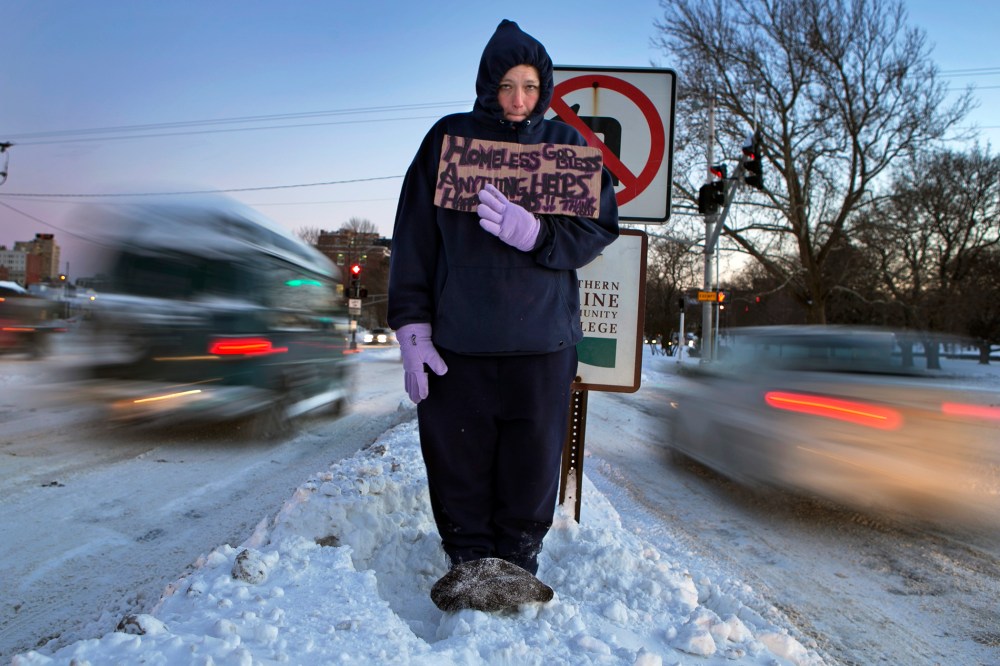
Everyone’s feeling the cold, but some people are feeling it more than others. As most of the country remains in the grip of a record-breaking cold snap, poor households and homeless Americans are struggling to keep warm.
For low-income households which rely on federal subsidies to meet the cost of their heating bills, the so-called “polar vortex” couldn’t have come at a worse time. Since 2010, the federal government has been steadily whittling away at the Low-Income Home Energy Assistance Program (LIHEAP), bringing total appropriations for winter heating down by about one-third, according to a 2013 report [PDF] from the National Energy Assistance Directors’ Association (NEADA). While government heating subsidies are still available, high energy prices and extreme weather could potentially stretch them beyond capacity.
Programs like LIHEAP “have been cut to the bone,” said NEADA executive director Mark Wolfe. “There’s no flexibility in these programs anymore.”
While millions of households were forced to make do with smaller grants, the across-the-board budget cuts known as sequestration forced some families to go without any assistance at all. All in all, the NEADA estimates that sequestration caused about 300,000 families to lose home energy assistance.
Recent cuts to food stamps may also jeopardize low-income families’ attempts to stay warm, albeit indirectly. According to the national food bank network Feeding America, nearly half of its clients have at one point been forced to choose between paying for food and paying for utilities. Since Feeding America reported that statistic, automatic cuts have slashed food stamps by $5 billion.
Wolfe said he anticipated that more families would be forced to choose between food and heat this winter.
“It’s because their budget is a zero sum game, really,” he said. “What they’re saying is there’s no capacity in their budget to take on emergencies.” Extreme cold temperatures put the homeless at even greater risk. Homeless shelters across the country are now seeing their resources stretched beyond capacity as they try to protect as many homeless people as possible from deadly cold temperatures. One Tulsa, Okla., shelter indicated that it may offer people space on the floor of its lobby, because every actual bed is already occupied. In Washington, D.C., the city is easing the pressure on homeless shelters by placing hundreds of people in hotels. If extreme cold temperatures persist throughout the winter, and some low-income households are unable to obtain sufficient energy assistance, their could be fatalities even among those with shelter, said Wolfe. “People do die from extreme cold,” he said. “It’s not a secret. The elderly turn down the heat…it happens all the time.”
Ned Resnikoff is an urban policy analyst, researcher, writer, and editor. His byline has appeared in a variety of publications, including the New York Times, San Francisco Chronicle, Dissent, and The Nation. He writes the newsletter Public Comment, which can be found at publiccomment.blog. Recommended


