








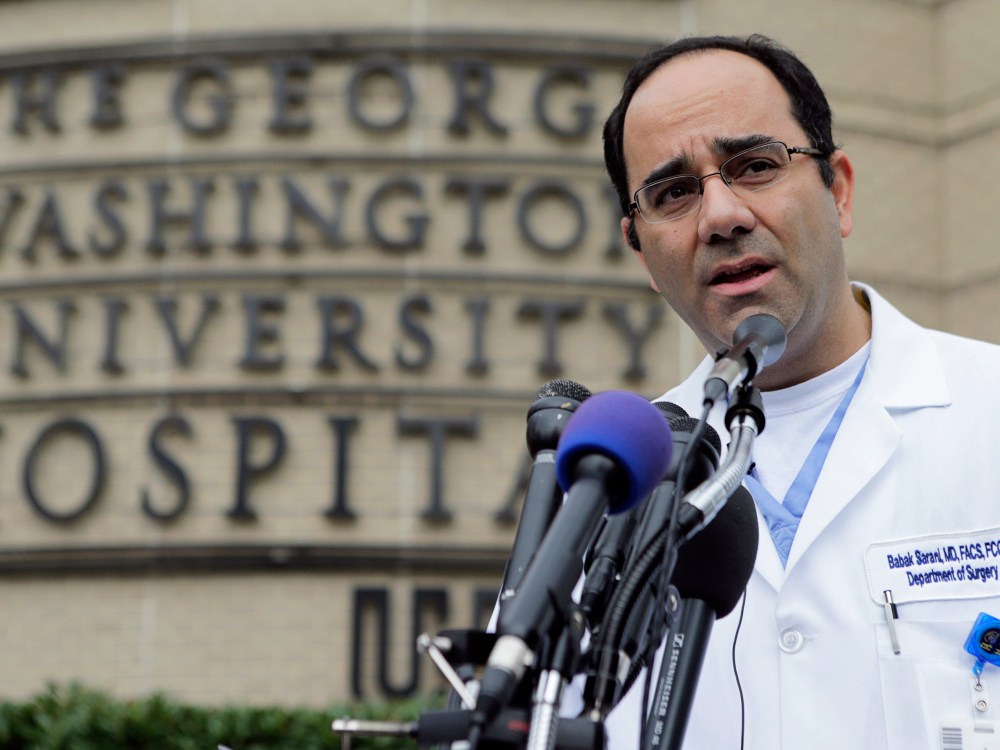
The moment the horn went off in the hospital, Dr. Babak Sarani knew something wasn’t right.
It was 8:40 a.m. on a Monday—an unusual time for the alert that summons his trauma unit at George Washington University Hospital.
But Dr. Sarani, the hospital’s chief trauma surgeon, did what he does several times a week at the DC hospital: he took the elevator downstairs and waited for a patient with a gunshot wound to be wheeled into the trauma bay.
A victim of the Navy Yard shooting was brought in. The man had a bullet wound to the left temple, and no heartbeat. Dr. Sarani could do nothing to save him. The man, whose name the hospital has withheld, was one of the 13 people who died in Monday’s shooting—the deadliest gun slaying in the U.S. since Newtown.
In all likelihood, it will only be a few days before Sarani repeats the routine. The time of day may be different, but the cause of injury will be the same.
GWU’s trauma unit treats about 200 gunshot victims every year; they make up about seven to 10% of its patients. For a U.S. hospital, “that’s considered low,” Sarani says, his voice rising. But as someone who sees the damage up close, “I would consider that high.”
Just over a mile from the White House, GWU has treated many high-profile patients: Ronald Reagan, who was brought here after being shot in 1981; the man who brandished a handgun outside the White House in 2001; and the security guard shot outside the U.S. Holocaust Memorial Museum in 2009.
But nearly every week, the hospital fills with victims who are relegated to a line in the crime blotter. From 2006: “Samuel King, 28, of the 1500 block of S Street SE, was found on the porch of a residence with a gunshot wound…pronounced dead at 8:27 pm.” From 2010: “…Officers from the Seventh District responded to the 2700 block of Bruce Place, SE for the report of a woman shot…The victim subsequently succumbed…The victim has been identified as 21-year-old Ashley McCrae.” From 2012: “1:24 a.m. Sept. 8…During the incident, the victim was shot in the right ankle.”
Less than a week before the Navy Yard tragedy, Dr. Sarani tended to a patient who was shot three or four times. One bullet tore through his intestines and kidneys. Like the vast majority of gunshot victims in DC and in the nation, the patient was young, black, male. And like 90% of the gunshot victims who arrive at GWU Hospital alive, he’s expected to survive.
For DC officials, this is progress. Gentrification, more aggressive policing, and other urban reforms have helped reduce the number of gunshot victims who arrive at the city’s emergency wards (or morgue): the murder rate in the District has dropped dramatically from its peak in the late 1980s and early 1990s, when it was known as the country’s “murder capital.” Last year, there were fewer than 100 homicides in DC—the lowest level since 1963. Before the Navy Yard shooting, this year’s murder rate was looking much the same, according to statistics from DC police.
Medical advances have helped more gunshot victims survive—partly an outgrowth of America’s combat operations. The trauma team at GWU includes surgeons who’ve served in Iraq and Afghanistan, where battlefield medicine has developed new techniques for transfusions and resuscitation.
But improved survival rates don’t fully capture the cost of gun violence, says Dr. Sarani. About 50% of the gunshot victims who leave GWU’s trauma unit sustain some form of delibitating condition for the rest of their lives, he says. Most frequently, it’s chronic pain in their back or legs. Other times, it’s brain damage, an amputation, or a limb that’s rendered useless, sometimes leaving them wheelchair-bound.
Sarani is now among the doctors pleading for the country to do more to combat gun violence. He once thought that casualties outside the inner city, in more affluent suburbs and neighborhoods, would prompt reform. But after seeing the massacres in Fort Hood, Aurora, and Newtown come and go without any change, he is frustrated. “Leaders get up and talk and make a lot of promises. But they can’t sustain the rally of the masses, and inevitably, as soon as the cameras are turned off, and the sex appeal of the whole thing is over, they cow to the special interests,” he says. Another doctor who attended to the Navy Yard victims made a similar plea. “I may see this every day, I may be the chief medical officer of a very large medical center, but there is something wrong here,” said Janis Orlowski of Medstar Washington Center, which treated three other Navy Yard victims. “I’d like you to put my trauma center out of business.” While political prospects for gun reform remain uncertain, Dr. Sarani tries to focus on what he can do at GWU. “I can save most of these people,” he says. But there will always be days like Monday. The unnamed man’s two sons showed up at 9:30 in the morning, then the wife arrived a half-hour later. Sarani broke the news about the man’s death at the Navy Yard. He clasped each son’s hand in both of his own to offer his condolences. But he held back from approaching the man’s widow. No hug or handshake would bring her any comfort, he felt. Additional reporting by Michele Richinick.
Suzy Khimm Recommended


