








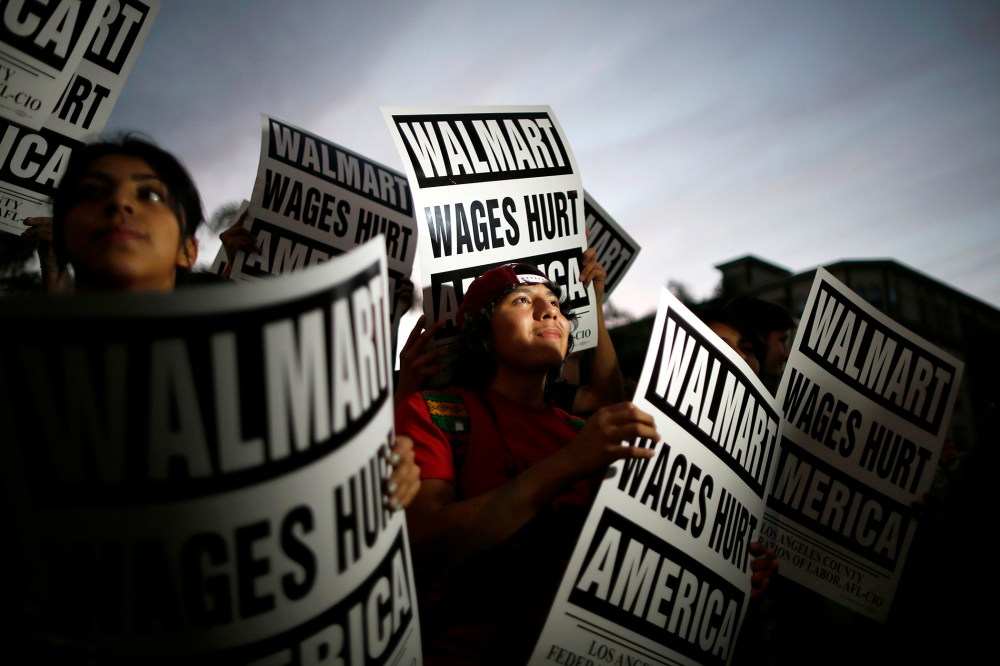
Last year, when Walmart workers around the country staged a nationwide strike on the biggest shopping day of the year, the bar for success was relatively low. By throwing the world’s largest employer on the defensive and sending a message, organized labor was able to claim a tactical victory.
This Friday, expectations are higher. The workers and their allies need to show that they came out of the past year stronger than before. And that could be hard to achieve.
Organizers insist the campaign will deliver. On a conference call last week, OUR (Organization United for Respect) Walmart told reporters to expect as many as 1,500 individual Black Friday protests across the country, a significant step up from last year’s estimated 1,200 events across 400 different stores.
But a protest—which doesn’t even necessarily include current Walmart employees—isn’t the same thing as a strike. Indeed, the organization has been downplaying the number of strikers, and instead emphasizing the support it enjoys from organizations like Color of Change and MoveOn.org.
On a conference call with reporters, Making Change at Walmart campaign director Daniel Schlademan declined to answer repeated questions about the number of striking workers. “The energy in support of Walmart workers is growing [and] the protests are growing,” Schlademan said. (Making Change at Walmart, a campaign funded by the labor union United Food and Commercial Workers (UFCW), works in concert with the workers at OUR Walmart.)
Organizers have said unequivocally that their base is growing.
“The amount of support we’ve been getting has been increasing daily,” Barbara Gertz, a Walmart employee and OUR Walmart member based in Denver, told msnbc. “It was kind of slow at first, but some more associates have realized they have a right to speak out.”
Within the last month, there have been several actions among Walmart workers on the local level. At least 80 workers at a Hialeah, Fla., Walmart engaged in an October 18 work stoppage, reportedly resulting in a round of modest raises and back-pay for time spent out on strike. Since then, local strikes organzied by OUR Walmart have taken place in Southern California, Chicago, Dallas, Ohio, and Seattle.
The group has also been using the legal system to land some blows. OUR Walmart has filed multiple Unfair Labor Practice charges against the company, accusing it of systematically intimidating, penalizing, and even firing OUR Walmart members in violation of their rights under the National Labor Relations Act (NLRB). Last week, the NLRB announced that it had found merit in some of the labor group’s charges, and that it would allow a legal action against the company to proceed. NLRB complaints can take years to adjudicate, and the penalties for guilty employers tend to be light. But if nothing else, the NLRB’s announcement was a public relations blow for the company. Another pr problem landed last week after reports that a Cleveland store was collecting food donations for its own employees. The subsequent media fallout was summarized in one Bloomberg article as “Walmart’s No Good, Very Bad, Pre-Thanksgiving Week.” Walmart is clearly aware of the need to burnish its image. In May, the company launched a major advertising campaign, called “The Real Walmart,” which features testimonials from content, generously compensated employees. And on Monday it announced a change of leadership, with Doug McMillon replacing Mike Duke as CEO. But a real improvement in working conditions at Walmart is still a long way off. For that workers will likely need economic leverage over the company, not just good press. That means showing that the movement can stop Walmart from operating normally, not just locally, but on a national or even global level. The strike numbers on Black Friday will show how close workers are to making that a possibility.
Ned Resnikoff is an urban policy analyst, researcher, writer, and editor. His byline has appeared in a variety of publications, including the New York Times, San Francisco Chronicle, Dissent, and The Nation. He writes the newsletter Public Comment, which can be found at publiccomment.blog. Recommended


