








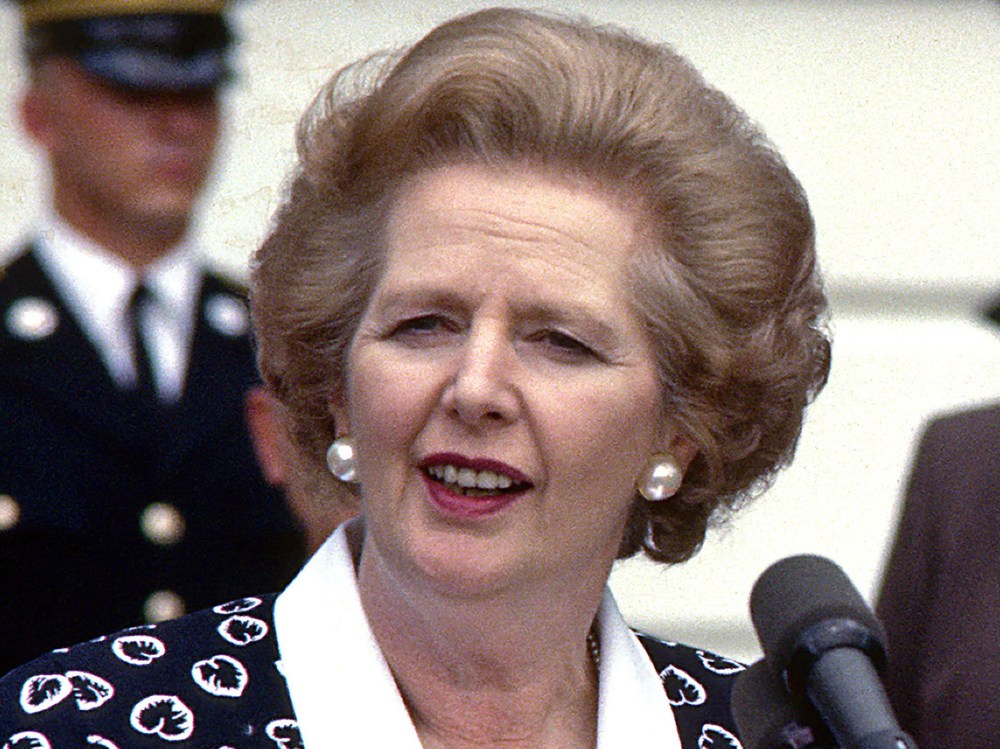
In a 2006 PBS interview, Charlie Rose asked Rupert Murdoch about his relationship with former United Kingdom Prime Minister Margaret Thatcher, whose funeral is being held today. Rose questioned the timely dilution of labor’s power under Thatcher’s tenure, which coincided with the expansion of Murdoch’s hold in Britain’s news businesses. Murdoch replied, “We supported her throughout…I never spoke to her, before or for a longtime after,” which we now know is not true. In 1981, Murdoch met with Thatcher to brief her on his bid for the Times Newspapers, which included the obstacles posed by the printers’ unions, at a time when Thatcher’s unpopular government needed some media support.
The relationship between Murdoch and Thatcher can be described as symbiotic; Murdoch’s newspapers offered their unwavering support while Thatcher dismantled pro-union laws and looked the other way on anti-trust violating news acquisitions. Before Murdoch arrived in London and Thatcher lay the legal groundwork, printers unions could, and would, shut down newspapers for days, even months, at a time.
Thatcher’s political campaigns marked a milestone for the Tory political party; public, printed support from a working class paper. Murdoch’s tabloid The Sun, which boasted a circulation of 11 million, helped Thatcher win her three successive terms in office. Front pages screamed their support for Maggie, the paper’s nickname for the PM, encouraging Labor party members to “Vote Tory This Time” on election day May 3, 1979.
Thatcher rode to victory not just on Murdoch’s headlines, but on the anti-labor sentiment that erupted after the 1978-79 “winter of discontent.” The winter prior to Thatcher’s first election win, workers from crucial public services – nursing, automotive, trucking, oil and transport industries – went on strike over the Labor government’s income policies. Streets overflowed with garbage and transportation came to a standstill. That winter, 1.5 million workers went on strike on a single day. Unemployment steadily climbed. Striking printers had shut down The Times and Sunday Times from December 1978 to November 1979. Britain’s status as an industrial giant declined.
Upon her election, Thatcher drastically reduced union power, and not just for coal miners. She passed the Employment Act of 1980, reducing union workers’ ability to strike. The law declared workers could only picket at their own place of work, effectively banning sympathy strikes, which had been a powerful tool. Six years later, Murdoch used this law as legal grounds to remove picketers from his new printing plant that, with its increased use of technology, drastically reduced the number of needed workers to put out newspapers.
The following year, Thatcher further weakened unions by announcing penalties of up to $470,000 for actions that were previously innocuous.
In addition to strengthening her government’s anti-labor position, Thatcher more than once allowed Murdoch to bypass the standard antitrust review for some of his media acquisitions. In 1981, Murdoch avoided the mandated antitrust review when he purchased the Times Newspaper, an acquisition he had informed the Prime Minister of in their January 1981 meeting. At the time, British law required a review of any person or company already publishing a paper with a circulation of more than 500,000 that sought to acquire another print asset. Murdoch already owned The Sun and News of the World, both of which had millions of subscribers. 1983 marked a landslide electoral victory for Thatcher and the Tories. She capitalized on her political support with the Trade Union Act of 1984, the same year Murdoch completed the construction of the Wapping plant, where he would eventually move the printing operations of all of his London newspapers. The Trade Union Act lay down a series of new restrictions for all unions; employ secret balloting of individual members before declaring industrial action; elect principle executive committees and voting general secretaries at least every five years; validate their political objects and funds at least every ten years. If the unions did not comply, they would lose their immunities. By 1985, Murdoch’s News Corp. decided it needed to break the printers’ unions, which exerted an unrivaled power over London’s newspaper businesses. As technology improved and computers – or what was then known as “single keystroking” – gained in popularity, the unions had been able to negotiate that 18 men work at printers needing only four, and that printers had to reset any type already set by a writer. To reduce its payrolls, News Corp. concluded in a letter it sent out, “The cheapest way of doing so would be to dismiss employees while participating in a strike or other industrial action.” The legal ability to fire workers en mass not only allowed Murdoch to drastically reduce his payrolls, but to save £120 million that, without Thatcher’s series of laws, he would have had to pay out in retirement and long-term benefits for the 5,500 employees that went on strike and were subsequently fired. Thatcher continued chipping away at union power with the Employment Act of 1982, which limited unions more so than its predecessor and came on the heels of a dispute between the unions and Murdoch, which had forced him to temporarily shut down the Sunday Times. The Act restricted ‘closed shops,’ businesses where owners agree to hire only union-members and all employees must belong to said union, by demanding 85% of ballots from the concerned union vote in favor of such a decision. It allowed employers to dismiss all striking workers and reduced the amount of compensation for a dismissal. These two provisions allowed Murdoch to save millions of dollars that would have gone to union workers’ retirement and unemployment benefits when he fired thousands of striking, unionized printers in 1986.
Katherine Guthrie Recommended


