








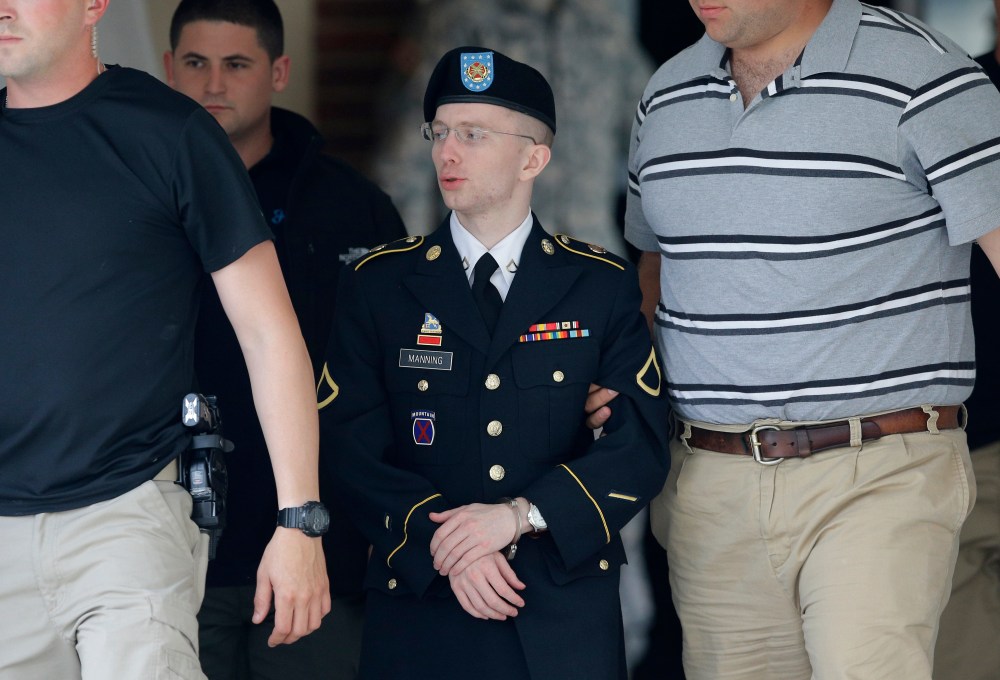
A year and a half after Pfc. Bradley Manning was arrested for one of the greatest unauthorized leaks in American history to the website Wikileaks, President Obama took steps to ensure that such a thing would never happen again. On October 7, 2011, he signed an executive order which mandated the creation of an inter-agency Insider Threat Task Force and required any agency handling classified material to “implement an insider threat detection and prevention program” with guidance from the task force.
Nearly two years later, the Insider Threat Program has gone far beyond an early warning system for potential leaks. It has instead become something far more aggressive, and far more sweeping.
“The program could make it easier for the government to stifle the flow of unclassified and potentially vital information to the public, while creating toxic work environments poisoned by unfounded suspicions and spurious investigations of loyal Americans, according to these current and former officials and experts,” according to a new report from McClatchy’s Washington Bureau. “Some non-intelligence agencies already are urging employees to watch their co-workers for ‘indicators’ that include stress, divorce and financial problems.”
Those non-intelligence agencies include the Department of Education, which cautions employees that “certain experiences,” such as “stress, divorce, [and] financial problems” could turn even a trusted co-worker “into an insider threat.” Broad parameters are left up to each agency’s interpretations of what constitutes as a threat.
“It’s about people’s profiles, their approach to work, how they interact with management,” a senior Pentagon official told McClatchy. “Are they cheery? Are they looking at Salon.com or The Onion during their lunch break?”
“If reading Salon.com is enough to make you a suspicious person, that feels like the ’50s to me,” University of South Florida historian David Johnson told msnbc. Johnson is the author of The Lavender Scare, a history of Washington’s efforts to out any closeted homosexuals from the federal government during the Cold War.
“Being Communist and being homosexual were seen as psychological problems,” said Johnson. “You were psychologically weak, so you were susceptible to either Communist indoctrination or homosexuality.”
Similarly, the Insider Threat Program relies at least in part on behavioral profiles and attempts to ferret out anyone who appears disgruntled or is exhibiting odd behavior.
“The divorce thing is a real odd one,” said Johnson. “It sounds familiar. If you’re psychologically weak, if you have personal problems, then this makes you susceptible to other bad stuff.” Rather than thwarting Wikileaks, such behavior may be playing right into its hands. Years before Wikileaks founder Julian Assange published the leaks which would make him internationally famous, he was writing about the potential of leaks to trigger hysteria in government officials. “The more secretive or unjust an organization is, the more leaks induce fear and paranoia in its leadership and planning coterie,” he wrote [PDF] in 2006. “The leak, in other words, is only the catalyst for the desired counter-overreaction,” wrote future New Inquiry editor-at-large Aaron Bady in 2010. “Wikileaks wants to provoke the conspiracy into turning off its own brain in response to the threat.” In addition to launching the Insider Threat Program, President Obama has prosecuted more alleged leakers than all other presidents in U.S. history combined. But the government’s response doesn’t even seem to have been particularly effective; two years after the launch Insider Threat Program, the NSA still failed to prevent Edward Snowden from leaking the details of PRISM.
Ned Resnikoff is an urban policy analyst, researcher, writer, and editor. His byline has appeared in a variety of publications, including the New York Times, San Francisco Chronicle, Dissent, and The Nation. He writes the newsletter Public Comment, which can be found at publiccomment.blog. Recommended


