








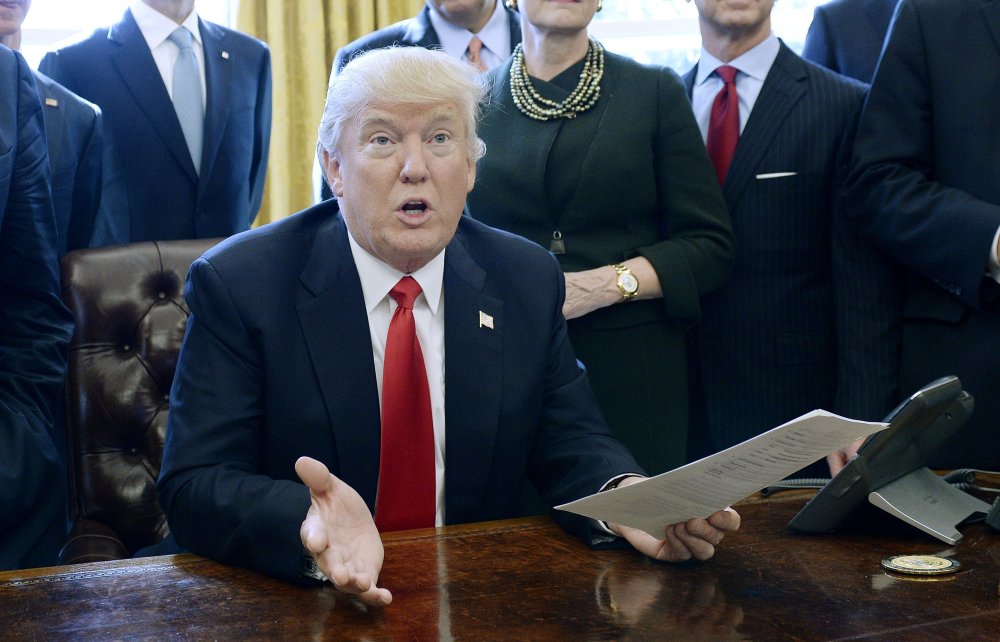
Donald Trump raised a few eyebrows on Friday afternoon when he declared, “I’m calling on Congress to give me a line-item veto for all government spending bills.” The president followed up soon after with a tweet, urging lawmakers to give him “a line-item veto for all govt spending bills!”
Trump probably should’ve Googled this one first. As we discussed yesterday, Congress created a line-item veto in 1996 — and it was struck down by the U.S. Supreme Court two years later.
The problem got a little worse when Treasury Secretary Steven Mnuchin shared his vision for how to get around the Supreme Court’s ruling: “Congress could pass a rule, OK, that allows them to do it.”
This really isn’t that complicated. According to the Supreme Court, presidents have some options after Congress passes legislation. Signing part of a bill into law, while simultaneously vetoing other parts of the bill, is not among those options. For Mnuchin to argue that lawmakers “could pass a rule” is, as the Washington Post put it, a failure of “Government 101.”
James Downie added, “Either no one else senior enough at the White House to prepare Mnuchin knew those basics, or no one was organized enough to prep the one Cabinet member to appear on any of the Sunday shows this weekend.”
All of which led to yesterday’s White House press briefing, where Principal Deputy Press Secretary Raj Shah was asked about the president’s call for a line-item veto. Shah said that anything that passed would “obviously” have to “pass constitutional muster.” It led, however, to this exchange:
Q: On the line-item veto in particular, though, have you been able to find a workaround to that Supreme Court ruling that says it’s unconstitutional?
Recommended


SHAH: Well, there are certain things being discussed with respect to House and Senate rules. I don’t want to get ahead of anything that we may come out in favor of.
This still doesn’t work. There are no “rules” that can be altered by Congress to give the president a power the Supreme Court says he cannot have. To pretend otherwise is folly.
What I suspect happened here is that the president, unaware of the high court’s ruling from 20 years ago, declared his support for a bad idea. This probably wasn’t vetted first by White House lawyers — or anyone with access to the internet — but rather, was presented to the public without any meaningful forethought or legwork.
No one briefed the Treasury secretary before he went on national television and fielded a couple of questions about this, and instead of walking this back, a White House spokesperson apparently found if necessary to pretend legislative “rules” can be altered to give the president an unconstitutional authority.
Trump World could just tell the public, “We simply made a mistake.” But that’s the one option this White House never seems to consider.
Steve Benen is a producer for "The Rachel Maddow Show," the editor of MaddowBlog and an MS NOW political contributor. He's also the bestselling author of "Ministry of Truth: Democracy, Reality, and the Republicans' War on the Recent Past."
