








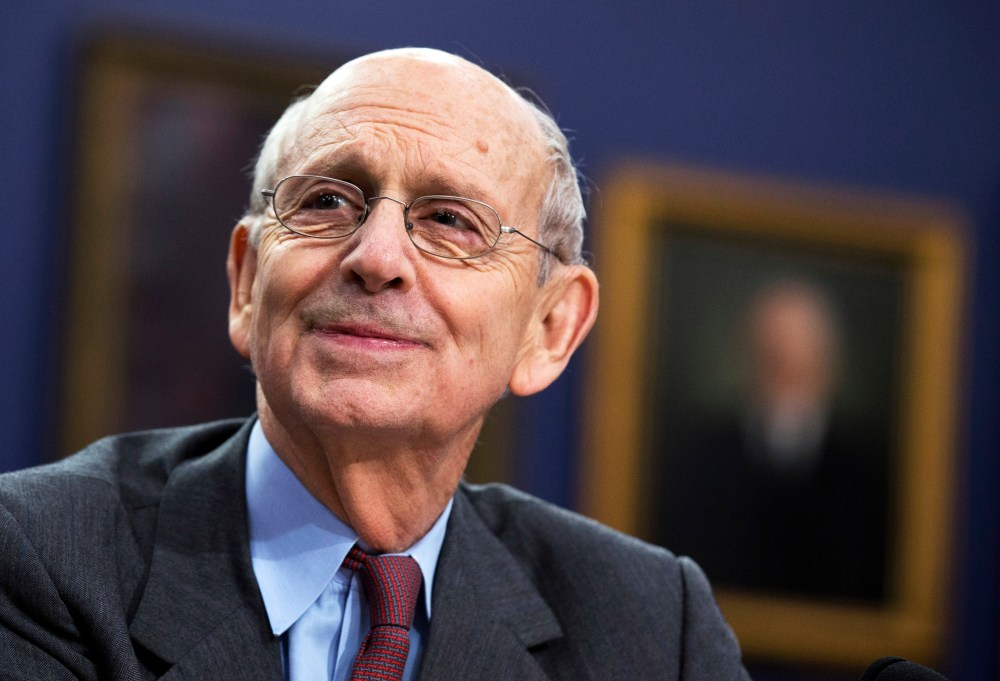

Aside from the day-to-day political developments that routinely dominate the conversation, a question hangs overhead in the nation’s capital: will Supreme Court Justice Stephen Breyer ever retire?
And while there’s no speculation about the possible answer, CNN’s Joan Biskupic, a longtime Supreme Court reporter, spoke with the center-left jurist over coffee in rural New Hampshire yesterday, and got a better sense of Breyer’s perspective.
Justice Stephen Breyer has not decided when he will retire and is especially gratified with his new role as the senior liberal on the bench, he told CNN in an exclusive interview — his first public comments amid the incessant speculation of a Supreme Court vacancy.
Asked specifically whether he’d decided when to step down, Breyer told Biskupic, “No.”
The justice, who’ll turn 83 next month, apparently voiced satisfaction with being the senior progressive on the high court — which is to say, he’s the longest serving member of the Supreme Court’s powerless three-member liberal minority.
In terms of the practical implications, Breyer described the justices’ private conferences in which they meet in private to decide how to vote on cases. Justice John Roberts speaks first, because he’s the chief justice, and he’s followed by Justice Clarence Thomas, who’s served for nearly 30 years. But next in line of seniority is now Breyer — which means he gets to speak third, a position he values with surprising pride.
“You have to figure out what you’re going to say in conference to a greater extent, to get it across simply,” Breyer said.
It led NBC News’ Benjy Sarlin to joke, “Democrats concerned by this will likely change their mind once they hear how much more personally fulfilling it is to speak 3rd rather than 4th in internal deliberations and get to write dissents [Ruth Bader Ginsburg] used to claim by seniority.”
Breyer’s comments come just two months after he delivered remarks at Harvard Law School, where he argued, “My experience of more than 30 years as a judge has shown me that, once men and women take the judicial oath, they take the oath to heart. They are loyal to the rule of law, not to the political party that helped to secure their appointment.”
In case this isn’t painfully obvious, after President Joe Biden’s victory in the fall, many took solace in the fact that the results would clear the way for Breyer to step down at a time when there’s a Democratic White House and a narrow Democratic majority in the Senate. But Breyer continues to insist that the political context is utterly irrelevant. It reflects a level of naivete so profound that it warps space and time. As we discussed in May, if Breyer assumes that a Republican-led Senate — which is likely in 2023, if not sooner — would confirm a Biden nominee for the Supreme Court, I suspect Merrick Garland would happily take the justice’s call. (Historical trivia: it’s been 126 years since a Republican-led Senate confirmed a Democratic president’s pick for the high court.) We’re talking about conditions in which GOP senators kept a Supreme Court seat vacant for 11 months in 2016 for purely partisan reasons, with some Senate Republicans suggesting they’d keep the seat empty indefinitely until their party controlled the White House again. No matter how pleasant it is to speak third during private Supreme Court deliberations, Breyer has a responsibility to at least recognize these developments and weigh his legacy accordingly.
Steve Benen is a producer for "The Rachel Maddow Show," the editor of MaddowBlog and an MS NOW political contributor. He's also the bestselling author of "Ministry of Truth: Democracy, Reality, and the Republicans' War on the Recent Past."
Latest Post
Recommended


