









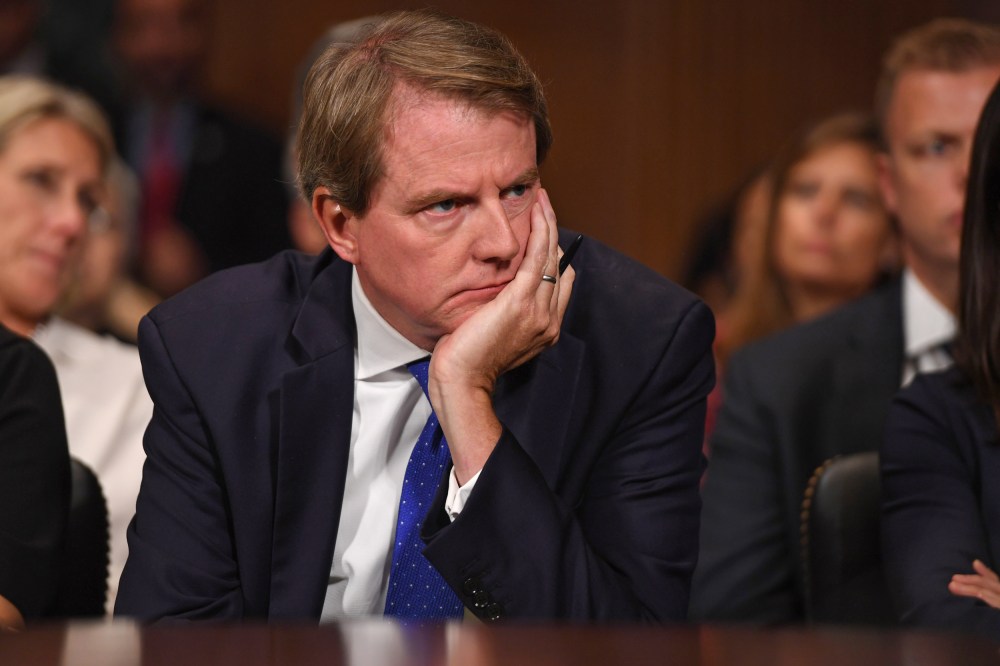

Congress has sought testimony from former White House Counsel Don McGahn for quite a while, subpoenaing the Republican lawyer about a year and a half ago. Team Trump, true to form, has fought against the subpoena, and earlier this year, a federal appeals court ruling said the judiciary should stay out of the dispute.
Lawyers representing the U.S. House asked the full U.S. Court of Appeals for the D.C. Circuit to consider the case, and this morning, as the Associated Press reported, Congress won. There is, however, a bit of a catch.
A federal appeals court in Washington on Friday revived House Democrats’ lawsuit to force former White House counsel Don McGahn to appear before a congressional committee, but left other legal issues unresolved with time growing short in the current Congress. The full U.S. Court of Appeals for the District of Columbia Circuit voted 7-2 in ruling that the House Judiciary Committee can make its claims in court, reversing the judgment of a three-judge panel that would have ended the court fight.
For those who may need a refresher, let’s pause to note how we arrived at this point.
McGahn was, for all intents and purposes, one of the star witnesses in Special Counsel Robert Mueller’s investigation into the Russia scandal. As we’ve discussed, the Republican lawyer spoke with investigators for dozens of hours, and in the redacted version of Mueller’s report, the former White House counsel was cited more than 150 times.
In some of the episodes in which Trump allegedly obstructed justice, the claims of suspected criminal misconduct are based heavily on what McGahn told investigators.
Indeed, as the former special counsel’s findings made clear, the former White House counsel very nearly resigned because the president directed him to “do crazy s**t,” including an incident in which, according to McGahn, Trump pressed the lawyer to push the Justice Department to derail the investigation by getting rid of Mueller and creating a false document to cover that up.
Naturally, Democratic lawmakers were eager to hear more, so they subpoenaed McGahn. The White House, predictably, directed McGahn to ignore that subpoena, and the matter ended up in the courts. (The Justice Department argued that if judges tried to “referee” the fight between the White House and the Congress, it would risk “politicizing the court and undermining public confidence” in the judiciary. Oddly enough, during the president’s impeachment trial, Jay Sekulow made the opposite argument.)
This morning, the D.C. Circuit concluded that the House Judiciary Committee can, in fact, issue a subpoena to compel the former White House counsel to testify, and the judiciary is not powerless to resolve such disputes. So, what’s the catch? The case is now headed back to the district court to consider other legal questions, and the likelihood of the case being fully resolved by the end of the year — the current Congress formally ends on Jan. 2, 2021 — isn’t great. For his part, House Judiciary Committee Chairman Jerry Nadler (D-N.Y.) issued a statement this morning, celebrating the appeals court decision as “a profound victory for the rule of law and our constitutional system of government.” The New York Democrat added, “We look forward to the favorable resolution of the remaining issues before the D.C. Circuit in short order.” Watch this space.
Steve Benen is a producer for "The Rachel Maddow Show," the editor of MaddowBlog and an MS NOW political contributor. He's also the bestselling author of "Ministry of Truth: Democracy, Reality, and the Republicans' War on the Recent Past."
Latest Post
Recommended


