








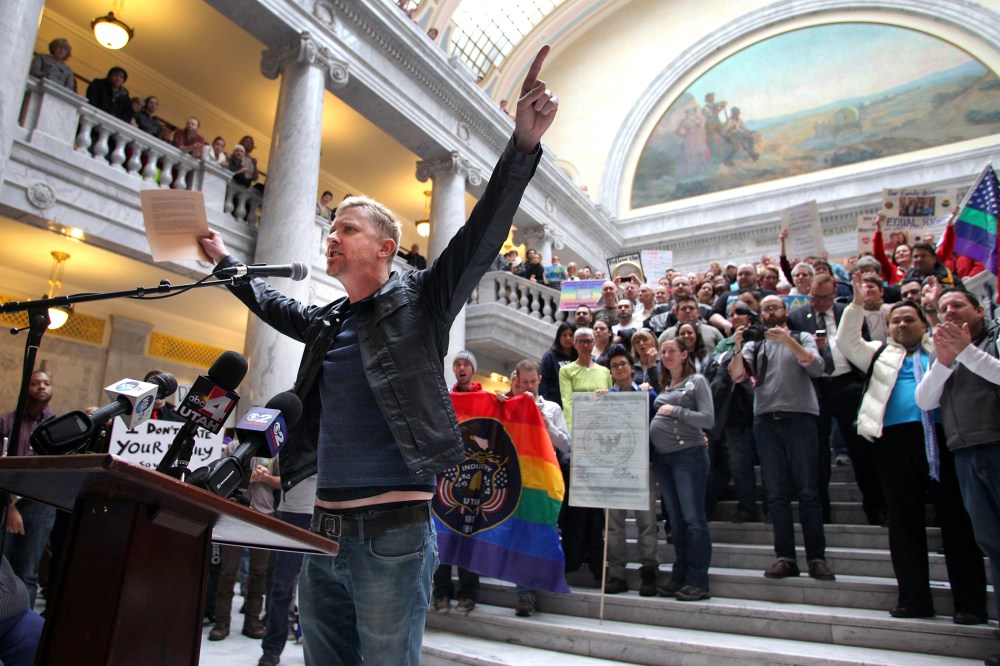
JoNell Evans’ mother quietly motioned for Evans’ partner, Stacia Ireland, to sit next to her on the couch. Evans’ mother could barely speak, but she said something that meant the world to both of them.
“JoNell is happy, I’m happy, and you are my daughters,” she said.
Evans’ mother died a week later. But if she had come to accept Evans’ and Ireland’s marriage, then someday maybe Utah, the most conservative state in the union, will too.
“To see that kind of transformation in our own family gave us hope that it’ll happen in our society as well,” Evans says.
Evans and Ireland are one of the approximately 1,300 couples who got marriage licenses in Utah in the weeks following a federal court ruling on Dec. 20 striking down the state’s 2004 ban on same-sex marriage. Evans went down to the crowded Salt Lake County courthouse immediately after the ruling to get a marriage license. Weeks later, on Jan. 6, the Supreme Court stayed the ruling, on Utah’s request. The state called marriages like Evans and Ireland’s an “affront to the sovereignty of the state” even as it argued couples like them would be “irreparably harmed in their dignitary and financial interests” if their marriages were retroactively annulled.
Then the state’s Republican leadership announced that Utah wouldn’t be recognizing any of them–unless forced to by the courts. After years of waiting for the state to recognize their partnership, Evans and Ireland were suddenly back where they started.
“It was for us and every couple we knew, a day of sadness and mourning,” says Evans. “I didn’t think it was possible for the governor to invalidate our legal marriage.”
Evans and Ireland aren’t letting Utah take their marriage without a fight. They’re one of four couples who have joined with the American Civil Liberties Union of Utah to sue the state to compel recognition of their marriages, performed in the brief window of time that such unions were legal in the state. The lawsuit argues that when those couples were married, they were vested with rights protected by the due process clauses of both the state and U.S. constitutions.
“These couples were legally married under Utah law and their unions must be treated the same as any other Utah marriage,” John Mejia, legal director of the Utah ACLU, said in a statement. “Regardless of what ultimately happens in the federal challenge to Utah’s marriage ban, the marriages that already occurred are valid and must be recognized now.”
The circumstances of Utah’s married same-sex couples are rare, so there’s little legal guidance on how to proceed. “There’s a lot of force to the plaintiffs’ argument, but it’s really an unresolved question,” says Samuel Bagenstos, a law professor at the University of Michigan.
Although the two had a commitment ceremony in 2007, in the eyes of the state, that didn’t matter. When Ireland was able to reach the clerk’s office, it was a joyful madhouse, teeming with couples seeking marriage licenses. Ireland had to wade through the crowd to get to Evans, who had gotten on line hours earlier to get the necessary forms. Salt Lake City’s Democratic mayor, Ralph Becker, was marrying couples on the spot. Every few minutes, cheers would come from the crowd as another couple was married. Eventually, it was Evans and Ireland’s turn.
“It was almost dreamlike,” Ireland said. “It was just an amazing, amazing day.”
Legal recognition means more than just symbolic acceptance. Twice in recent years, Ireland has had to go to the hospital for heart problems. The first time, in 2010, before they even left for the hospital, Evans had to scramble to collect the pile of legal documents they’d accumulated to approximate the privileges of legal marriage. “I had to have a presence of mind to have those legal documents in order to make sure I wasn’t being excluded from being by her side,” Evans recalled. Even still, the hospital officials didn’t treat Evans like Ireland’s spouse, refusing to allow her to sign documents for Ireland and keeping her at arm’s length. But when they had to rush to the hospital again last December–just after they had gotten married–everything had changed. Medical staff allowed Evans to participate in treatment discussions and came to her to sign paperwork. “It was a startling difference,” Evans said. “Once we said that I was Stacia’s wife, there was no hesitation, no questions.” That transformation is one they believe is happening in Utah at large. After years of seeing them together, Evans’ family, who first came to Utah as Mormon pioneers, has gradually begun to accept their partnership. “Stacia came, and was living here, and was their neighbor, and they saw her everyday, and they saw her as a good person and not a threat to them,” Evans said. “I think it’s been a matter of us, just by the way we live, educating them.” Evans and Ireland are convinced even Utah, which hasn’t voted for a Democrat for president since Lyndon Johnson, has evolved. Ireland is a former high school math teacher, and can remember when the school board voted to shut down every student organization at East High School in Salt Lake in 1996 order to prevent students from starting a gay-straight alliance club. Evans watched some of her own family members support the ban same-sex marriage in 2003. Times may have changed. A recent poll found the state’s residents evenly split over same-sex marriage, just 10 years after two-thirds of voters in the state voted to ban it. Evans and Ireland could have left Utah long ago for a state that would have been more accepting of their marriage. They think that eventually, voters in their home state will come around. “The home Stacia and I have created here is a place we don’t want to leave for the rest of our lives.” Evans said. “We’ve decided we’re going to live long enough to have it happen here.”
Adam Serwer Recommended


