When the state of Utah asked the Supreme Court to halt same-sex marriages in the state this week, it relied in part on a strange argument: That the failure to do so would harm same-sex couples.
Calling “every marriage performed uniting persons of the same sex” an “affront to the sovereignty of the state and the democratically expressed will of the people of Utah,” the request also states that “Same-sex couples may be irreperably harmed in their dignitary and financial interests if their marital status is retroactively voided.” Taken together, Utah states, these two things constitute an “exceptional harm.”
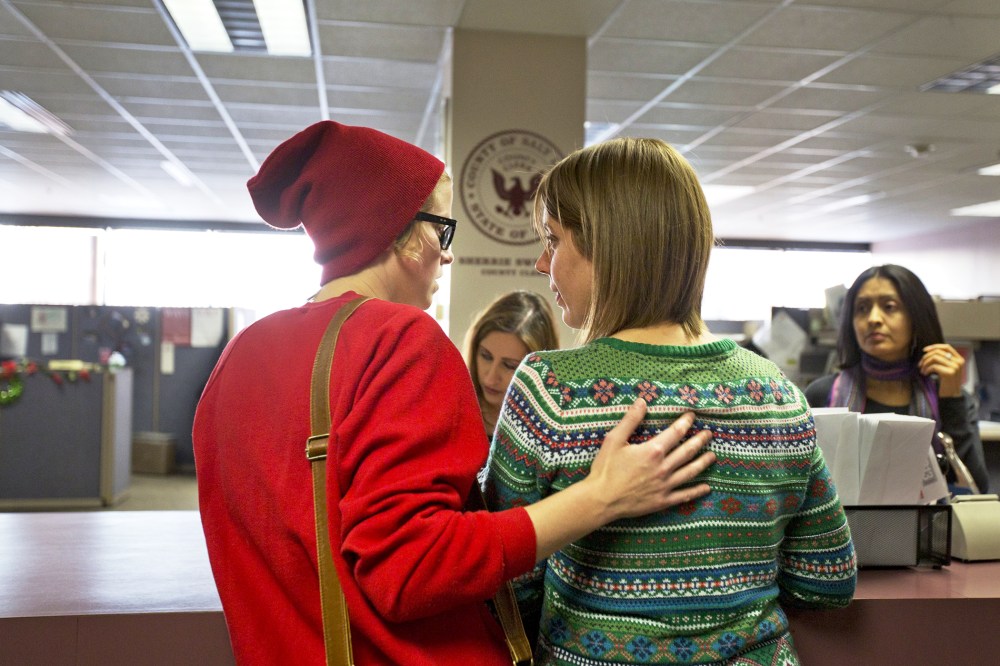
Two weeks ago, a district court in Utah struck down the most conservative state in the union’s ban on same-sex marriage, citing the Supreme Court’s decision to strike down the Defense of Marriage Act. Since that decision, clerks’ offices in Utah have been flooded with same-sex couples seeking marriage licenses. There’s no doubt that voiding those marriages will cause considerable suffering to those who have sought to get married only to see their unions dissolved by the state. What’s strange about Utah’s argument however, is that the “irreperable injury” of same-sex couples marriages being destroyed is exactly what will happen if Utah ultimately wins its case. Not only that, but in arguing that the dignity of same-sex couples will be harmed by the dissolution of their marriages, they’re implicitly acknoweldging that denying same-sex couples the right to marry is an affront to their dignity.
Utah also argues that the rationale of the Supreme Court’s decision striking down the Defense of Marriage Act, that the states should be able to decide for themselves what constitutes marriage, means allowing states to exclude same-sex couples.
As Rick Hasen, a law professor at the University of California-Irvine School of Law notes, the author of the decision, Justice Anthony Kennedy, was likely seeking to thread the needle in a manner that would strike down DOMA without mandating that all fifty states recognize a right to same-sex marriage. The tragectory of public opinion suggest that ultimately, this will happen without the court’s interference. In 2013, alone, the number of states recognizing same-sex marriage doubled from nine to eighteen. As Hasen suggests however, the Utah case implies that the high court may have to make a final ruling on same-sex marriage sooner or later. And when that happens, Kennedy’s empathy for same-sex couples will clash with his ideological instincts favoring incrementalism and federalism. It only takes four justices to ensure that the high court takes a case, so whether that happens depends a lot on Chief Justice John Roberts, and whether or not he’s willing to gamble that Kennedy’s incrementalism will win out over his respect for the rights of same-sex couples. The more conservative justices, Hasen writes, may not be able to “resist” putting Kennedy in a position he obviously doesn’t want to be in, where he will have to decide between the “dignity” of same-sex couples and the “democratically expressed will” of people in states that would deny it to them. Utah’s strange argument nonwithstanding, Hasen believes that the high court is likely to grant a stay and allow the issue to work its way through the courts. How soon the Supreme Court addresses same-sex marriage may depend on how lucky Roberts is feeling.
Adam Serwer Recommended