








A month ago, then-White House Communications Director Mike Dubke met with colleagues about messaging on Donald Trump’s first 100 days in office. Dubke, who resigned a few weeks later, said at the time that foreign policy posed a challenge for the White House team because, as he put it, “There is no Trump doctrine.”
The president’s team reportedly recoiled at the comment, insisting that “America First” is the Trump doctrine — as if a shallow bumper-sticker slogan and a foreign-policy doctrine are the same thing.
But as Trump World reflects on the president’s first trip abroad, and begins to take steps that affect the world, this administration’s incoherent approach to international affairs is starting to come into sharper focus.
This morning, for example, White House National Security Adviser H.R. McMaster and White House National Economic Council Director Gary Cohn wrote a Wall Street Journal op-ed in which they made a provocative case:
The president embarked on his first foreign trip with a clear-eyed outlook that the world is not a “global community” but an arena where nations, nongovernmental actors and businesses engage and compete for advantage. We bring to this forum unmatched military, political, economic, cultural and moral strength. Rather than deny this elemental nature of international affairs, we embrace it.
In this vision, U.S. allies aren’t partners, so much they’re competitors in the “arena.” It’s a model in which the American president stops leading the free world and starts defeating it.
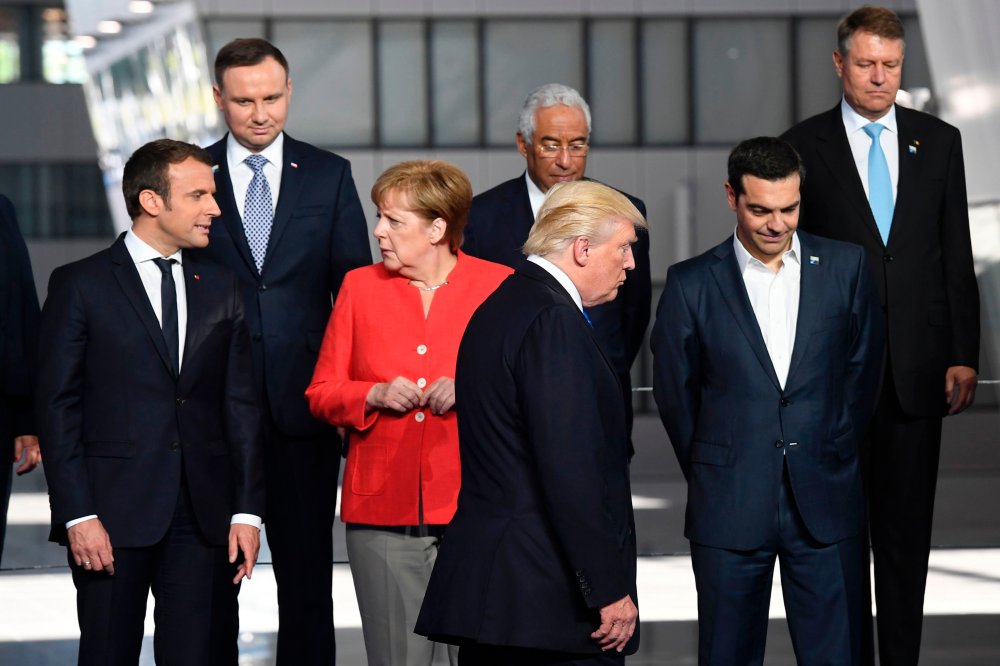
It’s this kind of thinking that leads Trump to undermine NATO, pick a pointless and counterproductive fight with Germany, “crack up the American alliance with Western Europe,” and move towards abandoning America’s participation in an international agreement on climate change.
It may not qualify as a doctrine, per se, but Trump’s goals are increasingly clear: identify the inter-generational pillars of stability in the Western world and tear them down.
What’s less clear is why Republicans, who used to see credibility on foreign policy as a birthright, are indifferent to the developments. Business Insider‘s Josh Barro noted yesterday, “What Trump has done in Europe was supposed to be Republicans’ greatest foreign-policy fear. Trump is demonstrating that America’s most important treaty commitments are unreliable, at least as long as he is president.”
And yet, there was Senate Foreign Relations Committee Chairman Bob Corker (R-Tenn.) applauding Trump upon his return to American soil over the weekend, celebrating the senator’s belief that the president’s trip was “executed to near perfection.”
The New Republic‘s Brian Beutler took note of the absurdity of the circumstances.
America can’t un-elect Trump, or annul his presidency, but it would be straightforward for the country’s other political branch of government to signal to the world that it would never allow a U.S. president to permanently upend the foundation of trust underlying the post-war global order without good reason. […] Instead, Trump returned to the U.S. in a wake of outraged howls from allied countries, and amid news reports that his top adviser tried to subvert U.S. intelligence agencies with the help of a Russian spy, and the top Republican foreign policy guy in Congress said the president’s first trip abroad was “executed to near perfection,” while GOP leaders shrugged off [Jared] Kushner’s mind-boggling improprieties. What they’re telling the world is that if another figure like Trump emerges promising to upend U.S. alliances and run a rogue, untrustworthy administration, one of America’s two political parties will welcome him, and help him get away with it. Circling back to a point from a couple of years ago, at the end of the Bush/Cheney era, the GOP’s entire approach to international affairs was left in tatters. It needed to be rebuilt, reconsidered, and molded anew into something coherent. That never actually happened: the intra-party debate was pushed aside, except to the extent that Republicans agreed that Democrats are always wrong, even when they’re right. The GOP that was once guided on foreign policy by responsible, learned hands — officials like Dick Lugar, John Warner, and Brent Scowcroft — who approached international affairs with maturity, are now ignored. Indeed, these Republicans now tend to agree with Democrats. Trump World is now filling the vacuum. The world may never be the same.
Steve Benen is a producer for "The Rachel Maddow Show," the editor of MaddowBlog and an MS NOW political contributor. He's also the bestselling author of "Ministry of Truth: Democracy, Reality, and the Republicans' War on the Recent Past." Recommended


