








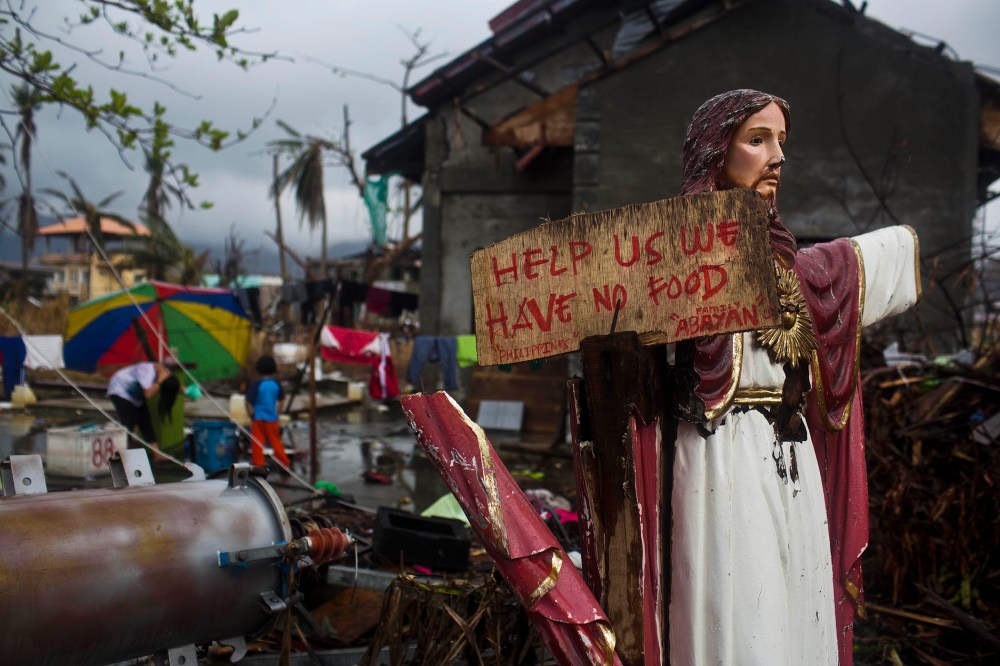
For one horrific week, the havoc in the Philippines wreaked by Typhoon Haiyan kept help from reaching survivors. The storm, the strongest ever recorded, took out bridges, clogged roads, and paralyzed seaports and airports, turning one of the most vulnerable regions of this 7,000-island nation into a scrapheap. Thousands of Filipinos are dead. More than four million are homeless. And millions have lost the means to support their families.
It didn’t have to be this bad.
Today, in the areas hit hardest, Oxfam and other aid organizations are providing water, sanitation, and other basics to meet the needs of survivors. In the weeks ahead we will be racing against the clock, along with the government of the Philippines and others, to prevent a second wave of death from disease and malnutrition. While the mission of saving lives and restoring communities continues, we must ask ourselves: Is this working?
The answer is no.
Lives and resources are being needlessly lost: the world’s system of disaster response is outdated.
From Haiti’s earthquake and Pakistan’s floods in 2010 to the Horn of Africa’s crippling drought and famine in 2011, disasters are overwhelming the aid world’s ability to respond.
Between 1987-2007, major natural disasters became four times as common worldwide. Climate change is a key reason. Since 1993, more than 530,000 people have died as a direct result of 15,000 extreme weather events. Financial losses amounted to more than $2.5 trillion.
During the coming decade, catastrophes like Typhoon Haiyan will cause billions of dollars in damage in poor countries, kill many thousands of people, and require at least $1 trillion in public humanitarian aid. Organizations like Oxfam and major donor countries must face the truth: in our current model, demand for disaster response is outstripping supply.
The solution won’t be found in bigger international relief organizations or in airdropping more supplies onto island nations. Swooping in with outside solutions that shouldering aside citizens, discounting local knowledge, and treating whole nations like helpless children is not the answer.
In most places, in most cases, governments and citizens in affected countries can develop workable strategies to deal with emergencies. The role of outside aid groups should be to invest in vulnerable countries, so that local and national institutions have the resources and expertise in place to safeguard their people. The global community must have the commitment and foresight to make these investments early—before disaster strikes.
In 2010, the global response to Haiti’s earthquake was enormous. But evaluations exposed tragic shortcomings in how humanitarian aid was provided: outsiders descended in droves and the response overlooked existing civil society systems, as well as the views and abilities of Haitians. What could have been an opportunity to rebuild and strengthen the country was squandered.
Every evaluation of major humanitarian crises in the last 10 years has found much the same thing.
Oxfam and other aid groups have decades of experience. The duty of such groups should be to share their expertise early and generously, recognizing that local people often have the best solutions. In 2010, El Salvador was ranked by the UN as the most vulnerable country in the world, with 95% of its people at risk from natural disaster. Yet when a massive tropical depression bore down on the country a year later, El Salvador was ready. Its civil-protection system kicked into gear, triggering community leaders to evacuate their towns and villages. Newly trained community volunteers stepped in. A water, sanitation, and hygiene team that received training through Oxfam reached thousands of people with aid before the government had even declared a national emergency. Twelve years earlier, when Hurricane Mitch battered El Salvador, 239 people died. During the huge 2011 storm, which dropped nearly twice the rain of Mitch, fewer than 40 Salvadorans lost their lives. Behind these numbers is a story of dedication—to partnership, community empowerment, and the right to safety with dignity. In extreme cases, people affected by disasters will always need international assistance to help with essentials like shelter and clean water. Such aid has saved countless lives and must continue to do so. We are not calling for less support to people in need, but for more investment in civil society and governments to prepare for, respond to—even avert—disasters. According to the UN, the government of the Philippines has some of the strongest laws on the books aimed at reducing the risks of disaster. But good policy means very little without execution. As Typhoon Haiyan revealed, the government has not yet made the investment needed to make sure that local authorities—those on the front lines at times of emergency—are prepared for disasters. As we bury Haiyan’s dead, feed the survivors, fight disease, and rebuild communities, we must resolve to find a better way forward. Raymond C. Offenheiser is President of Oxfam America.
Raymond C. Offenheiser Recommended


