








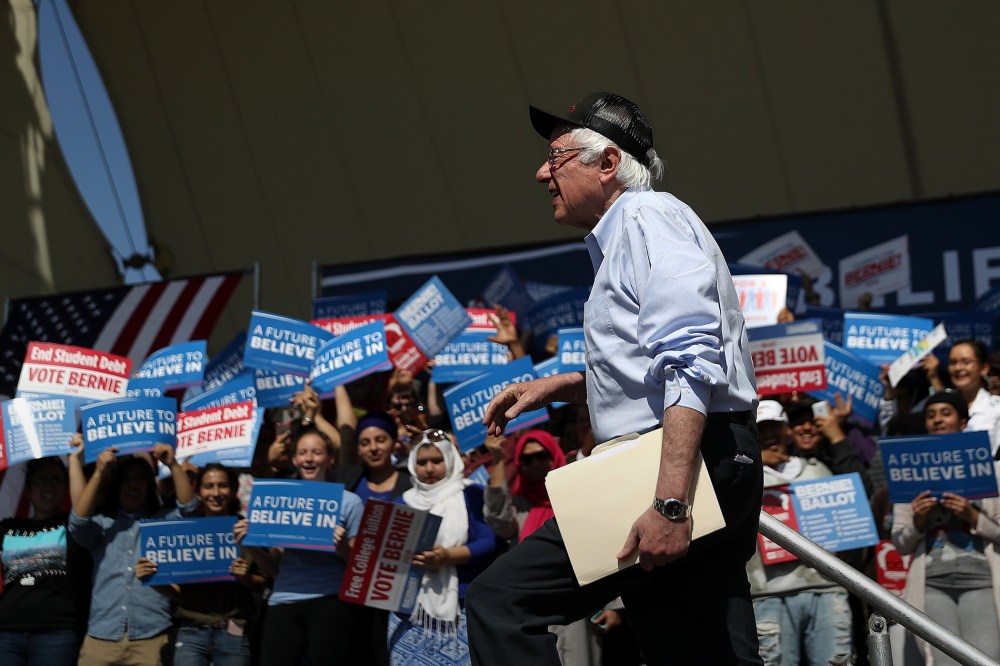
Throughout his campaign, California has been Bernie Sanders’ promised land — a progressive state rich in delegates and a reliable source of hope, just over the horizon.
“We think we have a path toward victory, and that path absolutely must go through California,” Sanders told the Los Angeles Times in March.

But now, with California’s June 7 primary finally coming into view, Sanders may be heading into the Golden State hobbled.
Despite notching two wins this month, with more likely to come, Sanders is running lower on cash than expected and replaced his top official in California Wednesday. Meanwhile, Democratic front-runner Hillary Clinton has moved to solidify her support in the state, which she won comfortably over Barack Obama in 2008.
The state has a history of progressive insurgents upsetting expectations, such as when Gary Hart beat then-presumptive nominee Walter Mondale in 1984, and Sanders could still be latest. With less than a month to go, though, it’s an uphill climb.
The campaign parted ways with its former California State director, Michael Ceraso, this week. No reason was given for the departure, but a spokesperson said the campaign feels “great” with their new director, Robert Becker, who has run several states for Sanders.
Meanwhile, Sanders officials say they “probably” won’t spend more on television advertising in the notoriously expensive state, which some California political experts say is virtually a declaration of surrender.
In another sign of trouble, a senior aide says the campaign is likely to stop producing new TV spots all together. That, after the campaign has cut more than 264 different TV ads.
RELATED: Trump voters give Sanders a boost in West Virginia
In Kentucky, which votes Tuesday, Sanders’ campaign is reusing two old ads and letting himself be outspent by Clinton’s campaign $178,000 to $93,000, according to ad tracking data from NBC News partner SMG Delta.
Sanders’ online fundraising machine has in the past allowed him to outspend Clinton in almost every contest he wanted to. But there are increasingly signs that that once seemingly bottomless well of donations is drying up.
Sanders raised only $26 million in April, way down from the $46 million he brought in in March and the $42 million he collected in February.
Meanwhile, Sanders was spending an average of about $40 million per month during the first quarter of the year (April data is not yet available), forcing a downsize to meet lower revenue. Last month, the campaign laid off hundreds of staffers and overall headcount has been dramatically reduced from its peak.
The cash crunch comes at a bad time. With some of the nation’s largest media markets and its biggest population, California is the most expensive state in the country in which to buy TV advertising — but it’s also perhaps the most important.
RELATED: Sanders: ‘I’m the stronger candidate to defeat Trump’
“If you’re behind in the polls and you’re not advertising on TV, it’s tough to win no matter what you’re running for,” said Doug Herman, a Los Angeles-based Democratic strategist.
But Sanders and his aides say major broadcast spending is unlikely, though they have already dropped $555,000 on cable in the California and Oregon.
“We’ll see,” said Tad Devine, Sanders’ top strategist and ad-maker. “For many weeks we have talked about barnstorming California as our communications strategy, and I think that’s probably what we’re going to do. But we will always reserve the option to do other things as well.”
Sanders told the Sacramento Bee Monday that he wasn’t sure TV would be worth it, adding the campaign was “in reasonably good financial shape.”
Even a conservative statewide advertising campaign would cost more than $5 million, operatives say.
In 2008, Obama spent $6.2 million in California, while Clinton dropped $5.6 million, according to the data compiled by the University of Wisconsin Advertising Project. And that year, the state voted on Super Tuesday, meaning it had to compete for resources with 21 other states, including the second most expensive one, New York.
Still, Sanders may be able to skirt by on free media attention from a hungry press corps.
“If I’m Bernie Sanders and I don’t have the resources I need to run TV ads, I would not give up hope,” said Darry Sragow, a longtime California Democratic strategist. Clinton’s campaign has yet not reserved any TV advertising time in California, and is hoping to spend as little money as possible on the remaining primary states. It only needs a fraction of remaining delegates to clinch the Democratic nomination. “I think that a lot of voters have a pretty strong sense that they’ll able to make judgements about Bernie Sanders. And that means that the conventional wisdom — the conventional wisdom almost always being wrong — that he can’t win CA without a huge TV buy is something that I think people should be skeptical of,” said Sragow. RELATED: What we learned about Democrats (so far) in 2016 Already, the Vermont senator has made up an impressive ground in California. “I’m looking at the trend line — we’ve done five polls between Clinton and Sanders — and he’s closed the gap in each of those,” said Mark DiCamillo, the director of the Field Poll. Sanders started at just six percent in that first poll in January, but has since risen to within striking distance of Clinton. Independents are allowed to vote in the state’s Democratic primary, which could be major boon for Sanders, since those voters tend to break heavily in his direction. Still, he’ll face demographic hurdles. Clinton won in 2008 by eight percentage points, and this year she’s likely to add to her column most of the African-American voters who sided with Obama. Sanders will need to galvanize progressive voters, especially in the liberal Bay Area, to turn out in large numbers, while trying to come as close to breaking even as possible with Latinos, who made up 30 percent of the vote in 2008. RELATED: Did Sanders ignore African-American voters? He also seems to be focusing on the Central Valley, the vast agricultural region in the interior of the state that mostly votes Republican in general elections, with back-to-back rallies this week in Stockton and Sacramento. Clinton, meanwhile, is favored in Southern California, which is more diverse and more populous, but tends to turn out in lower numbers. Sanders is also still holding out hope for another primary in California, which Clinton’s campaign agreed to in principle earlier this year, when they pushed to add another debate before New Hampshire. Additional reporting by Chris Jansing.
Alex Seitz-Wald Recommended


