








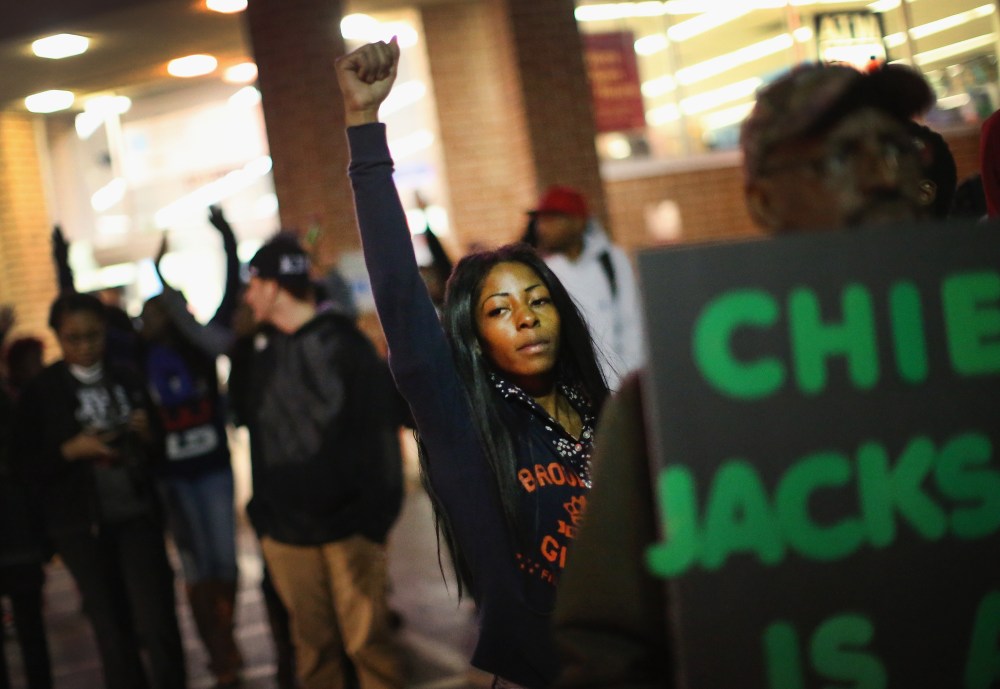
In Ferguson, after months of waiting, heartbreak and debate, we expect to finally have some answers when we soon learn if Darren Wilson will be indicted for the shooting death of Michael Brown. According to the media, police are planning a militarized response to anticipated protests. Community activists are booking tickets to be on site when the grand jury’s decision is announced.
The stage is set for conflict.
%22Indicting%20and%20convicting%20Darren%20Wilson%20may%20seem%20like%20justice%2C%20but%20is%20it%20the%20endgame%3F%20What%20is%20the%20strategy%20for%20what%20comes%20next%3F%22′
But, what ultimately will come of these months of protest and the inevitable confrontation following the grand jury decision? Indicting and convicting Darren Wilson may seem like justice, but is it the endgame? What is the strategy for what comes next?
The hard truth remains that in a democracy you must convince enough people of the rightness of both your cause and your remedy. For racial justice activists, this task is immensely challenging given how our brains process race in the midst of existing racial polarization.
Ferguson feels to some like our generation’s Birmingham. But in a more complex time that many would like to think of as “post racial,” with a black president, attorney general, and captain in the St. Louis County police, many are legitimately ambivalent about the role race may have played in the death of Michael Brown. Protests that don’t recognize and speak directly to this ambivalence can polarize rather than unify outrage.
Photo essay: How the crisis in Ferguson unfolded, in photographs
What role does social psychology play in this dynamic? Our perceptions of Michael Brown as victim or as perpetrator are colored by implicit biases as well as how American society has historically talked about black men. We know that narratives or stories, more than data or facts, help our brains interpret human emotion and behavior. When we have little personal contact with particular groups of people, narratives about these groups take on greater importance. The distorted stories we are told about black men and boys as more likely to be engaged in criminal activity, disinterested in educational achievement, and rebellious against authority chillingly connect to the claims of fear by those who killed Trayvon Martin, Jordan Davis and John Crawford.
Racial anxieties — the worry that we will be treated differently because of our race — has long been a burden for people of color. In the Perception Institute’s soon-to-be-released report, “The Science of Equality: Addressing Implicit Bias, Racial Anxiety, and Stereotype Threat in Education and Health Care,” we detail research showing that whites are increasingly experiencing that burden as well. The worry that they will be assumed racist, or that their responses or statements will suggest they are racist, can lead whites to avoid engaging difficult questions and interracial interactions.
Related: From Emmett Till to Michael Brown, a story as old as America itself
Our challenge as activists is to overcome the implicit biases and racial anxieties that interact to diminish opportunities to expand public empathy. Our protests can no longer ignore what we know about how our brains operate. I am not suggesting that we avoid truths to make white people feel comfortable about race, but instead, that we use this information to be strategic about how we tell our truths.
I have to believe that the protests in Ferguson are not in vain. They have provided an important vehicle for a silenced community to voice its grief and anger. They have shown a spotlight on a tangled thicket of problems, including racial profiling and the militarization of America’s police forces, that cry out for reform. Leaders like the Organization for Black Struggle have articulated alist of values and demands in the wake of Ferguson that rightfully call for putting our sense of outrage at the service of positive change. Yet while the protests to date have galvanized those who already agree on the issues at stake, polls show that they have not solved the problem of polarization, and they have not moved the needle onpublic opinion. Continuing on this path will almost certainly reinforce racial polarization. %22We%20may%20need%20to%20move%20away%20from%20previous%20tactics%20that%20have%20been%20shown%20to%20increase%20polarization%2C%20even%20when%20those%20tactics%20feel%20empowering%20and%20familiar.%22′ Avoiding this paralysis is exactly what the civil rights movement understood, and this is why that movement was so brilliantly effective. Children endured police dogs and fire hoses to show a larger truth and to catalyze a national response from the broader society. We have been trying to follow in the civil rights movement’s footsteps by copying theirtactics. We must instead adopt that movement’s values, values that put strategy and long-term goals above all else. Doing so will require the uncomfortable. We may need to move away from our pieties, away from previous tactics that have been shown to increase polarization—particularly when our desired remedies are unpopular—even when those tactics feel empowering and familiar. And while it feels wrong to be thinking in terms of strategy in the face of loss and grief, strategic questions are exactly the ones we must ask ourselves, or we are doomed to be in this position again, responding spontaneously to the death of an unarmed young black man, with no reform on the horizons, no shifting of the structures creating these problems, and with our feelings of hopelessness, futility and rage confirmed. The social psychological sciences tell us that change is possible. Racial difference does not need to end in tragedy. For fundamental changes for black men and boys, we need police officers to recognize that racial stereotypes may affect how they see black men and boys so that they can take the steps researchers have identified as necessary to prevent stereotypes from driving behavior. We must prevent any possibility that horrific tragedies like Michael Brown’s death in Ferguson are caused by stereotypes and create a society in which our men and boys are treated with respect and compassion and given the opportunity to achieve to their potential. Alexis McGill Johnson is Executive Director ofPerception Institute, a consortium of researchers, educators, and social justice advocates whose work analyzes the role of bias and racial anxiety in our society.
Alexis McGill Johnson Recommended


