








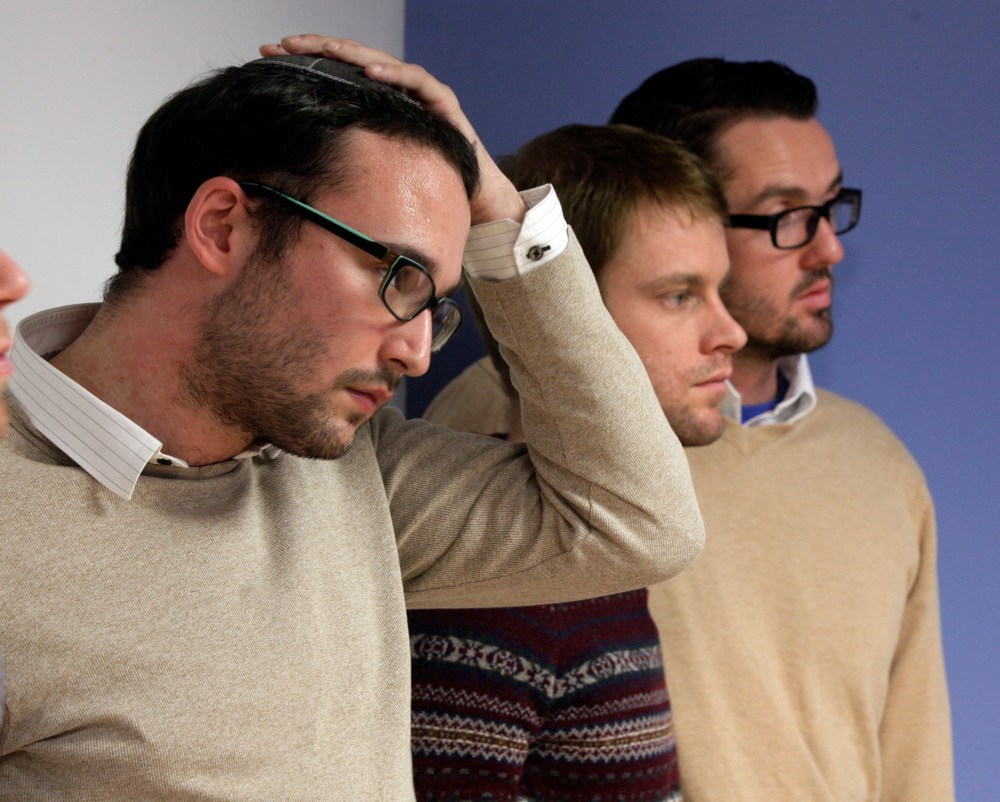
Justin Utley was 25 when he began going to Evergreen, a support group in Salt Lake City, Utah, that helped people “diminish same-sex attractions and overcome homosexual behavior.” After returning from his mission trip as a young Mormon, he’d approached his bishop and told him he might be gay—which led him to seek help using a church-recommended practice.
But what was supposed to be the road to a celestial kingdom became a two-year struggle to change his identity, and he left the program to pursue a relationship with another man. Utley, now 35, describes Evergreen as a “conversion therapy support group” that treated homosexuality as a curable addiction.
“The belief was that you’re only gay if you do something that is gay,” Utley said.
But while Evergreen never resorted to shock therapy or other extreme measures once associated with “reparative therapy,” male attendees would sit through discussions and be given assignments on how to bond better with men as friends. The men were not allowed to spend time together outside of Evergreen, but people rarely followed that rule—often hooking up with one another after leaving group sessions.
Utley and many of the men who attended Evergreen also saw licensed therapists at the same time who had been recommended by both the group and by officials of the Mormon Church, which Utley used to be a member of until he formally left in 2006. To treat the man’s “addiction,” therapists often prescribed medication for bipolar disorders or schizophrenia. Utley never took any medication, but was talked into believing he’d been molested as a child—which provided a reason for his same-gender attraction, he was told.
Utley said the powerful desire to overcome his feelings explains why conversion therapy still existed as a practice despite being denounced by psychologists over the last few years. “I wanted too badly to be a part of this social ideal and doctrinal idea that I’d be married to a woman with kids,” he said. “You just fall in love with that idea, even when it’s not possible. When that’s taken away, it rips your heart out because that’s what you were raised to become.”
California, New Jersey take on the fight
The use of reparative therapy can be traced back to the early 20th century in the United States when homosexuality was widely believed to be a mental condition. In 1973, homosexuality was removed from the American Psychiatric Association’s list of mental disorders, but many people still believed that therapy was a solution for those who wanted to change their sexual orientation. Famed psychiatrist Dr. Robert Spitzer published a controversial paper in 2001 contending reparative therapy could work in some cases—an argument he later retracted in 2012.
But while reparative therapy has been regarded as ineffective, and even damaging, by many licensed therapists, states have been hesitant to ban the practice for minors. In California, a new state law that would have banned conversion therapy for minors was set to take effect at the start of this year, but a U.S. 9th Circuit Court of Appeals ruled last December that the ban violates the First Amendment rights of therapists and parents.
“This law is an astounding overreach by the government into the realm of counseling and would have caused irreparable harm,” said Mat Staver, chairman of Liberty Counsel, a right-wing organization that challenged the California law.
New Jersey is currently facing a similar battle after the state Senate’s health committee approved a bill that would ban licensed practitioners from using or recommending reparative therapy on minors, even with parental permission. Gov. Chris Christie has not said whether he would sign the bill if it reaches his desk, but declared Friday that he opposed the use of reparative therapy.
“Governor Christie doesnot believe in conversion therapy,” spokesman Kevin Roberts told the New Jersey Star-Ledger. “There is no mistaking his point of view on this when you look at his prior statements where he makes clear that people’s sexual orientation is determined at birth.” ‘Wouldn’t you want a second opinion?’ As LGBT advocates in both California and New Jersey continue to fight to outlaw the use of reparative therapy on minors, opponents of banning the practice are arguing government overreach and saying states should focus on educating parents and children on why therapy is harmful instead of outlawing it and creating a network of unlicensed therapists. “Banning it may simply drive it underground, where it won’t even be subject to state regulation or limited to therapists who are licensed,” Christopher Ferguson, associate professor of psychology and criminal justice at Texas A&M International University, wrote for Time last October. “With gay conversion therapy, the treatment may be worse than the ‘problem,’ but the same could be said for government efforts to intervene.” But having experienced two years of Evergreen and counseling and meeting men who’d been in therapy for years, Utley said he remains convinced the damage done by the practice should be enough to take the option off the table entirely. “If you had any other condition, wouldn’t you want to know your other options?” he asked. “If it’s a serious mental disorder, wouldn’t you want a second opinion? Or why not go to a specialist? Why depend on something with such little-documented success?” He adds that most people resort to reparative therapy to quell any feelings of self-hatred. “When I first went [to Evergreen], I was elated to find people who were on the same boat as me. I wanted to die before I admitted I was gay…When faced with a situation like this, eternal salvation comes into question when you’re religious. And your religious and emotional rationale supersedes anything else, and you’re willing to accept anything to keep yourself in line with your religious beliefs.” Utley said what saved him was realizing his worth and value to people who weren’t looking to change him. “Wouldn’t it be more healthy to just accept who you are?”
Traci Lee Recommended


