








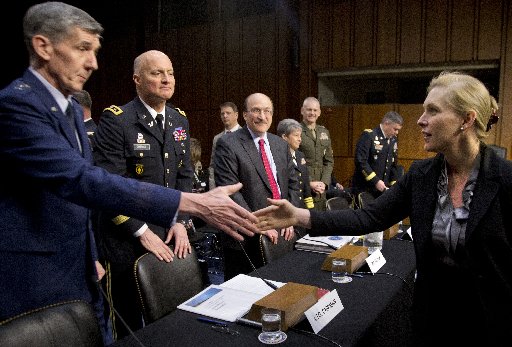
For the first time in nearly a decade, Congress convened a hearing on sexual assaults in the military—an epidemic that’s estimated to affect as many as 19,000 service members annually, according to a recent Pentagon report.
Of those 19,000, only 3,191 assaults were reported in 2011, according to the Pentagon report, and about a tenth of those cases went to trial. One in three convicted sex offenders remains in the armed forces.
The Senate Committee on Armed Services Subcommittee on Personnel heard from witnesses Tuesday morning, both female and male, recounting horrors that had been covered up for years.
“I was raped during military service and during my first assignment—that was 1988, I was 18-years-old, it was two weeks before my nineteenth birthday, ” said BriGette McCoy, a former Specialist in the U.S. Army. “That would not be the last time I was assaulted or harassed. This is my story but it’s not mine alone. That year, the year that I was raped, that same year I was raped again by another soldier in my unit. His formal apology consisted of him driving by me on base, rolling down his window and saying to me ‘sorry.’”
“Let’s not allow sexual predators who happen to wear a uniform the opportunity to become highly trained, highly degree-ed sexual predators. Let’s make sure they are convicted and dishonorably discharged and listed on the national registry,” McCoy said.
Former U.S. Sargent Rebekah Havrilla said in her testimony that she initially chose not to report a sexual assault “because I had no faith in my chain of command.” She told the committee that she was raped by another service member one week before her unit was scheduled to return to the U.S.
“I can’t tell you a single day that went by where I was in my unit that didn’t go by without some type of rape joke, sex joke, simulated sex play between men,” Havrilla said. “We had a sexual assault and harassment training and one of our sergeants got up on a table and stripped completely naked and danced and laughed at it—that’s the kind of culture I lived in on a daily basis.”
Senator Kirsten Gillibrand ( D-NY) chaired Tuesday’s hearing. She told msnbc’s Andrea Mitchell in February that the hearing aimed to be a first step in ensuring accountability and transparency when sexual assaults are committed in the military.
“This hearing is going to shine a light on what the problem is, what are the solutions, and what needs to be done to make sure men and women can serve without the concern for being sexually assaulted by other men or women in the military,” Gillibrand told Mitchell in February.
Senator Lindsey Graham, himself a veteran of the U.S. Air Force, Air Force Reserve, and South Carolina National Guard, gave an impassioned opening statement before the testimony began.
“Clearly the message we’re sending to the female members of the military is that we’re way too indifferent, and that your complaints are falling on deaf ears, and to all of our commanders: How in the world can you lead your unit in a responsible manner if the people in that unit feel like the system doesn’t care about them?” Graham said Tuesday morning. “I will do everything I can within reason to make sure that stops.”
Senators not serving on the subcommittee also attended Tuesday’s hearing, Missouri’s Claire McCaskill and California’s Barbara Boxer among them.
Senator Jeanne Shaheen ( D-NH), a member of the Subcommittee on Personnel, spoke with msnbc’s Andrea Mitchell about the emotional testimony from service members Tuesday afternoon.
“One of the most important points they made was that rape and sexual assaults are crimes: they’re not about sex, they’re about power, they’re about intimidation, and we have to treat them that way,” Shaheen told Mitchell. In a letter written jointly with Sen. Boxer, Shaheen called on newly installed Defense Secretary Chuck Hagel to investigate the case of Air Force Lt. Col. James Wilkerson, who after being convicted of aggravated sexual assault, was unilaterally reinstated by Air Force Commander Lt. Gen. Craig Franklin. According to a press release issued by Shaheen on Monday, Hagel indicated in his response that he would investigate the case and look into whether changes need to be made to the Uniform Code of Military Justice, which allowed Franklin to single-handedly overturn the jury verdict against Wilkerson. Shaheen pointed to independent prosecutors as a possible solution to chain of command issues within the military, stressing the importance of “looking at the kinds of things that work on the civilian side and seeing how we can do some of that on the military side—allowing victims of sexual assault and rape who were not able to get satisfaction and justice through the military to have access to a civilian process that allows them to get some justice,” on Andrea Mitchell Reports Wednesday. “If you’re a sexual offender in the civilian side, you’ve committed a crime and most likely you’re going to lose your job or you’re going to have a sentence in some way that’s going to have a negative impact on you. And we’ve got to look at offenders in the military and treat them the same way,” Shaheen said. Watch Andrea Mitchell’s interview with Sen. Jeanne Shaheen:
Erin Delmore Recommended


