








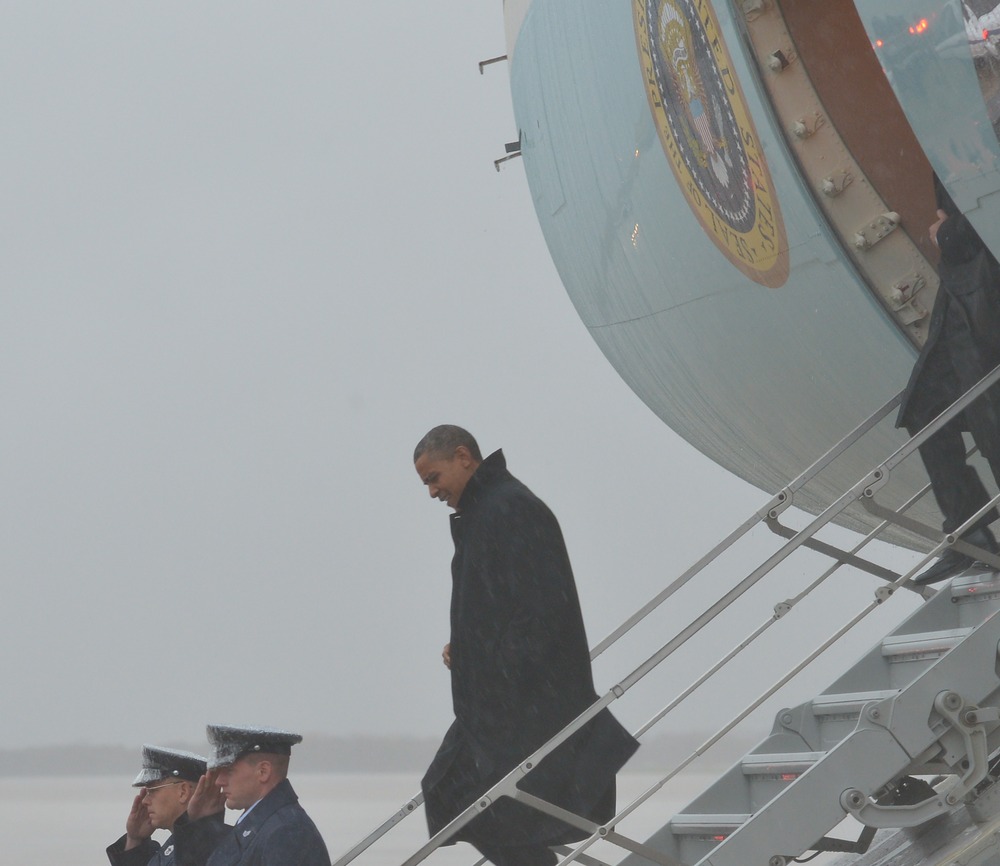
Early voting made a big impact for President Obama in the 2008 election, so it’s no surprise his campaign sounded an early alarm about what could happen if Hurricane Sandy succeeds in shutting down polling stations or makes it more challenging for voters to cast their ballots. But political experts insist that the impact will be negligible.
Obama campaign adviser David Axelrod voiced concerned Sunday, although the president said Monday he is not worried about the impact of the hurricane on the election.
The two swing states which lie directly in the hurricane’s wake are North Carolina and Virginia. These states are currently conducting early in-person voting, though only some citizens of Virginia are eligible to show up at the polls early. The question supporters in both parties are asking themselves is if Hurricane Sandy could distort the early voting numbers in those two states, and thereby reshape the entire national election.
Doubtful, says George Washington University political scientist John Sides. Hurricane Sandy may keep some potential early voters at home for a few days, but it’s unlikely to discourage many of them from voting at all. The majority of people who show up to the polls early are highly motivated voters.
“A lot of these people are not going to be put off by one or two days of bad weather and cancellation of early voting,” said Sides. “As soon as it resumes, you can expect the vast majority of them to vote anyway.”
That’s particularly true, he said, because of the strength of Obama’s ground game. “The nature of the field operation for the Democrats for, Obama, is that it’s pretty highly developed, and they can probably accommodate this kind of circumstance,” said Sides. “Obviously they’re trying to get as many people to the polls now before it starts, but there’s nothing stopping them from restarting the mobilization movement as soon as Sandy stops.”
In Virginia, on the other hand, any negative effect the storm has on early in-person turnout could actually be good news for Obama. More than 43% of early voters (most of whom vote in person) are over 60 years of age. Older voters tend to lean more conservative.
“I’d be surprised if the net effect of this were really to disadvantage the Democrats, given that the disposition of these early voters is probably Republican tilt if anything,” said Sides.
Even if Hurricane Sandy does make a net difference in Virginia and North Carolina voting, these states wouldn’t necessarily decide the election. North Carolina in particular, said political scientist Jonathan Bernstein, is not in the top tier of states to watch this election cycle.
“If North Carolina goes for Obama, I think he ends up winning basically everything [he won in 2008] but Indiana,” he said. Losing the state, on the other hand, would be less than fatal.
Virginia could be slightly more significant.
“Virginia was on the edge of what Obama got last time, but it’s been running quite a bit more favorably to him this time,” said Bernstein. “So there are scenarios where he could lose Ohio and win Virginia and other states, and it winds up mattering.” But Virginia’s limited eligibility for early voting means that Hurricane Sandy would likely suppress vanishingly few votes. Only 13.5% of Virginian ballots were handed in early in 2008, compared to 60.6% of North Carolinian votes. Both the Obama and the Romney campaign have canceled major events for Monday, but the Obama campaign is still working on increasing voter turnout door-to-door, according to spokesperson Adam Fetcher. “Where it’s safe to do so, our historic grassroots organization is running at full speed in Eastern battleground states to persuade undecided voters and get our supporters out to the polls between now and Election Day,” Fetcher wrote in an e-mail. The Romney campaign declined to comment on how the storm is impacting its grassroots campaign activities. Spokesperson Amanda Henneberg instead provided a statement saying, “Governor Romney’s concern is the safety and well-being of those in the path of this storm, as opposed to political considerations.” Hurricane Sandy will barely graze critical swing state Ohio, relative to the damage it is expected to cause along the eastern seaboard. In Ohio, African-Americans—a key Democratic constituency—tend to disproportionately vote early. Early voting in Ohio has become a particular point of contention this year, as the state could be a “must win” for Romney. Whatever other devastation Hurricane Sandy wreaks, it appears to have left the fundamentals of the race untouched: the election will probably continue to hinge on the country’s tentative economic recovery.
Ned Resnikoff is an urban policy analyst, researcher, writer, and editor. His byline has appeared in a variety of publications, including the New York Times, San Francisco Chronicle, Dissent, and The Nation. He writes the newsletter Public Comment, which can be found at publiccomment.blog. Recommended


