








Over the past few years, there’s been a spate of thought-provoking and morally jarring movies devoted to what is often referred to as “Black-Jewish relations.” These movies explore complicated issues like the manner in which fair-skinned Jews in the United States have, intentionally or not, become “white.” These movies home in on how minorities perform masculinity in a society that degrades and emasculates them. By juxtaposing white Jewish and non-Jewish Black characters, these movies raise all sorts of difficult questions about their respective places in American society.
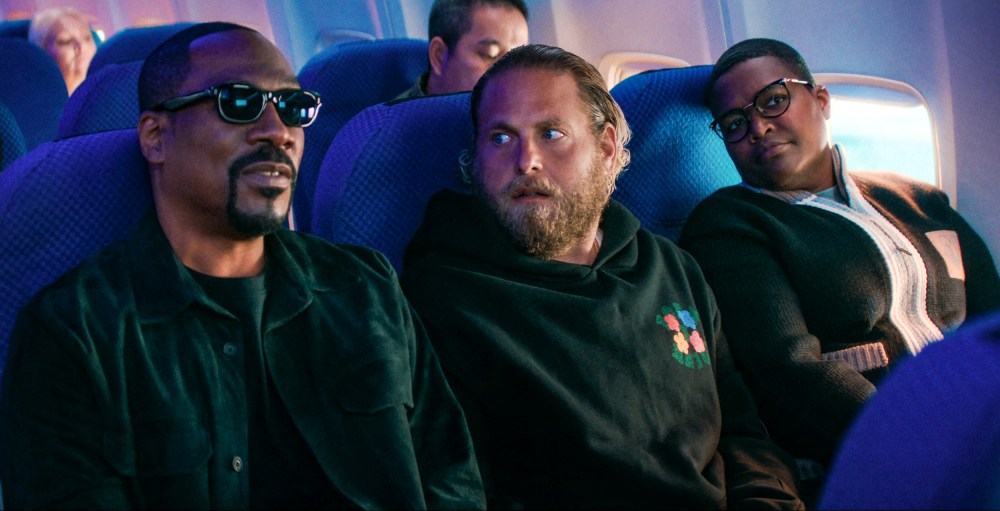
Netflix’s recently released film “You People,” unfortunately, is not one of these movies. Like the rumored CGI-generated kiss between its star-crossed lovers (Jonah Hill and Lauren London), which allegedly stood in for a real one, a lot of what happens in the story world seems, well, sort of not entirely believable.
It’s hard to tell a story about Black-Jewish relations, when the Jews have no idea who they are.
This doesn’t mean the film’s all-star comedy ensemble fails to deliver a few very funny moments. There’s something arch about a Jewish character in “You People” who wonders how to make his recently purchased, modestly priced engagement ring look “Holocaust,” so as to make it more emotionally appealing to his beloved. Similarly, unleashing a comic titan like Eddie Murphy to opine on changing trends in fine natural hair will usually end well (and outrageously).
But unlike movies about Black-Jewish relations such as Spike Lee’s “BlacKKKlansman,” or the Safdie brothers’ “Uncut Gems,” “You People” lacks the courage of its convictions. It bids a retreat from its most disturbing — and interesting — observation about America’s racial divide. Along the way, it trashes white Jewish liberals, seemingly without knowing it.
In “You People,” Mo (played by a scene-stealing Sam Jay) is a podcaster with a knack for fusing wisdom and vulgarity. She explains to her white Jewish bestie/podcast partner Ezra Cohen (Jonah Hill), the sad truth about romance in a non-post-racial age.
Such wise counsel is needed because 35-year-old, bacon-eating Ezra is in love with Amira (Lauren London). A bacon eater herself, Amira is a Black, Muslim costume designer who is initially charmed by Ezra’s declaration that no one should be “put in a box.”

Ezra means to say we are all individuals. We are not just reflexes of, or reducible to, the sociological categories we represent. But Mo, sensing that sociology (and history) is an indomitable, thirsty beast, explains to Ezra how boxed-in we really are:
Dude, Black people and white people will never be cool. Period.. . . . It’s kind of like when you cheat on a woman, right? When you cheat on a woman It’s like you try to move forward but you never can. Why? ‘Cuz she ‘keep asking questions. . . . For Black people in this country White dudes are the cheater. And we’re the chick who can’t move on.. . .We can’t forget what y’all did and what y’all are still doing.
Mo’s conviction is disturbing. But one of art’s main tasks is to bring these unpleasant, unhappy and unpopular possibilities to our awareness. In the darkness of a movie theater, or comedy club, or through the tranquility of a written page, artists coax and cajole us to run our fingers along the jagged edges of these ideas.
The premise that “Black people and white people will never be cool” is unsettling. It’s also worth exploring because I surmise it speaks to a truth shared by some, or many, Black people in this country.
One of art’s main tasks is to bring these unpleasant, unhappy and unpopular possibilities to our awareness.
This trend of airing unsettling truths is especially prevalent in other “Blacks and Jews” films of this era.
Spike Lee’s “BlacKKKlansman” features a white Jewish cop (Adam Driver), with no interest in his Judaism. Fortunately, detective Flip Zimmerman’s erasure of his Jewish identity does not prevent him from doing his job; he assists his Black colleague to infiltrate and break up the local Klan ring. Still, Lee issued a not unfriendly warning: Jews are flipping into whiteness. In the process, they are endangering themselves (and their Black allies).
True to this narrative, Detective Zimmerman disappears from the narrative. No goodbye. No closure, or sense of where he, and his Judaism, are going. The story ends with Flip’s Black partner, Ron Stallworth (John David Washington), gazing out at a massive cross being burned in front of his window. His Jewish colleague is nowhere to be found.
“Uncut Gems” had its own unpleasant truth to share. It focussed on the infidelity, gambling, rage-y jealousy and unrelenting, but kind of endearing, moral shiftiness of jeweler Howard Ratner (played by Adam Sandler). The camera lingered remorselessly on Ratner’s demented face before and after it was altered by Jew-on-Jew violence. In so doing, it spotlighted Jewish male dysfunction — a dysfunction that resembled media and Hollywood stereotypes of Black male dysfunction.
“Uncut Gems” (in which Ratner reminds Kevin Garnett’s sidekick: “The first two points scored in the NBA was a Jew”) suggests that when they are messed up, Black and Jewish men can be messed up in similar ways. The film’s heroism was to force viewers to confront the pathologies of the latter, not the former.
Both works state their disturbing convictions, stick to them, stick it to us, and make us bleed. This courage is lacking in “You People.” It put on blast Mo’s claim about irreparable Black-White estrangement. Then it runs from that bold insight, fast.
Mo’s prophecy comes true when a pre-wedding event goes sideways. As the night winds down, Ezra lights up his would-be father-in-law Akbar (Eddie Murphy) for being so unwelcoming. “I will never, ever, ever know what it’s like to be a Black man in this country,” Ezra scolds Akbar, “But I do know what an asshole is.” Amira excoriates her would-be mother-in-law Shelley (Julia-Louis Dreyfuss) for treating her like some exotic Black objet d’art upon which to lavish praise and rehearse her canned liberal pieties. Grim as it all is, the ethno-racial meltdown at the rehearsal dinner does make sense. That’s the sociology speaking (and beasting)! If “You People” really respected Mo’ s insight about the Black-White divide, it would have ended right there, credits rolling to the accompaniment of Gil Scott-Heron’s “Whitey on the Moon.” Yet five minutes later, Shelley and Akbar reverse field. The future in-laws conspire to bring the estranged couple back together. A Hollywood ending breaks out; imam, rabbi, wedding, etc. “You People” inexplicably flees from its most interesting idea. Shelly’s motivation for linking arms with Akbar is perplexing — as is everything about the depiction of Jews in “You People.” While the film drops its convictions about Black people’s reluctance to forgive whites, it seems to have no coherent convictions about Jews at all. The Jews in this tale aren’t even caricatures, they’re blank spaces. They’re not boxes, they’re deconstructed cardboard en route to recycling. This is what imbalances and dooms the movie. Mo’s apt moniker for Ezra is “a Jew with nothing to do.” And so it is, with every Member of the Tribe on screen. Ezra’s dad, a podiatrist (played by David Duchovny looking sleepy and/or stoned), conceptualizes Black America through MTV’s Pimp My Ride. Shelley is an oversharing “ally” whose efforts to bond with Amira are so over the top they feel like TikTok videos. Hipster Ezra loves The (Black) Culture. When quizzed, however, he doesn’t seem to know that much about it other than what he gleaned listening to hip-hop. It’s hard to tell a story about Black-Jewish relations, when the Jews have no idea who they are. “You People’s” white Jews emerge as hypocritical liberals who superficially consume Black culture and — note this — have none of their own. This depiction would upset me, if I believed that the filmmakers had actually thought any of this through. Hating assimilated Jews is an ancient genre of Jew-on-Jew violence, a mosaic martial art. If that was meant to be “You People’s” disturbing conviction, so be it. But I doubt it. It was only when Ezra claimed to be a “chameleon” that I felt someone in the writer’s room had perhaps devoted a thought to Judaism. The premise was immediately abandoned. But the trope of the shape-shifting Jew is a thing (and a thing non-Jewish Black people — and elsewhere, antisemites — have frequently observed). This unique superpower to blend in was perhaps most masterfully probed in cinema by Woody Allen in his 1983 mockumentary “Zelig.” In a famous scene, Leonard Zelig, whose identity continually morphs into that of the person he’s standing next to, shambles into a Nazi rally. He sits on a stage in full fascist regalia behind the frothing Führer himself (the controversial sequence used real archival footage). Talk about a disturbing conviction! As my colleague Professor Terrence L. Johnson and I point out in our book “Blacks and Jews in America: An Invitation to Dialogue,” this tense relationship can be, and has been, explored through fiction, poetry, cinema, music and so forth. Comedians too, from SNL to “Curb Your Enthusiasm,” have chimed in thoughtfully (and sometimes not). Comedy is especially good at letting us process disturbing truths. We’re laughing, after all. Disarmed. Vulnerable to new ideas. Primed for the cut. “You People” occasionally makes us smile. But it lacked the courage to draw blood and teach us anything interesting about Black people and/or Jews.
Jacques Berlinerblau is a professor of Jewish civilization at Georgetown University. 


