








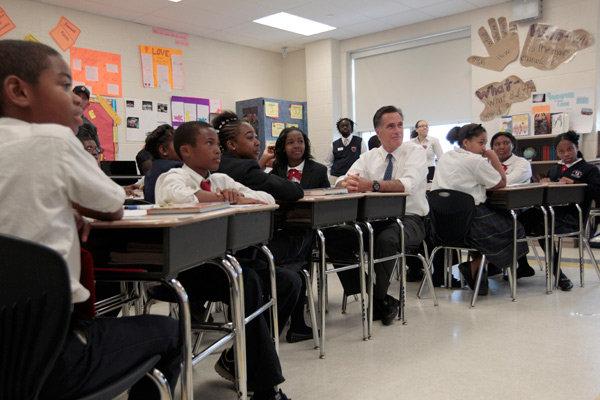
While pushing his newly announced education plan, Mitt Romney faced tough questions over classroom sizes during a campaign stop at a West Philadelphia charter school.
In a roundtable discussion with teachers and educational leaders, the likely Republican presidential nominee argued smaller classroom sizes do not lead to better learning in schools:
“I came into office and talked to people and said, ‘What can we do to improve our schools?’ And a number of folks said well we need smaller classroom sizes, that’ll make the biggest difference. So I gathered information, across our state. We had 351 cities and towns. I said let’s compare the average classroom size from each school district with the performance of our students. Because we test our kids and we’ll see if there’s a relationship. And there was not. As a matter of fact, the school district with the smallest classrooms, Cambridge, had students performing at the bottom 10 percent. So just getting smaller classrooms didn’t seem to be the key.”
Many educators at the event questioned Romney’s research, including a music teacher who responded, “I can’t think of any teacher in the whole time I’ve been teaching, for 10 years, 13 years, who would say that more students would benefit them. And I can’t think of a parent who would say ‘I would like my student to be in a classroom with a lot of kids with only one teacher.’ So I’m kind of wondering where this research comes from.”
The study Romney cited was a report done by the McKinsey consulting firm, which examined education systems in foreign countries such as Singapore and South Korea, and found that the highest performing schools had the same class sizes in the United States.
“So it’s not the classroom size that’s driving the success of those school systems,” Romney concluded. But another teacher on the panel contested Romney’s statements, citing a different report. “There was a study done by the University of Tennessee, a definitive study about class size and what they said was that in first through third grade, if the class size is under 18 those kids stay ahead of everybody else all the way through school, including classes where you might have 25 in the class and co-teachers. Those students lose their gains after a couple years. If you have small classes in those primary years, those most important years, that’s what makes the difference.” Romney also had trouble outside the school, where Obama campaign aides organized a protest and press conference with Philadelphia’s Democratic mayor, Michael Nutter. Mayor Nutter accused Romney of having “no record to run on” and that it’d be nice if he “seemed to know something about education.” The candidate announced his education agenda to Latino small business owners in Washington yesterday. His proposal focuses on expanding school choice and holding teachers more accountable.
Clare Kim Recommended


