








In a hospital ward in Kadirli, in southern Turkey, Walaa squeezed her sister’s hand as she whimpered in pain.
“Say Bismillah, Mona, say Bismillah,” Walaa told her sister, hoping that invoking God’s name would lead to some relief.
The nurse was gently rubbing cream on Mona’s thigh and slowly pulling back a huge scab of brown-red, burned skin. The more she pulled, the louder the 13-year old’s cries became.

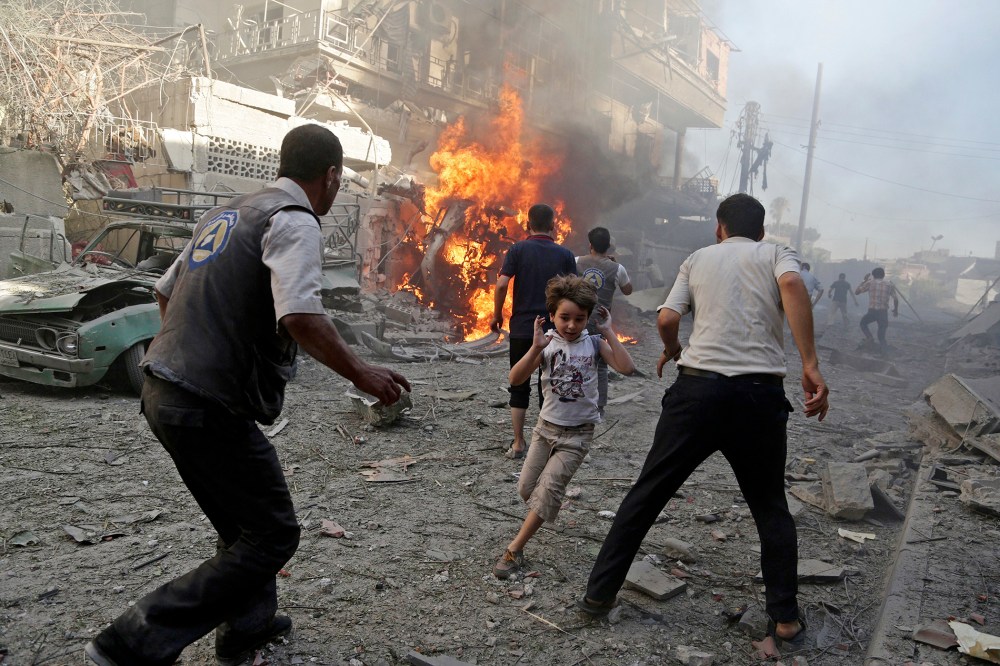
Mona’s family says she was wounded during what they believe was a Russian airstrike on Oct. 3 on their village.
“A rocket hit the house and destroyed the two top floors, where Mona and her cousins were asleep,” Walaa, 35, told me. Their aunt and cousin died instantly, but rescuers managed to pull Mona out of the rubble, bloody and dusty. Her leg was broken, her skull smashed from a piece of concrete, her left eye permanently damaged and her legs burned.
“Mona doesn’t remember anything, she has no idea what happened to her,” Walaa said.
I imagine Mona and her sister still sat in that hospital ward in South Turkey recovering from their own experience of terror as the gruesome attacks in Paris unfolded over the weekend. The horror and terror that Parisians experienced for a day in France is the same horror and terror that Mona, her sister and hundreds of thousands of civilians have lived under for almost five years of war inside Syria. And it’s the same horror and terror that millions of Syrians have fled and continue to flee to places like Turkey, Lebanon and now, more frequently, Europe. But the key regional and international players trying to find a way to peace have failed to make the protection of civilians in Syria a top priority.
As international leaders gathered in Vienna over the weekend to discuss the situation in Syria, they focused on the long-term possibility of elections there. But the urgent need to protect civilians wasn’t on their agenda.
RELATED: U.S. pledges $100 million for Syria’s opposition
I recently spent 10 days in Turkey interviewing Syrians who fled the new Syrian-Russian offensive in Idlib province. Doctors in southern Turkey told me that their intensive care units were filled with Syrians who were rushed across the border with wounds from airstrikes, some so serious they were still unconscious. Others weren’t injured, but the volume and intensity of the strikes were a final straw in their decision to leave Syria. The UN Office for the Coordination of Humanitarian Affairs says that 120,000 people fled Aleppo, Idlib and Hama areas under attack in Syria between Oct. 5 and Oct. 22, after the joint Syrian-Russian offensive began on Oct. 3.
The urgent need to protect these civilians was absent from the Oct. 23 Vienna meeting of the key regional and international players in Syria. Their nine-point agreement mentioned nothing about stopping indiscriminate attacks or providing civilians with safe passage. Russia hasn’t said a word about any measures it is taking to protect civilians in areas it is bombing or about pressuring President Bashar al-Assad to stop attacking civilians. It has said it was hitting military targets, while the wounded civilians trickling into Turkey say otherwise.
Those who recently made it out say they had been living in fear of air attacks. Their children shudder and cry every time they hear a helicopter or plane. Little aid has reached areas inside Syria, and some refugees told me that there was only more aid to go around after many of the villagers left. People have had to survive without water and electricity for weeks. Those trying to flee have to sneak out in the dead of night, walking through the brush of olive groves, or risking their lives on roads targeted by snipers or air strikes.
RELATED: Kerry: US not entering ‘into Syria’s Civil War’ by sending troops
The Vienna negotiators said they would ensure access to aid agencies throughout Syria, but failed to adopt concrete measures or set out a plan to enable them to deliver aid to besieged and hard-to-reach areas. Poor equipment, a shortage of medicines, and overworked, understaffed doctors have made hospitals scenes of chaos and distress, especially after an attack. Doctors told me that the lack of supplies and expertise for more complicated care means they have often had to amputate wounded arms and legs to save lives. And the hospitals themselves have frequently been the targets of attacks. In Gaziantep, another 13-year old, Ahmed sat on a hospital chair cradling his bandaged arm. “I was riding on a motorcycle with my dad in the market when we heard planes overhead and the whoosh of rockets,” he said. “I just remember flying in the air.” Shrapnel sliced into his stomach and his right arm was blown off from the elbow. His father was killed instantly. “I held my arm with me and they carried me off to the field hospital,” Ahmed told me. His arm was hurriedly stitched up at the elbow and he was sent to Turkey to seek better treatment. World leaders need to press all parties to provide clear and effective prior warnings of all strikes in time to permit civilians to flee, and to provide safe passage if they do. Neighboring countries need to keep their borders open. And there needs to be an absolute commitment in Vienna from all sides to stop attacking hospitals. These are commitments the parties can make immediately while they try to wade through the more complicated process of finding their way to peace. Hadeel Al-Shalchi is the Syria researcher at Human Rights Watch.
Hadeel Al-Shalchi Recommended


