








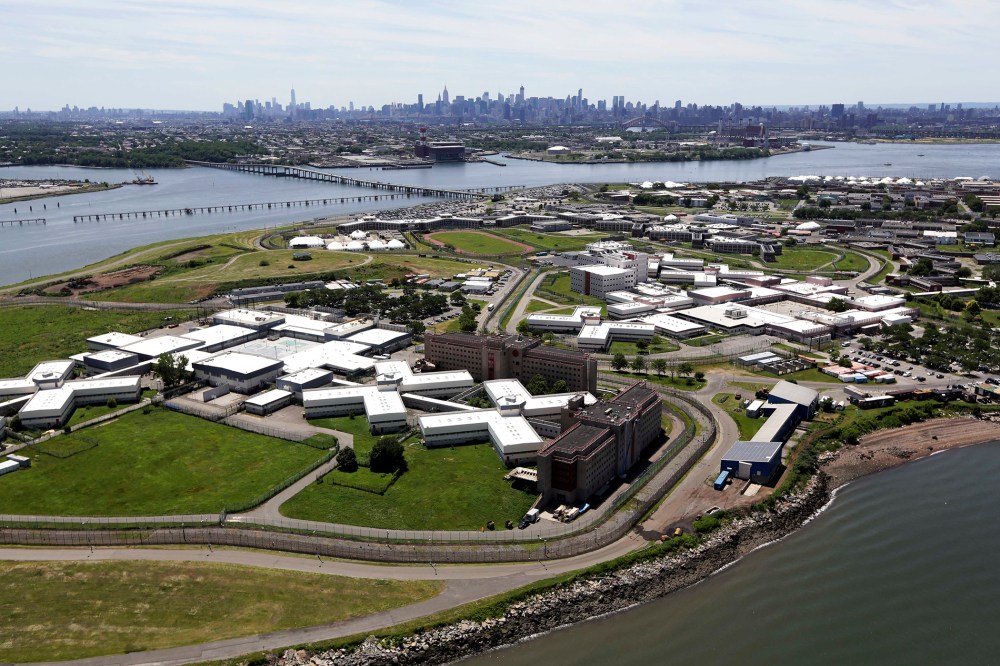
Violence and intimidation plague adolescent male prisoners at Rikers Island, and guards operate with virtually no accountability, according to a 79-page report by the federal government that accuses the New York City Department of Corrections (DOC) of widespread civil rights violations.
The report, issued by U.S. Attorney’s Office for the Southern District of New York and addressed to New York City Mayor Bill de Blasio, details evidence of what it calls “a pattern and practice of conduct at Rikers Island that violates the rights of adolescents protected by the Eighth Amendment and the Due Process Clause of the Fourteenth Amendment of the United States Constitution” that have resulted in a “staggering” number of injuries among the young inmates. Rikers Island is the country’s second-largest jail, and sits in New York City’s East River.
Specifically, the U.S. Attorney’s Office points to more than a dozen examples of violence by guards as one of the most serious threats to the young men housed at the prison. “We find that adolescent inmates at Rikers are not adequately protected from harm, including serious physical harm from the rampant use of unnecessary and excessive force by DOC staff,” the report says. For instance, the report claims that “correction officers resort to ‘headshots,’ or blows to an inmate’s head or facial area, too frequently.”
%22We%20find%20that%20adolescent%20inmates%20at%20Rikers%20are%20not%20adequately%20protected%20from%20harm%2C%20including%20serious%20physical%20harm%20from%20the%20rampant%20use%20of%20unnecessary%20and%20excessive%20force%20by%20DOC%20staff.%22′
The report also claims that the city’s corrections department relies on solitary confinement as a disciplinary measure “at an alarming rate and for excessive periods of time.” This is a problem in juvenile facilities around the country, where solitary confinement is often used to deal with children suffering from mental health problems. The state of Ohio, for example, entered into an agreement in June to drastically reduce and eventually eliminate the use of solitary confinement for juveniles.
In addition to corrections officers’ use of force excessively, the report included a long list of administrative failures ranging from false reports to a lack of disciplinary measure for excessive force to a lack of training in dealing with teenagers.
A federal investigation looked at the jail’s conditions between 2011 and 2013, and discovered a “deep-seated culture of violence” perpetrated by guards and inmates alike. No charges were announced against individuals, and officers involved in incidents cited by the report were not mentioned by name.The guards, the report says, enjoy a “powerful code of silence” that “prevents staff who witness force from reporting [it].”
The report covers three jails at the facility where 16-to-18 year-old boys are held, but the report admitted that similar problems likely exist in the jails that house other inmates as well.
The report says the DOC has taken some steps to bring peace to Rikers, including providing more youth programs and adding staff, but none of these measures, the report says, address the underlying problem of abusive officers operating without punishment. Mayor Bill de Blasio and the city have 49 days to respond to the Justice Department’s findings, and if the city does not make a serious effort to change its policies, the DOJ could ask a judge to compel it to do so. The report lists more than 10 pages of proposed remedial measures. DOC Commissioner Joe Ponte said in response to the report that, “Since joining the Department of Correction in April I have made it clear the excessive use of force, unnecessary or unwarranted use of punitive segregation and corruption of any kind are absolutely unacceptable, and will not be tolerated under my watch.” De Blasio, meanwhile, has pledged to reform the jail system in New York even has he has retreated from campaign promises to change law enforcement policy to make it less brutal towards black and Hispanic men. While de Blasio campaigned on a platform dedicated to reforming the controversial “stop and frisk” search policy of the NYPD, arrests for minor “quality of life” violations like panhandling and dancing in subway cars have skyrocketed since de Blasio took office.
Rachel Kleinman
Meredith Clark
Meredith Clark is a freelance writer and editor. She was previously a senior news producer for "Patriot Act with Hasan Minhaj," a reporter with MSNBC.com, the digital politics and culture editor at Glamour and a senior news and politics editor at Refinery29. She has written for Vulture, Rolling Stone, Self, Marie Claire, Cosmopolitan, The Daily Beast and Bustle. Recommended



