








President Obama has been the subject of some pretty kooky criticism from the right over the years, but there’s one aspect of the attacks that’s always struck me as amusing: the nuttiest condemnations never seem to apply to the president, but always seem to apply to prominent Republicans.
“Obama maintains an enemies list!” No, you’re thinking of Wisconsin Gov. Scott Walker (R). “The president believes in crony capitalism!” No, you’re thinking of Virginia Gov. Bob McDonnell (R). “Obama was born on foreign soil!” No, you’re thinking of Texas Sen. Ted Cruz (R).
“The president uses his power to silence his political opponents!” No, you’re thinking of Mitch Daniels (R).
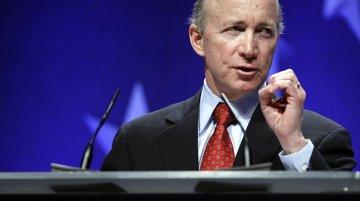
Former Indiana Gov. Mitch Daniels pledged to promote academic freedom when he became president of Purdue University in January, but newly released emails show he attempted to eliminate what he considered liberal “propaganda” at Indiana’s public universities while governor.
Emails obtained by The Associated Press through a Freedom of Information Act request show Daniels requested that historian and anti-war activist Howard Zinn’s writings be banned from classrooms and asked for a “cleanup” of college courses. In another exchange, the Republican talks about cutting funding for a program run by a local university professor who was one of his sharpest critics.
The success of those efforts remains unclear; Zinn’s book, for example, is still used in some courses for aspiring teachers. But Daniels did launch an expansive push while governor to change what courses those hopeful teachers could take for credit at Indiana colleges.
Ken Paulson, president of the First Amendment Center, told the AP he could think of no modern examples to rival Daniels’ efforts. “What sets this apart is what appears to be a back-channel effort by the governor to limit access to ideas. Under the First Amendment, the government is prohibited from trying to suppress expression with which it disagrees.”
But that’s exactly what Daniels did as Indiana’s two-term chief executive.
Indeed, the former governor, who’s now leads one of the state’s largest universities, is responding to the report by conceding he hoped to keep information he considered unreliable out of the hands of students.
“Even someone as extreme and radical and, as far as I’m concerned, completely wrong as Howard Zinn, had he been a Purdue professor with tenure, he would have been permitted to do his work here, but not to foist it on unknowing and unsuspecting students in our public schools. That’s a completely different subject,” Daniels said Tuesday. In a 2010 email discovered by the AP, the then-governor asked a staffer if Zinn’s book was used in Indiana and “if it is, how do we get rid of it before more young people are force-fed a totally false version of our history.” Daniels also argued yesterday that he was only focused on materials in K-12 education, but the emails obtained by the AP showed that the then-governor learned of a civil rights course at Indiana University that used a Zinn book. Daniels called the work “crap” that “should not be accepted for any credit by the state.” Just as alarming, Daniels also worked in 2009 to have the state audit the Indiana Urban Schools Association, apparently because it was led by clinical professor of education Charles Little, a critic of the governor. The AP reported that “it wasn’t immediately clear if the audit went through.”
The place for in-depth analysis, commentary and informed perspectives. Recommended


